Pushback on Trump Initiatives

by Kristin Rowan, Editor

Pushback on Trump Initiatives From All Sides

Pushback on Trump initiatives, including the steep cuts to Medicare, Medicaid, Social Security, and VA benefits erupted this week. Coalitions, associations, and members of Congress seek to stop the cuts before the new bill is passed. The Republican-backed bill, under direction from President Trump, called the “Big, Beautiful Bill” would cut federal spending by billions of dollars over ten years. Pushback on Trump’s executive orders is also making headway, with temporary and preliminary injunctions.

Protect Our Healthcare Coalition

Protect Our Healthcare Coalition is a group of consumer and non-profit organizations in Rhode Island. This week, they joined with Medicaid members and Senators Reed and Whitehouse to speak out against the Medicaid cuts in the bill. The coalition also released a report on the impact of Medicaid services in the state.

“Republicans…want to whack Medicaid so fewer people have coverage and costs go up. These cuts will do real harm, pushing seniors out of nursing homes, increasing hospital closures, and denying families access to preventative care. If you think the emergency room is crowded now, just wait until Trump’s Medicaid cuts happen.”

Jack Reed

Senator, (D) Rhode Island

Protecting Retirement and Health Benefits

Congresswoman Mikie Sherrill (NJ-11) introduced the Protecting Retirement and Health Benefits for Working Families Act. The bill is in response to the recent federal program and job cuts. The legislation requires that before any cuts are made to jobs or programs that the administration can prove those cuts won’t harm to benefits and those who rely on them. It also requires a study within one year of any mass layoffs or closures to ensure no harm was done.

Federal Judge Blocks...

DoE Layoffs

More than 1,300 employees of the Department of Education received notice of termination in March from then-Secretary of Education Linda McMahon. The layoffs reduced the staff by nearly half. McMahon initially said they were part of the plan to reorganize and streamline the department for efficiency and accountability. Trump later revealed the layoffs to be the first step in dismantling the Department of Education altogether. District Judge Myong Joun, a Biden appointee, said, “The record abundantly reveals that defendants’ true intention is to effectively dismantle the department without an authorizing statute.” Judge Joun issued an injunction blocking the mass layoff.

Sweeping Agency Changes

In February, the Trump administration issued an executive order, followed by a number of memos, instructing multiple federal agencies to cut staff. The executive order called for the immediate dismissal of temporary and reemployed annuitant staff members. Specifically, it called out those performing functions not mandated by statute or other law, not designated as essential, or is not suited to federal service due to failure to comply with federal employment requirements. The order also reduced hiring ratios to 1:4, permitting agencies not under a hiring freeze to hire one person for every four that leave.

U.S. District Judge Susan Illston, in San Francisco, as part of a lawsuit filed by labor unions, nonprofits, and local governments, issued a temporary block on the overhaul. The lawsuit alleges that Trump needs authorization from Congress to restructure the federal government. Judge Illston says the office of the president can seek changes to agencies, but only through Congress. Illston also issued a temporary restraining order barring agencies from any further implementation of the executive order. This includes the final dismissal of employees who have received layoff notices that have not yet been executed. The temporary restraining order expires May 23, 2025. Additionally, Illston ordered the administration to submit restructuring plans to the court.

Revoking Student Status

The administration attempted end the legal status of international students. This would effectively nullify their right to stay in the United States. Some individual students challenged the action successfully. On May 22, 2025, a federal judge in California blocked the action. He prohibited the administration from arresting or detaining foreign-born students on the basis of their immigration status. The administration insists the immigration status was only revoked for students who had criminal charges.

Pushback on Trump Initiatives is Ongoing

Along with the passing of the “Big, Beautiful Bill,” these issues are ongoing and The Rowan Report will provide updates as they become available.

# # #

Kristin Rowan, Editor

Kristin Rowan has been working at The Rowan Report since 2008. She is the owner and Editor-in-chief of The Rowan Report, the industry’s most trusted source for care at home news, and speaker on Artificial Intelligence and Lone Worker Safety and state and national conferences.

She also runs Girard Marketing Group, a multi-faceted boutique marketing firm specializing in content creation, social media management, and event marketing.  Connect with Kristin directly kristin@girardmarketinggroup.com or www.girardmarketinggroup.com

©2025 by The Rowan Report, Peoria, AZ. All rights reserved. This article originally appeared in The Rowan Report. One copy may be printed for personal use: further reproduction by permission only. editor@therowanreport.com


 

Shoot the Messenger

by Elizabeth E. Hogue, Esq.

Shoot the Messenger at Your Own Risk

Shoot the messenger of fraud and abuse at your peril. Providers must take seriously the concerns of employees about possible fraudulent and abusive practices. Most whistleblowers take their concerns to their employers first, especially if they are required to do so by employers’ Compliance Plans. When employers ignore their concerns or, even worse, retaliate against employees or contractors for raising issues in the first place, employees may turn to outside enforcers for assistance in addressing their concerns. Providers must take employees’ allegations seriously whether or not they are valid. Thorough investigations are required in order to demonstrate to employees that there is no problem or that the problem has been corrected.

Shoot the Messenger

Qui Tam

Private citizens may initiate so-called “whistleblower” or qui tam lawsuits to enforce prohibitions against fraud and abuse in the Medicare, Medicaid, and Medicaid Waiver Programs and other state and federal health care programs, such as VA and Tri-Care. 

False Claims Act

One of the federal statutes that allows for whistleblower actions is the False Claims Act (FCA). This Act generally prohibits providers from “knowingly” presenting or causing to be presented false or fraudulent claims for payment by the government. Whistleblowers continue to be a major source of information for government enforcers.

Whistleblower Requirements

In order to bring a qui tam action under the FCA, private parties must have direct and independent knowledge of fraud by providers against whom suits are filed. Thus, current or former employees who are familiar with providers’ practices may often initiate whistleblower actions under the FCA. As you can imagine, employees and contractors who are ignored or retaliated against when they bring possible violations to the attention of employers or partners by firing them, for example, are likely to initiate whistleblower suits.  

Here is an example:

In United States ex rel. Chorches v. American Medical Response [No. 15-3920 (2d Cir. July 27, 2017)], Paul Fabula worked as an emergency medical technician (EMT) for American Medical Response. Fabula realized that his employer fraudulently sought reimbursement from the Medicare Program by falsely claiming that ambulance services were medically necessary when they were not. Specifically, EMTs were asked to falsify electronic Patient Care Reports (PCRs) to make it appear that services were medically necessary. Supervisors printed copies of PCRs, revised them, and directed staff members to sign the revised forms.

In one instance, Fabula provided services with another staff member who prepared the PCR. A supervisor instructed the staff member to fraudulently revise the form. When the staff member refused, the supervisor directed Fabula to sign the revised form. When Fabula refused, he was fired.

Don't Shoot the Messenger

What did Fabula do? Why, of course, he filed a whistleblower suit! The message from this case and numerous others is clear: don’t shoot the proverbial messenger who brings information about possible fraud and abuse violations. Listen up!

# # #

Elizabeth E. Hogue, Esq.

Elizabeth Hogue is an attorney in private practice with extensive experience in health care. She represents clients across the U.S., including professional associations, managed care providers, hospitals, long-term care facilities, home health agencies, durable medical equipment companies, and hospices.

©2025 Elizabeth E. Hogue, Esq. All rights reserved.

No portion of this material may be reproduced in any form without the advance written permission of the author.

©2025 by The Rowan Report, Peoria, AZ. All rights reserved. This article originally appeared in The Rowan Report. One copy may be printed for personal use: further reproduction by permission only. editor@therowanreport.com

Interoperability

by Ben Rosen, Sr. Client Success Manager, Netsmart

Interoperability

What you need to know and how it affects you

For over two decades, tech companies and government agencies have been moving toward the goal of interoperability in healthcare technology. At long last, standards and protocols are in place — and continually being improved — to support open data exchange networks. As a result, healthcare providers, including human services, post-acute providers, and specialty practices, have more opportunities to participate in alternative payment models and adapt more readily to the evolving payment landscape.

Interoperability in Healthcare

What's driving the need for change?

Government regulatory agencies, together with payers and healthcare organizations, have long recognized the need to improve care coordination among healthcare providers. Making it easier to share information via a nationwide data sharing network is a critical component of this effort.

End Game

The ultimate goal of providing access to complete, accurate patient information is to help drive down costs to providers and electronic health record (EHR) users. Through exhaustive work and years of innovation, we’re seeing the tangible outcome of this effort. Information now flows seamlessly across multiple healthcare networks. Using a concise view of the data, we can focus on broader population health initiatives that improve outcomes for chronic conditions, reduce emergency department (ED) visits, and prevent hospitalizations. The interoperability market is moving ahead at blazing speeds. Therefore, we must understand the players who are the driving forces behind the movement.

Interoperability

The Interoperability Highway

Who are the players and how do they work together?

Healthcare technology is complex. It’s not surprising, then, that getting the disparate systems to share information seamlessly and securely is a complicated process. In the last decade an increasing number of vendors, organizations, and healthcare players started working together to advance a useful interoperability market.

Some of the larger players in this space include government and regulatory agencies. To understand the role these entities play and how they coordinate with other organizations and efforts, let’s compare the process to building a national highway system.

Building an open data exchange network

  • Assistant Secretary for Technology Policy and Office of the National Coordinator for Health (ASTP/ONC): This federal agency sets the vision, rules and regulations for health information technology policy. Compare it to the Federal Highway Administration (FHWA), the federal agency that provides stewardship over the construction, maintenance, and preservation for all interstate highways.
  • Trusted Exchange Framework and Common Agreement (TEFCA): Established by the ASTP/ONC, TEFCA sets the rules for health data exchange over the network. This is similar to plans or blueprints for highway construction. This would also include engineering, construction and safety standards for the highway.
  • The Sequoia Project (RCE): The Sequoia Project is the Recognized Co-ordinating Entity (RCE) for TEFCA and is appointed by the ASTP/ONC. The Sequoia Project is a non-profit, public-private collaborative that leads the implementation project for nationwide data exchange. They approve and help regulate the TEFCA exchange, via QHINs. The Sequoia Project can be compared to a construction manager that approves contractors and oversees quality control measures to ensure standards are met.
  • Qualified Health Information Networks (QHIN)s: QHINs are data sharing networks built to operate the exchange network as outlined by TEFCA. In our analogy, QHINs are the highways, and the companies that build QHINs can be compared to the construction companies that physically build and maintain the roadways themselves.

Now that you’re familiar with the entities involved in developing the standards for interoperability and building the data exchange networks that make it a reality, we will next look at how these enhanced capabilities can impact your organization.

This is part one of a four-part series covering the forces that are driving interoperability, as well as the future vision of open networks, and what it all could mean to your organization. Check back for part 2, “How TEFCA affects your technology and what the heck is a QHIN?” coming soon.

# # #

Interoperability Ben Rosen Netsmart

Ben Rosen is a senior client success manager and business unit owner for the interoperability solution suite at Netsmart. With more than a decade of healthcare experience, Ben has led numerous initiatives to integrate healthcare systems and enhance data sharing across the care continuum. His dedication to advancing healthcare interoperability drives his active involvement in industry initiatives and standards organizations, where he provides insight for frameworks such as HL7 FHIR, USCDI and others. Ben holds a Bachelor of Science in kinesiology from Kansas State University and a Bachelor of Science in nursing degree from the University of Nebraska Medical Center.

©2025 by The Rowan Report, Peoria, AZ. All rights reserved. This article originally appeared in the Netsmart blog and is reprinted here with permission. For more information or to request permission to print, please contact Netsmart.

DOJ Rejects Plan

by Kristin Rowan, Editor

DOJ Rejects Plan to Divest Assets

DOJ rejects plans to divest assets from UnitedHealth and Amedisys to BrightSpring Health Services and the Pennant Group. Last week, we reported that Amedisys and UnitedHealth had entered an agreement to divest certain home health and hospice agencies to satisfy anti-trust concerns. The plan is contingent on the finalization of the merger between UnitedHealth and Amedisys.

Divesting Assets

The merger between UnitedHealth and Amedisys has been ongoing since last summer. Shortly after the announcement, the Department of Justice sued under anti-trust allegations to stop the merger. According to the DOJ, even if the companies offload the 120 planned locations, it would not safeguard competition in home health and hospice markets. The DOJ cited overlap in certain markets where UnitedHealth and Amedisys both currently have agencies.

This could spell T-R-O-U-B-L-E

Following the lawsuit, Amedisys and UnitedHealth started talks with VitalCaring to divest properties. That deal fell through after VitalCaring lost its own lawsuit last year. This latest blow could stall the merger altogether. The DOJ reportedly rejected the divestiture stating that it wasn’t enough. Unless Amedisys and UnitedHealth divest more properties in certain markets, the DOJ is unlikely to approve the merger. 

Mediation

The parties are scheduled to enter mediation on August 18th. The judge has now scheduled a follow-up mediation appointment on August 25th, anticipating that one day of mediation will not resolve the lawsuit. Amedisys and UnitedHealth have 90 days to secure additional divestiture that will satisfy the DOJ before mediation begins. 

DOJ Rejects Plan

This is an ongoing story and The Rowan Report will continue to bring you the latest news on the merger. Please see our accompanying articles this week on the new UnitedHealth CEO and the new DOJ investigation on UnitedHealth Group.

# # #

Kristin Rowan, Editor

Kristin Rowan has been working at The Rowan Report since 2008. She is the owner and Editor-in-chief of The Rowan Report, the industry’s most trusted source for care at home news, and speaker on Artificial Intelligence and Lone Worker Safety and state and national conferences.

She also runs Girard Marketing Group, a multi-faceted boutique marketing firm specializing in content creation, social media management, and event marketing.  Connect with Kristin directly kristin@girardmarketinggroup.com or www.girardmarketinggroup.com

©2025 by The Rowan Report, Peoria, AZ. All rights reserved. This article originally appeared in The Rowan Report. One copy may be printed for personal use: further reproduction by permission only. editor@therowanreport.com


BREAKING NEWS: UnitedHealth CEO Steps Down

by Kristin Rowan, Editor

Breaking News: UnitedHealth Group CEO Andrew Witty Steps Down

Citing “personal reasons” with no elaboration, UnitedHealth Group CEO Andrew Witty steps down from his position, effective immediately. Witty joined UnitedHealth Group in 2018 and became the company’s CEO in 2021. Despite overwhelming growth during Witty’s tenure, the company continues to face numerous setbacks.

UnitedHealth Group Struggles Since January

The shooting death of Brian Thompson, UnitedHealthcare CEO, in December seems to have set off an onslaught of setbacks for the insurance giant.

  • Share prices have dropped 38% since December, from $503 down to $308
  • The company recently cut its annual forecast, after first adjusting it down, causing the final 18% stock drop
  • For the first time since 2008, UHG missed its forecasted earnings
  • Statements from the company look to 2026 before growth resumes

New (Old) CEO

Stephen Hemsley is the new CEO of UnitedHealth Group, effective immediately. Hemsley, who currently serves as the director of the board, was the company’s CEO from 2006 to 2017. Hemsley will stay on as chairman of the board and company CEO. Witty will serve as senior adviser to Hemsley. 

Contradictions and Conflicts

In an official statement regarding the leadership change, Hemsley said, “We are grateful for Andrew’s stewardship of UnitedHealth Group…. The Board and I have greatly valued his leadership and compassion as chief executive….” 

On a call with investors, Hemsley said, “Many of the issues standing in the way of achieving our goals as well as our opportunities are largely within our control.”

During that same call, Hemsley said, “I’m deeply disappointed in and apologize for the performance setbacks we have encountered from both external and internal challenges.”

UnitedHealth CEO Steps Down

In addition to the conflicting statements, Hemsley will serve as CEO and Chairman of the Board, creating conflict and reducing oversight. The chairman of the board plays a key role in oversight, governance, and communication with the CEO. They also evaluate the CEO’s performance. Holding both roles, especially in light of the shareholder request for reports, may we be in the best interest of UnitedHealth Group, but probably not in the best interest of anyone else.

# # #

Kristin Rowan, Editor

Kristin Rowan has been working at The Rowan Report since 2008. She is the owner and Editor-in-chief of The Rowan Report, the industry’s most trusted source for care at home news, and speaker on Artificial Intelligence and Lone Worker Safety and state and national conferences.

She also runs Girard Marketing Group, a multi-faceted boutique marketing firm specializing in content creation, social media management, and event marketing.  Connect with Kristin directly kristin@girardmarketinggroup.com or www.girardmarketinggroup.com

©2025 by The Rowan Report, Peoria, AZ. All rights reserved. This article originally appeared in The Rowan Report. One copy may be printed for personal use: further reproduction by permission only. editor@therowanreport.com

 

A New Path for Hospice Care

FOR IMMEDIATE RELEASE

Contact:        press@empathhealth.org
EmpathHealth.org

Empath Health Introduces One Hospice Model, Bringing Together Florida's Established Not-for-Profit Hospices Under One Mission

CLearwater, FL, May 5, 2025. Empath Health, one of the nation’s largest 501(c)(3) integrated care networks, today unveiled its One Hospice Model—a first-of-its-kind framework that preserves community-based hospice while adding the scale, innovation and accountability of a statewide system. “Families deserve hospice that puts mission before margin,” said Jonathan D. Fleece, President & CEO of Empath Health. “By uniting Florida’s most trusted not-for-profit hospices under one model, we keep local relationships intact and ensure every person facing serious illness receives Full Life Care—supported by the strength and expertise of an entire network.”

The model integrates seven locally known hospice brands—Empath Hospice, Hospice of Marion County, Suncoast Hospice, Suncoast Hospice of Hillsborough, Tidewell Hospice and Trustbridge (Hospice by the Sea and Hospice of Palm Beach County)—which collectively care for one in five hospice patients statewide. Five of these affiliates have served their communities for more than 40 years, delivering generations of compassionate, not-for-profit care.

Regional hubs in Tampa Bay, Sarasota, Palm Beach and Ocala keep decision-making local while enterprise teams provide centralized quality, technology and research support. Regional presidents Travis Fogle (Tampa Bay), Brad Perkins (Sarasota) and Tony Maxwell, PA (Ocala/Palm Beach) oversee clinical operations and community partnerships.

“By uniting Florida’s most trusted not-for-profit hospices under one model, we keep local relationships intact and ensure every person facing serious illness receives Full Life Care – supported by the strength and expertise of an entire network.”

While all Empath Health services are available through direct community access, families who begin care with an Empath-affiliated hospice gain direct referral into the wider Empath network of services—available regionally, when needed. This integrated approach allows patients to easily access Empath Home Health for skilled nursing at home; Empath Palliative Care for earlier symptom relief; Empath LIFE / PACE for comprehensive elder day-center support; Empath GUIDE for dementia education and caregiver coaching; EPIC HIV/AIDS Services for prevention, case management and housing; and Empath Grief Care, including Empath Blue Butterfly programs for children. The result is a coordinated Full Life Care journey—from the first serious illness conversations through loss and healing—thoughtfully adapted to each community’s resources and needs.

As policymakers and the public scrutinize hospice ownership, Empath offers a scalable not-for-profit alternative. The organization reinvests much of its revenue into care, workforce development and community programs, and publicly reports quality metrics that exceed national benchmarks. By pairing local leadership with statewide strength, the One Hospice Model offers a blueprint for mission-driven innovation at scale.

# # #

About Empath Health

Empath Health is a pioneering not-for-profit health network redefining healthcare through Full Life Care—supporting chronic, post-acute, end-of-life, and grief care needs across Florida. Its full spectrum of services includes home health, palliative care, all-inclusive elder care (PACE), HIV/STI prevention, grief support, and compassionate hospice care through seven programs: Empath Hospice, Hospice of Marion County, Suncoast Hospice, Suncoast Hospice of Hillsborough, Tidewell Hospice and Trustbridge (Hospice by the Sea and Hospice of Palm Beach County). With decades of trusted service and deep community roots, Empath Health reaches more than 81,000 people each year and serves one in five hospice patients statewide.

© 2025 This press release orginally appeared on Business Wire and is reprinted with permission. For more information or to request permission to print, please use the media contact above.

New Deal to Sell HH & Hospice Agencies

by Kristin Rowan, Editor

UnitedHealth, Amedisys to Divest Home Health & Hospice...Again

History

UnitedHealth, Amedisys to divest home health and hospice properties to satisfy DOJ. Almost two years ago, the health services division of UnitedHealth Group, Optum, announced plans to by Amedisys. The purchase announcement came after Optum outbid Option Care Health with an unsolicited offer. The Department of Justice launched an anti-trust probe shortly after the announcement. To satisfy the DOJ, UnitedHealth and Amedisys plan to divest some of its businesses as part of the acquisition agreement.

Anti Anti-Trust

We previously reported that Amedisys entered into an agreement with VitalCaring to divest some of its home health and hospice locations. This agreement was meant to satisfy the DOJ concerns raised in its anti-trust lawsuit against Amedisys and UnitedHealth. 

In January of 2025, VitalCaring lost a lawsuit filed by Encompass Health and Enhabit and were ordered to pay 43% of all future profits to the two companies. In the wake of that court decision, VitalCaring pulled the agreement and signed a mutual release with UnitedHealth, with all parties walking away from the deal.

BrightSpring

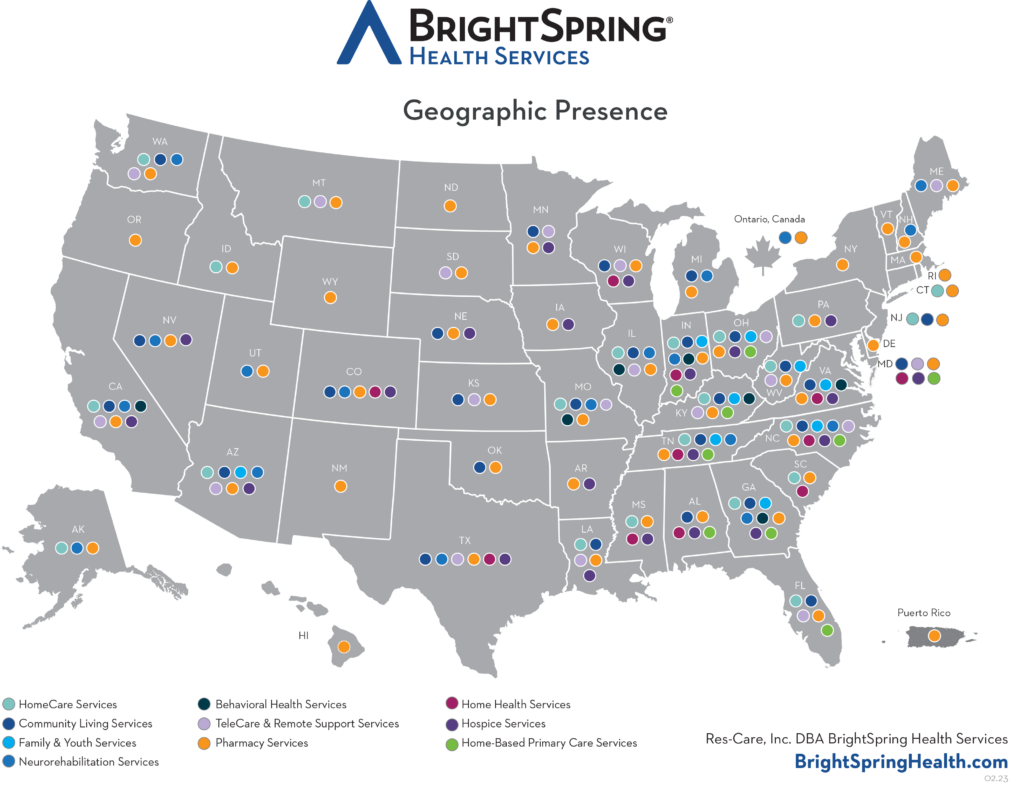
BrightSpring Health Services is an $11.5B company with locations across the United States and employing more than 37,000 people. In January of this year, BrightSpring sold is Community Living Business to Sevita. BrightSprings intends to acquire additional properties, focusing on its home- and community-based businesses. According to the BrightSpring President and CEO Jon Rousseau, BrightSpring is “focused on getting to 3x leverage within the next two years.”

Amedisys operates in 38 states with more than 500 locations. The document Amedisys submitted to the SEC does not indicate how many of its properties and those of UnitedHealth will be divested. A UnitedHealth statement said the company plans to divest at least 128 home health and hospice facilities.

One has to wonder whether we are trading one monopoly for another.

BrightSpring Health Services

New Deal

As the DOJ lawsuit enters mediation this August, UnitedHealth and Amedisys search for another way to divest its properties. Enter the New Deal. BrightSpring Health Services, parent company to Adoration Home Health Acquisition LLC, Adoration Hospice Care Acquisitions LLC and Senescence LLC, DBA All Saints Hospice will purchase some of the properties from both Amedisys and UnitedHealth. The Pennant Group, parent company to Cornerstone Healthcare, Inc. and Tensaw River Healthcare, LLC, will purchase additional properties from bother companies.

According to documents submitted to the Securities and Exchange Commission (SEC), both agreements have mulitple contingencies, including the finalization of the UnitedHealth/Amedisys merger. Financial information on the two deals was not included in the Amedisys SEC filing. In a separate filing, Pennant valued their part of the agreement at nearly $102.5 million.

No Deal Yet

The sale of properties to BrightSpring and Pennant Group relies on the finalization of the merger between Amedisys and UnitedHealth. A magistrate will oversee mediation between the two companies and the DOJ beginning this August.

The SEC and the DOJ have not yet responded to the intent to divest to BrightSpring and Pennant Group.

Final Thoughts

The proposed merger between UnitedHealth and Amedisys has been ongoing for two years. The two companies, who previously stated their competition helped keep them honest and keep costs low, now state that the merger will lower costs even more. The DOJ disagrees. To alleviate concerns, the merger includes the release of properties anywhere the merger would create an unfair advantage. Mediation in August will reveal more on the position of the DOJ, the response from UnitedHealth and Amedisys, and the specifics of the divestment of home health and hospice agencies. The merger proposal expires December 31, 2025. We will continue to follow the story as the parties enter mediation.

# # #

Kristin Rowan, Editor

Kristin Rowan has been working at The Rowan Report since 2008. She is the owner and Editor-in-chief of The Rowan Report, the industry’s most trusted source for care at home news, and speaker on Artificial Intelligence and Lone Worker Safety and state and national conferences.

She also runs Girard Marketing Group, a multi-faceted boutique marketing firm specializing in content creation, social media management, and event marketing.  Connect with Kristin directly kristin@girardmarketinggroup.com or www.girardmarketinggroup.com

©2025 by The Rowan Report, Peoria, AZ. All rights reserved. This article originally appeared in The Rowan Report. One copy may be printed for personal use: further reproduction by permission only. editor@therowanreport.com


Update is Not an Increase

by Kristin Rowan, Editor

Updates to Hospice Rule

On April 11, 2025, the Centers for Medicare and Medicaid Services (CMS) issued their proposed rule for hospice rates, Conditions of Participation (CoPs) and face-t0-face encounter requirements for FY 2026. The proposed rule also includes a change in regulatory text for the Hospice Quality Reporting Program.

Following Executive Order 14192, an attempt to reduce the expense attached to following Federal regulations, CMS is seeking feedback on streamlining regulations and reducing expenses. The RFI to submit responses can be found here.

Payment Updates

The proposed update to the hospice payment rate yields a net increase of 2.4 percent. This change includes a 3.2 percent market basket increase based on the estimate cost increase for inpatient hospitalization. The 0.8 percent productivity adjustment offsets the market basket increase. The quality data penalty of 4 percent remains in place.

Market Basket Objections

Not for the first time, commentors on CMS proposed rules objected to the use of the hospital wage index in determining hospice pay rates. According to a report from the Federal Register, a few commenters on the FY 2025 payment update opposed using the IPPS wage index to determine the hospice wage index. According to the commenters, the hospital wage index uses cost report wage data that excludes hospice wage costs. The exclusion of hospice costs skews the accuracy of wage adjustments for hospice providers.

In response to the same proposed rule, MedPAC recommended that wage index policies be repealed and replaced by new Medicare wage index systems that use all-employer, occupation-level wage data; account for wage differences across geographical areas, and match wages in adjacent local areas. 

CMS Ignores Objections

Despite years of comments, objections, and suggestions to update the hospice wage index calculations using more accurate data, CMS continues to insist that using the pre-floor and pre-reclassified hospital wage index is the more appropriate for determining hospice payment rates. CMS states that this position is “longstanding and consistent with other Medicare payment systems.”

Productivity Adjustment

The productivity adjustment started with the Affordable Care Act. It’s stated purpose is to “reduce Medicare spending by recognizing that hospitals can improve their efficiency and productivity.” Average efficiency and productivity gains in all private non-farming businesses form the productivity adjustment.

The most recent document from CMS about the productivity adjustment comes from 2022, using data from 2019. The report shows that hospital growth falls far below the average growth of private non-farming businesses. Using two different methods of calculations, hospital growth falls between 0.2 and 0.3 percent. Non-farming business growth is 0.8 percent. 

Labor Productivity

CMS uses labor productivity as its measure for the productivity adjustment for Medicare hospitals and hospices. The estimate for labor productivity across all private non-farming businesses is 2.0 percent. The calculation for hospital labor productivity is 0.8 percent. This is the number used in this year’s productivity adjustment. Actual labor productivity growth in hospitals from 1993 to 2018 was 0.4 percent.

Quality Reporting Reduction

Hospices that do not submit the required quality data incur a payment reduction of 4 percent. This yields a 1.6 percent decrease over last year’s rates after factoring in the 2.4 percent increase. Quality data reporting includes the HIS tool, administrative data, and CAHPS hospice survey. The threshold to avoid the 4 percent reduction includes submitting at least 90 percent of HIS records within 30 days of an event date and ongoing monthly participation in CAHPS surveys.  The HOPE reporting tool replaces the HIS system beginning October 1, 2025. These requirements are not changing with the FY 2026 proposed rule, with the exception of the change from the HIS tool to the HOPE tool.

Comment from The Alliance

In last week’s newsletter, we summarized Dr. Steven Landers’s keynote address from the New England Home Care & Hospice Conference and Expo. Always passionate about care at home, and particularly about hospice, which he describes as “a national treasure,” Dr. Landers strongly stated that an “update is not an increase” when it doesn’t keep up with inflation and pay increases. 

Final Thoughts

Every year, CMS, MedPAC, and HHS make changes to hospice and home health payment rates based on faulty information that doesn’t account for the nature of the work or the person-centered requirements of the industry. Non-farming industries can increase efficiency and productivity in myriad ways that cut staff. We see it in grocery stores with the increasing number of self-checkout lines. We see it in restaurants with QR code menus, ordering kiosks, and payment kiosks. There is no substitute for one-on-one contact in a home setting for care at home, particularly in hospice. Nurses can’t take on enough more patients in a day to make a meaningful impact on efficiency and productivity without sacrificing quality of care.

AI for Efficiency and Productivity

I’ve been speaking for some time now on the advantages of using augmented and generative intelligence in care at home. As long as CMS continues to lower reimbursement rates using the collective productivity rates of impertinent industries, care at home has to embrace the technology that increases productivity and efficiency in the office and in the field. Talk to text, documentation, scheduling, onboarding, and data analytics are readily available through AI platforms and drastically reduce costs across departments.

You can read about some of the AI tools here. For more information or to engage our consulting services for AI adoption, contact me directly.

# # #

Kristin Rowan, Editor

Kristin Rowan has been working at The Rowan Report since 2008. She is the owner and Editor-in-chief of The Rowan Report, the industry’s most trusted source for care at home news, and speaker on Artificial Intelligence and Lone Worker Safety and state and national conferences.

She also runs Girard Marketing Group, a multi-faceted boutique marketing firm specializing in content creation, social media management, and event marketing.  Connect with Kristin directly kristin@girardmarketinggroup.com or www.girardmarketinggroup.com

©2025 by The Rowan Report, Peoria, AZ. All rights reserved. This article originally appeared in The Rowan Report. One copy may be printed for personal use: further reproduction by permission only. editor@therowanreport.com

 

Trouble in MA Paradise?

by Kristin Rowan, Editor

Medicare Advantage

It’s no secret within the care at home community that Medicare Advantage is not without its problems. Coverage and care are good when the beneficiary is relatively healthy. When it’s really needed, MA plans deny coverage. Multiple insurance companies have upcoded patient care for higher reimbursements. And predatory marketing tactics target our most vulnerable.

Predatory Marketing

Medicare Advantage payers use unethical marketing to target seniors, sometimes going as far as to call unwitting customers and strong-arm them into changing from their traditional Medicare plans to MA. Anecdotally, a family friend was convinced to switch to Medicare Advantage three times. Each time, his family caregiver reversed that change before any real damage was done. Similarly, our own Editor Emeritus, Tim Rowan, fielded calls aimed at his disabled, grieving brother, urging him to change to a MA plan. Luckily, those calls were deflected by someone who knew better. Not everyone is as lucky.

UHC Projects Lower Earnings

Despite a 9.8 billion dollar year-over-year increase in revenue in the first quarter of 2025, UnitedHealth Group last week submitted a lower earnings outlook for 2025. UHG attributed the revision to “increased care activity” in its Medicare Advantage business. 

UHG has strong growth in providing benefits and services to more members. In Massachusetts, for example, the company reported 100% growth in care activity. Simultaneously, Optum Health, the arm responsible for home health, took on more clients with lower reimbursement rates, impacting overall revenue. Optum cites changes to the CMS risk adjustment model particularly for complex patients as a contributor to the problem.

Breaking it Down

UHG initially projected strong growth through 2025. The projection was partly based on the expection of a gradual increase in care activity. More members should increase revenue. What UHG did not account for was rapid growth of high-risk members in a risk-adjustment model that had not yet been thoroughly tested. Medicare Advantage is a money losing model that is propped up by Traditional Medicare. UHG is finally feeling that impact and it will only get worse as HHS cracks down on waste, fraud, and abuse in MA.  

Elevance Pulls Plug on MA Marketing

One week after UHG revised its earnings projections for 2025, Elevance announced plans to cut is Medicare Advantage marketing. EVP of payer solutions at ATI Advisory, a consulting firm in the healthcare space, says cutting spending on MA marketing happens for different reasons. 

“It’s often a temporary decision to give an MAO a year to ‘catch up’ or right-size impacts from the prior year. For example, it might be in response to larger-than-expected enrollment during the prior year, higher-than-expected utilization the plan is trying to get under control, or a change in federal policy.”

Breaking it Down

Elevance reported better earnings in Q1 2025 than were expected. The company listed home health as one of its key revenue drivers. The operating revenue increase came from higher premiums and growth in MA membership. The announcement to cut marketing spend came less than a week later. 

In other words, the company had a surge of MA sign-ups at the beginning of the year when plan coverage started after open-enrollment. Now that the company is seeing how many of those members actually need care and how much they will have to spend to provide that care, they no longer want to enroll additional MA members.

Opposition

The National Association of Benefits and Insurance Professionals expressed “deep concern” over Elevance’s announcement. NABIP represents licensed health insurance agents and brokers with a stated goal of promoting access to affordable health insurance coverage. 

“This decision directly harms Medicare beneficiaries by limiting their access to essential healthcare options and support during Medicare’s enrollment period,” NABIP CEO Jessica Brooks-Woods said.

NABIP asked CMS, Congress, and health plans to mitigate the effects of this announcement. They urged CMS to “freeze any carrier-initiated changes after October 1 that would limit agent access. 

Breaking it Down

NABIP represents agents and brokers who sell insurance plans to eligible members. They are membership based and rely on member fees as a main revenue stream along with fees collected for education, advertising, and sponsorships. Their PAC raises money from members to support political candidates.

Agents and brokers make money from commissions on sales of healthcare plans. The commission on Medicare Part D is around $109 per member per year. The commission on Medicare Advantage plans varies by state and carrier, but is as high as $780 per member per year. Commissions for Medicare Supplement plans are a percentage of premiums. The average commission for supplement plans is $322. 

But, of Course...

According to The Commonwealth Fund, average supplement plan premiums dropped from 2016 to 2020, decreasing agent compensation. In the same period, Medicare Advantage premiums have decreased, but agency compensation has increased at a rate higher than inflation.

It is not surprising, then, that the member-based advocacy group on behalf of sales people who earn nearly 7 times the commission on MA plans wouldn’t want companies like Elevance to stop marketing them.

Final Thoughts

I don’t believe Medicare Advantage is going anywhere anytime soon. I also don’t believe any government agency can monitor itself for fraud, waste, and abuse. Further, I don’t believe an association that makes its living on commissions has the best interest of its customers as its first priority. 

Perhaps fewer beneficiaries will be subjected to the predatory marketing and sales calls pushing them into Medicare Advantage plans. Perhaps knowledgeable, well-intentioned individuals and associations can shed light on the real advantages of Traditional Medicare. Perhaps CMS, under the direction of HHS, will turn the “waste, fraud, and abuse” mirror in the direction it belongs. 

# # #

Kristin Rowan, Editor

Kristin Rowan has been working at The Rowan Report since 2008. She is the owner and Editor-in-chief of The Rowan Report, the industry’s most trusted source for care at home news, and speaker on Artificial Intelligence and Lone Worker Safety and state and national conferences.

She also runs Girard Marketing Group, a multi-faceted boutique marketing firm specializing in content creation, social media management, and event marketing.  Connect with Kristin directly kristin@girardmarketinggroup.com or www.girardmarketinggroup.com

©2025 by The Rowan Report, Peoria, AZ. All rights reserved. This article originally appeared in The Rowan Report. One copy may be printed for personal use: further reproduction by permission only. editor@therowanreport.com

 

Medicaid Cuts Remain Unknown So Far

by Tim Rowan, Editor Emeritus

"Life and Death"

Medicaid Cuts are Looming

We don’t need to cut benefits, and it really infuriates me to hear people here talking about that because it stresses people out. This is life and death for them.     –Senator Bernie Moreno (R-OH)

Budget Reconciliation Threatens Medicaid

After last weeks HHS purge, all of Care at Home is on edge as the U.S. House and Senate negotiate differences in each body’s budget reconciliation bill. The same jitters are found among Medicaid-eligible citizens, especially those who hear more rumors than actual progress reports from Washington. All we know for sure this week are two things: Speaker Johnson has pushed his deadline for a vote on the bill, asking for $880 billion in cuts, from Memorial Day to Independence Day; and the parallel Senate budget bill, at this date, is quite different. Watching the reconciliation talks should be nerve-wracking but entertaining.

The House Version

As of May 1, it is too early to assign a dollar amount to the FY 2026 Medicaid budget. H.B. 1968, named “Full-Year Continuing Appropriations Act of 2025,” delegates specific cut decisions to committees. It first directs the House Energy and Commerce Committee, which oversees Medicaid and part of Medicare, to reduce the federal deficit by $880 billion over ten years. The Agriculture Committee, which oversees SNAP, is ordered to cut $230 billion over the same time period.

Image of a Congressional Bill Document

Medicaid Cuts: Per Capita Caps

The Energy and Commerce Committee is the oldest standing legislative committee in the House. It has broad jurisdiction over our nation’s energy, health care, telecommunications, and consumer product safety policies. In the 119th Congress, it is chaired by Brett Guthrie (R-KY), a West Point graduate with a degree in Public and Private Management from Yale.

Guthrie has advocated changes to Medicaid since his days as a Kentucky state legislator. He pushed for the $880 billion in cuts that found life in H.B. 1968. Guthrie’s solution to growing Medicaid costs is “per capita caps” which would give states a fixed maximum amount of money for each person on Medicaid. According to an analysis by Axios, published after interviewing Guthrie:

  • “The federal government now covers a percentage of states’ Medicaid costs, so the amount reimbursed goes up or down depending on how much a state spends on the program.
  • Per capita caps would likely result in less money for states, forcing them to make up the difference by raising taxes or cutting spending elsewhere.”

In His Own Words

Guthrie told Axios he saw how the Medicaid program affected state budgets firsthand while serving in the Kentucky Statehouse. “I dealt with it,” he told Axios. “That is why I care about this…It just overwhelmed state budgets. What I’ve learned is, as we keep subsidizing health care, the price keeps going up. So, my idea with per capita allotments has always been that it will control costs.”

People might “fall off” Medicaid. “I’ve talked to a lot of providers, other groups, and they’re concerned. I’m not saying they’re not, but I think we can do it in a way that people get service.”
(202) 225-3501; (202) 225-3501

Brett Guthrie

Chairman, Energy and Commerce Committee

SNAP Cuts

Glenn Thompson (R-PA) chairs the Agricultural Committee, which will be asked to make cuts to SNAP. Prior to being elected to Pennsylvania’s Fifteenth District, Thompson spent 28 years as a therapist, rehabilitation services manager, and a licensed nursing home administrator.
(202) 225-5121; (814) 353-0215

Strange Bedfellows in the Senate

Along with every Democrat, at least two conservative Republicans have expressed uncertainty about putting budget savings on the backs of Medicaid beneficiaries. Senators Bernie Moreno of Ohio and Josh Hawley of Missouri both warned in interviews with newsmagazine Semafor that proposals to cut the federal government’s share of the costs in states that have expanded Medicaid, and to otherwise cap Medicaid expansion spending, could lead to coverage losses. Moreno bluntly told Semafor that both ideas amount to “cutting benefits.”

“There’s not 50 votes for any kind of cuts in benefits. That’s just a fact,” Moreno said.

Just A Skosh of A Difference to Negotiate

A detailed analysis by the Geiger Gibson Program in Community Health at the Milken Institute School of Public Health at George Washington University compares the House and Senate versions side by side. Their analysis points out that the Senate outline for its bill calls for at least $1 billion in Medicaid spending reductions over the 10-year budget window. As already noted, the House wants its committees to find at least $880 billion over the same window.

“The Senate bill also authorizes the Budget Committee to adjust the targets for the purpose of “protecting the Medicaid program,” which may include “strengthening and improving” Medicaid (undefined) in a deficit-neutral fashion. The Senate measure thus effectively prioritizes protections for Medicaid over other potential policy aims to be achieved through the reconciliation process. The House bill, by contrast, calls for scaling back tax relief if the spending reduction targets are not met, thereby placing additional pressure on the $880 billion floor.

The House and Senate now must reconcile two extremely different measures before the reconciliation process actually proceeds, the university report concludes. “Although it is unclear whether the House will proceed with a legislation to achieve reconciliation in advance of a final agreement.”

$779 billion is a lot of reconciling...

One final independent analysis may draw this discussion to a close that speaks directly to our industry’s concerns. The Commonwealth Fund, in a March 25 “Issue Briefing,” looked at the long-term consequences of deep Medicaid cuts. In its executive summary, the briefing says:


Key Findings and Conclusions

Combined losses from proposed Medicaid and SNAP cuts would reach $1.1 trillion over a decade, including a $95 billion loss of federal funding in 2026 alone. State gross domestic products (GDPs) would be $113 billion lower, exceeding federal budget savings. About 1.03 million jobs would be lost nationwide in health care, food-related industries, and other sectors. State and local governments would lose $8.8 billion in state and local tax revenues. Not extending the enhanced health insurance premium tax credits that are scheduled to expire after December 2025 would lead to an additional 286,000 jobs lost in 2026, for a combined total of more than 1.3 million jobs lost in the United States.

Stay tuned. We at the Rowan Report are committed to keeping a close eye on developments in this bi-partisan battle.

# # #

Tim Rowan Editor Emeritus

Tim Rowan is a 30-year home care technology consultant who co-founded and served as Editor and principal writer of this publication for 25 years. He continues to occasionally contribute news and analysis articles under The Rowan Report’s new ownership. He also continues to work part-time as a Home Care recruiting and retention consultant. More information: RowanResources.com
Tim@RowanResources.com

©2024 by The Rowan Report, Peoria, AZ. All rights reserved. This article originally appeared in Healthcare at Home: The Rowan Report. One copy may be printed for personal use: further reproduction by permission only. editor@therowanreport.com