HOPE is on the Way: Part 1 – Outcome Measures

Clinical

By Beth Noyce, RN, BSJMC, HCS-C, BCHH-C, COQS
Home health & hospice consultant

The Hospice Outcome Patient Evaluation is a step closer to implementation.

After four years of considering options, the Technical Expert Panel (TEP) has finished its work that will inform future Hospice Quality Reporting Program results. The TEP considered quality measures to include in hospice’s future assessment tool and best choices for risk adjustment and exclusion.

The panel convened in 2019 “[we are] committed to improving the quality of care given to hospice patients,” says the 2022-2023 TEP Summary Report: Hospice Quality Reporting Program. The panel aimed to ensure that hospice quality measures are meaningful for hospice beneficiaries, transparent to hospice providers, and useful to consumers. They considered quality measures from both HOPE and claims data.

“From day one it was very clear Medicare wanted to make this a very different experience for hospice teams and make it a more valuable thing for consumers,” says Dr. Jeff McNally, Hospice Medical Director at Utah’s Intermountain Hospice,” describing his participation on the HQRP TEP. “I was actually encouraged and inspired by it,” he says. “It was the first time I had first-hand experience working with any kind of CMS entity.

“The reality is some clinicians in the field and leaders don’t have the best things to say about CMS,” he explains, but “whatever we were considering we always circled back to whether it would be burdensome to the clinical team and would it be valuable to consumers.”

The panel initially planned to meet multiple times in person, with two meetings per year and potential virtual meetings as needed. “Then COVID hit,” Dr. McNally says. “It slowed the process considerably. We never did meet again in person.”

The HQRP TEP met eight times over four years, virtually after the initial meeting. McNally described participants as coming to each meeting prepared with data and proposals for HOPE measures for which they would request input from panelists.”

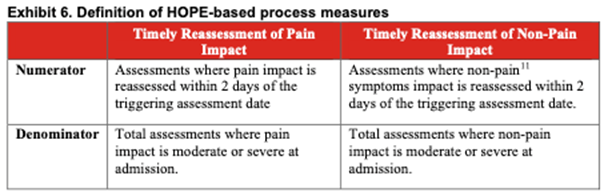
From TEP recommendations early in their work, Abt Associates developed two outcome measures and two process measures in harmony with hospice’s central tenet to manage symptoms:

  • Process measures:
    • Timely Reassessment of Pain Impact
    • Timely Reassessment of Non-Pain Symptom Impact
  • Outcome measures:
    • Timely Reduction of Pain Symptom Impact
    • Timely Reduction of Non-Pain Symptom Impact

“The most important [recommendations] were some of the outcome measures about symptom management,” McNally explains. “What should we be helping agencies show that they’re doing well? And how do we do that? Deciding which ones, and how many symptom management measures to use and the most valuable way to show it in a fair way.”

During the past two years, TEP members prioritized which of the risk-adjustment factors suggested by Abt. Associates should apply to outcome measures and which exclusions should apply to both outcome and process measures.

The report describes risk adjustment as using statistics to exclude “confounding factors,” or elements that are outside of a hospice’s control, from calculations that could make a hospice’s performance appear either better or worse than it is. In essence, risk adjustment increases the fairness in outcome-measure calculations while exclusions do the same for both outcome and process measures.

For the outcome measures being considered, the report says that the “TEP broadly agreed that risk adjustment is very important because it accounts for external factors outside hospices’ control and more accurately reflects the quality of care provided.”

Judi Lund Person, Principal of LundPerson & Associates, LLC, agrees. “The discussion of risk-adjustment factors is vitally important to the success of upcoming process measure implementation,” says Lund Person.

Determining which risk-adjustment factors to bring to the table was not easy. “There were some nuance things that we hashed out to try and decide how to weigh some factors in risk adjustment” for outcome measures, McNally explains.

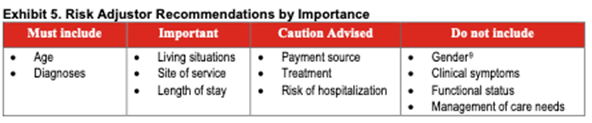
Exhibit 5 (below) summarizes the TEP’s rankings of risk adjustors suggested.

While the TEP’s priorities seem clear, the discussion concerning each risk adjustor was more complex. The TEP broadly agreed that the most important risk-adjustment factors are age and diagnosis. Some diseases are more difficult to manage than others, and patient condition tends to decline with age regardless of provider activity. Therefore, the TEP recommended that CMS adjust for these factors to ensure that common external factors do not adversely affect reported hospice care quality.

Here’s part of the nuance – the TEP also raised concerns that how well other patients with certain diseases or of certain age groups are treated might be valuable to some patients and their families seeking care for someone of the same age group or condition. Panelists fretted over possibly obscuring that information for consumers seeking hospice care by adjusting for those risk factors.

Living situation as a risk adjustor ranked as important to TEP members because hospices have no control over what level of assistance is available to patients. Similarly, site of service ranked high as a risk adjustor because, said some panelists, care is delivered very differently across settings, and patients and/or caregivers tend to provide higher hospice satisfaction ratings for hospices in home settings than for those in facilities,” according to the report.

Lund Person, who is also former Vice President of Regulatory and Compliance at the National Hospice and Palliative Care Organization (NHPCO), notes that the TEP recognized living situation and site of service as “important” risk adjustment recommendations.

“Identifying site of service will help to distinguish between care at home and care in a facility,” she says. Also vital, she continues, “is the recommendation from the TEP to consider length-of-stay as a risk-adjustment factor, including the differences between a 4-day length of stay and a 6-month length of stay.”

One TEP member cautioned that using payment sources, IV therapy, and risk of hospitalization as risk adjustors might tempt some hospices to use them to distort a hospices’ apparent care quality.

TEP members did not recommend using as risk adjustors gender, clinical symptoms, functional status and management of care needs. They did not discuss why they rejected gender, but several agreed that using clinical symptoms would not be of value because of their high correlation with diagnoses. Because hospice providers typically see hospice patients decline in ADL and IADL abilities, and hospice goals are focused on comfort rather than functional improvement, functional status was on the TEP’s “Do Not Include” as a risk adjustor list. And finally, one TEP member strongly opposed adjusting for patients’ medication management, supervision or safety assistance needs (management of care needs), explaining that “the public and CMS should hold hospices accountable for planning around oral medication, injectable medication management, and supervision and safety assistance,” the report says.

The TEP did suggest that using some risk adjustment factors as part of the HQRP could assist hospices internally with quality improvement while others would be more valuable to patients and families. For example, Patients and families would benefit from more straightforward risk adjustment that helps them select a hospice,” the report says, “including factors such as diagnosis. For publicly reported data used to select a hospice, the TEP suggested using demographic factors (including age but excluding gender), socioeconomic factors, living situation, and diagnoses.”

Dr. McNally hopes eventually to use HPRP data to promote Intermountain Hospice’s care. Intermountain Hospice is part of Intermountain Health, a health care provider with presence in multiple states. “You can’t take the current metrics to doctors’ offices and families to show anything meaningful,” he says. “It’d be great to have metrics we could take to our neurology docs and other docs,” he says. “I really think we provide better care and more options when patients stay within our system.

This article is the first in a series about implementation of HOPE. Next week, Beth Noyce shares details from the panel as it evaluated process measures.

# # #

©2024 by The Rowan Report, Peoria, AZ. All rights reserved. This article originally appeared in Healthcare at Home: The Rowan Report. One copy may be printed for personal use: further reproduction by permission only. editor@therowanreport.com


Is the Covid Boost for Telehealth Over?

Clinical

by Tim Rowan, Editor Emeritus

In 2020, doctors flooded telehealth companies with requests for help caring for patients reluctant to leave home to come to their appointments. Following suit, many Home Health agencies that had never considered investing in home telehealth before, opened up their wallets to acquire equipment, from simple wearables to high-end, HIPAA-compliant video systems.

In addition to the need to provide care at a safe distance, many HHA leaders knew the added service would attract the attention of hospitals desperate to discharge recovering Covid victims as well as non-Covid patients. Some HHAs established relationships with hospitals they had not had before, given the chance to demonstration Home Health’s unique advantages over extended hospital stays and discharges to institutions such as SNFs that had become virtual death sentences during the height of the pandemic.

All Things Must Pass

With the introduction and widespread free availability of Covid mRNA vaccines, the death rate graph line began to tilt downward. Then came the discovery that the SARS-CoV-2 and its variants are transmitted through the air and not through unwashed surfaces. People stopped disinfecting their counter tops after unloading groceries. And they started in-person doctor visits again. Patients returned to allowing nurses into their homes.

In regions where vaccination and booster rates were high, hospitals found themselves with more and more empty beds. They took down tented treatment centers in their parking lots and sent refrigerated trailers back to trucking companies. Desperation referrals to Home Health tapered off, as did the need for virtual visits.

Isaac Newton said every action has an equal and opposite reaction. If that holds true in the healthcare business as it does in physics, the reaction to Covid easing is seen in Remote Patient Monitoring tech companies. According to Fierce Healthcare, the New York Stock Exchange told one RPM company, Amwell, formerly known as “American Well,” to raise its stock price or be delisted. Fierce added detail about the company’s woes:

“Despite decimating its workforce at the end of 2023 to cut expenses, the company still projects a 2024 loss between $160 million and $155 million amid incremental revenue growth. The company’s market cap was a stone’s throw from $6 billion at the height of its valuation, when shares were trading for more than $42 each. Amwell shares were trading at $0.72 as of market close on April 5, giving the company a current market cap of about $208.6 million.

Another market leader fared no better, Fierce Healthcare found. “Telehealth giant Teledoc, which has been in operation for 20 years, has struggled in the stock market and is facing headwinds as the virtual care market has become crowded with digital health players. Shares dropped 22 percent in February as the company missed fourth-quarter revenue estimates and offered a downbeat forecast for the rest of the year.”

Teledoc’s 15-year CEO, Jason Gorevic, resigned last week after the company reported a net loss of $220 million for 2023, following 2022’s historic loss of $13.7 billion, mostly from a write-off related to the plummeting value of its ill-advised Livongo acquisition. According to Fierce Healthcare, Teladoc shelled out $18.5 billion for the digital chronic condition management company, a record in digital health.

Gorevic’s rationale that the telehealth field has become too crowded may not be far off. Last July, Becker’s Hospital Review published an industry survey titled “280+ Telehealth Companies to Know.” The list included a half dozen names we recognized from past Home Health conferences, including Health Recovery Solutions, AMC, Vivify, and FoneMed.

Do Hospital Woes Translate Down to Home Health?

Making comparisons between telemedicine companies that focus on hospitals and physicians and those who focus on post-acute providers is hampered by the fact that few in our sector are publicly traded and do not share their numbers. UnitedHealth, which acquired Vivify in 2019 and assigned it to its Optum division, does not separately report Vivify revenue.

Health Recovery Solutions, one of the best-known names in post-acute RPM, is privately held by its founding CEO and seven investors. Its most recent influx of $800,000 occurred in January, 2022, making it impossible to determine whether it was motivated by investor confidence or the need for cash as Covid began its decline.

Analysis

This publication has promoted the advantages of remote patient monitoring for its entire 25-year existence. We have covered startups and established tech companies offering every technology from PERS to Zo monitors to automated phone calls, in-home cameras and microphones. We have followed the evolution of two-way communications and vital sign detectors from tabletop devices to tablets and smartphones. We have even tested a few robots. We have seen HHAs experience great success, and we have seen devices collecting dust on shelves.

Throughout, we have maintained that, when selected, implemented, and deployed properly, monitoring patients 24/7 instead of once or twice a week can improve patient outcomes, boost agency reputation, and, more often than not, produce a healthy ROI. The end of the latest pandemic may mean the end of demand for Remote Patient Monitoring systems, but that would be unfortunate.

Tim Rowan, Editor EmeritusTim Rowan is a 30-year home care technology consultant who co-founded and served as Editor and principal writer of this publication for 25 years. He continues to occasionally contribute news and analysis articles under The Rowan Report’s new ownership. He also continues to work part-time as a Home Care recruiting and retention consultant. More information: RowanResources.com or Tim@RowanResources.com

©2024 by The Rowan Report, Peoria, AZ. All rights reserved. This article originally appeared in Healthcare at Home: The Rowan Report. One copy may be printed for personal use: further reproduction by permission only. editor@therowanreport.com

SNF Abuses Could be Selling Point for In-Home Care Providers

Clinical

by Tim Rowan, Editor Emeritus

For as long as I can remember, Home Health and Home Care owners and advocates, including their national and state associations, have struggled to develop concrete data to prove what we all know to be true: In-home care is a great deal for payers, both public and private. Underpaying our sector in a misguided attempt to reduce costs results in paying more in the long run. Buying more in-home care translates into lower overall cost.

This is one part of the story, and we continually search for the proof our sector so desperately needs. But there is another aspect to the Home Health, Home Care advantage that must not be overlooked as we focus on payer finances.

Patient care and safetyPhoto of a rundown nursing home room

One need look no further than our post-acute care neighbor, Skilled Nursing Facilities, to understand how much better off elderly citizens are when in-home caregivers and clinicians enabled them to stay in their own homes and avoid institutionalized care. A new, peer-reviewed study titles “Profits Over Patients” was published in the online collective The Conversation. If unfamiliar, think of it as The Huffington Post for scholars and researchers.

In the exposé, investigators Sean Campbell and Charlene Harrington reveal that for-profit organizations have been infiltrated by Wall Street investors and other venture capitalists, seeking quick turnarounds and handsome profits. Founders and other SNF owners gladly accept generous offers to be acquired or partner with investors who immediately begin to impose cost-cutting measures and maximize profits. The probe, which paired an academic expert with an investigative reporter, discovered a number of startling findings:

“The investigation revealed an industry that places a premium on cost cutting and big profits, with low staffing and poor quality, often to the detriment of patient well-being. Operating under weak and poorly enforced regulations with financially insignificant penalties, the for-profit sector fosters an environment where corners are frequently cut, compromising the quality of care and endangering patient health.”

Campbell and Harrington also looked at the ineffectiveness of state inspectors, who have limited ability to impose meaningful fines for violations. One startling example in the report is that of a Louisville SNF. The care was found to be “abysmal” when Kentucky inspectors filed their survey report.

“Residents wandered the halls in a facility that can house up to 250 people, yelling at each other and stealing blankets. One resident beat a roommate with a stick, causing bruising and skin tears. Another was found in bed with a broken finger and a bloody forehead gash. That person was allowed to roam and enter the beds of other residents. In another ase, there was sexual touching in the dayroom between residents, according to the [surveyor’s] report.

“Meals were served from filthy meal carts on plastic foam trays, and residents struggled to cut their food with dull plastic cutlery. Broken tiles lined showers, and a mysterious black gunk marred the floors.

“Overall, there was a critical lack of training, lack of staff, and lack of supervision.”

The report said state inspectors found 29 deficiencies, including six that put residents in immediate jeopardy of serious harm and three where actual harm was found. The fine imposed was $319,000 — more than 29 times the average for a nursing home. Payments from Medicare and Medicaid were suspended. The investors and owners chalked the fine up to a normal cost of doing business and, five months later, inspectors found six additional deficiencies “of immediate jeopardy,” the highest level.

The parent company of the Kentucky SNF, Infinity Healthcare Management, owns 58 facilities across five states. Since 2021, Infinity has been hit with nearly $10 million in fines, more than 4.5 times the national average.

Cut staff, save money, hide money

The investigation revealed an industry that places a premium on cost cutting and big profits, with low staffing and poor quality, endangering patient health. “Meanwhile,” the authors assert, “owners make the facilities look less profitable by siphoning money from the homes through byzantine networks of interconnected corporation

s. Federal regulators have neglected the problem as each year likely billions of dollars are funneled out of nursing homes through related parties and into owners’ pockets.”

The report points out that problems of this magnitude are found far less often in small, single-location facilities and in national chains and franchises. The sweet sport for abuse seems to be in the mid-range, for-profit organizations that have been taken over by far-away investors. Sadly, 72 percent of the SNF’s in this category are for-profit. “While such chains account for about 39 percent of all facilities, they operate 11 of the 15 most-fined facilities.

Relevance

A frequent message at Home Healthcare conferences in recent years has been the renewed interest in our sector from big money investors. While quick profits and the enticement of early retirement might bring Home Health and Home Care owners to the negotiating table, this exposé may be a reason to take a breath and think it through. Most of you who nurtured your company from startup to attractive acquisition target did so as much out of compassion as entrepreneurship. Would you not wonder, from your perch on the sun deck of a cruise ship, whether your legacy is being dragged in the mud and your patients and employees reduced to a Wall Street cost column?

Read the entire report here.

Tim Rowan is a 30-year home care technology consultant who co-founded and served as Editor and principal writer of this publication for 25 years. He continues to occasionally contribute news and analysis articles under The Rowan Report’s new ownership. He also continues to work part-time as a Home Care recruiting and retention consultant. More information: RowanResources.com or Tim@RowanResources.com

©2024 by The Rowan Report, Peoria, AZ. All rights reserved. This article originally appeared in Healthcare at Home: The Rowan Report. One copy may be printed for personal use: further reproduction by permission only. editor@therowanreport.com

Little Clinical, Cost Benefit to Diabetes Tech

Admin

CONTACT: Shannon Bishop-Green, SBishopGreen@MessagePartnersPR.com, (860) 305-3197
NEW REPORT FINDS THAT DIGITAL DIABETES MANAGEMENT TOOLS FAIL TO DELIVER MEANINGFUL HEALTH BENEFITS TO PATIENTS WHILE INCREASING SPENDING
Independent evaluation from Peterson Health Technology Institute recommends new directions for digital diabetes solutions
NEW YORK — Peterson Health Technology Institute (PHTI), an independent organization that evaluates healthcare technologies to improve health and lower costs, today released a new evaluation of digital diabetes management tools. These solutions are used by millions of Americans and have been funded by $58 billion of investment and mergers and acquisitions, yet the evidence shows that the technologies do not deliver meaningful clinical benefits, and result in increased healthcare spending.
The analysis, conducted by a team of health technology assessment experts and informed by clinical advisors, evaluated eight widely used digital tools that people with Type 2 diabetes use to track and manage blood glucose using a noncontinuous glucometer.
The report found that people who use these tools achieve only small reductions in hemoglobin A1c (HbA1c) compared to those who do not, and these reductions are not sufficient or sustained enough to change the trajectory of their health, care, or long-term prognosis, including cardiovascular risks. The solutions also result in increased overall healthcare costs. One promising solution, Virta, supports nutritional ketosis to achieve diabetes remission in patients who follow the rigorous diet modifications.
“When these digital diabetes management tools launched more than a decade ago, they promised to improve health outcomes for people with diabetes and deliver savings to payers. Based on the scientific evidence, these solutions have fallen short, and it is time to move toward the next generation of innovation,” said Caroline Pearson, executive director of PHTI. “Patients with diabetes invest time, energy, and resources in these tools, and they deserve to experience meaningful, positive benefits for their health. The healthcare sector as a whole needs transparent, accurate information about the clinical and economic impact of these digital tools that are taking up precious healthcare dollars.”
PHTI’s rigorous analysis incorporated an evidence-based assessment framework and review of more than 1,100 articles, including 120 submitted to PHTI by companies evaluated in the report. PHTI’s ratings are at the category level, including remote patient monitoring solutions that support providers, and behavior and lifestyle modification solutions that engage users to improve their diet, exercise, and self-management.
HbA1c is the standard form of measurement of glycemic control in diabetics. The studies show that these digital tools deliver small reductions in HbA1c of 0.23 to 0.60 percentage points compared to usual care. These results are generally below industry standards for Minimal Clinically Important Difference (MCID) of 0.50 percentage points. Further, the evidence indicates that this small improvement is not durable because the reduction is not sustained over time.
Additionally, PHTI’s analysis did not find evidence to demonstrate that digital diabetes management tools improve other health factors, including weight loss, body mass index, blood pressure, cholesterol, or other common conditions impacting people with diabetes. The analysis also concluded that, despite the disproportionate impact of diabetes on low-income and racially and ethnically diverse communities, these tools are not currently being deployed in ways that improve health equity.
PHTI’s evaluation further determined that these tools increase net healthcare spending. This is due to the fact that price for the solutions exceeds the associated healthcare cost savings, because the minimal clinical benefit does not enable the patient to avoid other care or treatments. For patients using tools in the remote patient monitoring category, annual spending is projected to increase by $2,002 for commercial insurance patients, by $1,011 for Medicare patients, and by $723 for Medicaid patients, as a result of higher provider payments. For patients using tools in the behavior and lifestyle modification category, annual spending is estimated to increase by $484 for commercial insurance patients, by $513 for Medicare patients, and by $574 for Medicaid patients. For all payers, the increased spending associated with virtual diabetes solutions has a significant impact on total spending given how many people are eligible to use the solutions, including 4.3% of those with commercial insurance, 17.0% of those with Medicare, and 4.8% of those with Medicaid.
In addition to its scientific literature review, PHTI proactively engaged the companies included in the report and provided an opportunity for them to share data and product information. Companies in PHTI’s evaluation include DarioHealth, Glooko, Omada, Perry Health, Teladoc (Livongo), Verily (Onduo), Vida, and Virta. The evaluation considered evidence about which populations stand to benefit the most from using the technology, as well as the durability of clinical impacts given the importance of sustained glucose control to achieve health benefits. The economic analysis modeled expected healthcare savings resulting from improved glycemic control for patients using digital diabetes management solutions who are enrolled in Medicare, Medicaid, and commercial insurance.
PHTI identified two potential bright spots for digital diabetes management tools. Initial data showed that Virta users are much more likely to achieve clinically meaningful benefits in glycemic control, including diabetes remission and the ability to reduce or eliminate their diabetes medications, if they can maintain the rigorous dietary requirements of the intervention. The other area of greater potential is among patients with higher starting HbA1c levels who are newly starting insulin. By engaging these patients at an early critical transition point in their care, digital solutions could have more impact by helping establish good self-management habits among these higher-risk patients.
Category-level ratings are available here.
In the United States, about one in seven adults—more than 38 million living in the U.S.—has Type 2 diabetes, which is the eighth leading cause of death. At over $400 billion of total healthcare spending annually, diabetes is the most expensive chronic condition to treat and manage. Given the critical role of patient self-management, investment in digital health tools has surged in recent years.
Throughout the assessment process, PHTI worked with a range of independent evaluation partners, clinical advisors, patients with Type 2 diabetes, and other stakeholders. Report contributors and reviewers included:
  • Curta: assessed the clinical and economic impact of these technologies using the published ICER-PHTI Assessment Framework for Digital Health Technologies, including the systematic literature review and budget impact assessment
  • Charm Economics: identified what technologies cost to deliver, how they work, and their impact on patients and purchasers
  • Institute for Clinical and Economic Review (ICER): co-developed the ICER-PHTI Assessment Framework for Digital Health Technologies, and was consulted to review its implementation in this report
  • Ami Bhatt, MD, chief innovation officer of the American College of Cardiology
  • Richard Milani, MD, chief clinical innovation officer, Sutter Health; former innovation lead at Ochner Health System
  • Karen Rheuban, MD, co-founder and director of the University of Virginia Center for Telehealth
“Managing diabetes is complex and essential to future cardiovascular health. Patients will gain agency and drive better clinical benefit if they direct their time and effort towards effective interventions rather than tools that provide marginal or no benefit,” said report contributor Ami Bhatt, MD, chief innovation officer of the American College of Cardiology.
“New diabetes technologies need to be easier to use, by the people who need them most, at lower cost than standard care, and provide real health benefits,” said report contributor Richard Milani, MD, chief clinical innovation officer at Sutter Health. “This evaluation suggests there is room for new innovations that deliver for patients and address worrying increases in healthcare spending.”
The PHTI report provides recommendations and best practices for innovators, providers, and payers. The next generation of diabetes management solutions should aim for clinically meaningful improvements in glycemic control, potentially integrating continuous glucose monitors and new GLP-1 obesity medications. Solutions should also generate sufficient evidence to support broader adoption, and they should prioritize access for populations who need them most. Providers of diabetes care should have clarity about the performance of these digital solutions when recommending them to their patients. Payers, including health plans and employers, should adapt their contracting approach to require transparency about the solution’s usage and benefits within their covered population and to include financial performance guarantees tied to clinical outcomes.
“PHTI is filling an important role in delivering actionable and market-facing information to digital health purchasers about what solutions will make a meaningful impact on health outcomes for members, making them worth investment,” said Peter Long, PhD, executive vice president, Strategy and Health Solutions at Blue Shield of California and a PHTI Advisory Board member. “Having an organization like PHTI cut through the noise of digital health options helps payers make faster and more effective decisions for members so that we can focus on the big work of transforming the healthcare system.”
PHTI has announced that future assessment areas include virtual physical therapy, blood pressure monitoring, and mental health tools.
# # #
About the Peterson Health Technology Institute
The Peterson Health Technology Institute (PHTI) provides independent evaluations of innovative healthcare technologies to improve health and lower costs. Through its rigorous, evidence-based research, PHTI analyzes the clinical benefits and economic impact of digital health solutions, as well as their effects on health equity, privacy, and security. These evaluations inform decisions for providers, patients, payers, and investors, accelerating the adoption of high-value technology in healthcare. PHTI was founded in 2023 by the Peterson Center on Healthcare. For more information, please visit PHTI.com.

OIG Says Providers Can Offer Services to Caregivers

Clinical

by Elizabeth E. Hogue, Esq.,

Primary caregivers – often patients’ family members – are crucial players in home care. Without them, it can be impossible to provide home care services and to keep patients in their homes. If patients cannot care for themselves, reliable caregivers are an essential prerequisite for the provision of all types of home care.

Caregivers have a very “hard row to hoe” because caregiving is physically, emotionally, intellectually, and spiritually demanding. Is it possible that enhanced assistance for caregivers can positively impact quality of care? Intuitively, the answer to this question seems to be “yes.” What additional assistance may be helpful and can providers offer it?

Here are some initial ideas for helpful assistance:

  • Caregiver support groups
  • More intensive education about patients’ clinical conditions, with an emphasis on signs and symptoms of changes in patients’ conditions and what to do about them
  • Assistance from volunteers, especially for patients who are chronically ill

The next question is whether providers can offer additional assistance, such as the activities described above. This issue has been addressed by the Office of Inspector General (OIG) of the U.S. Department of Health and Human Services, the primary enforcer of fraud and abuse prohibitions. The OIG has clearly stated that providers may not give patients or potential patients free items or services that cost more than $15.00 at a time or more than $75.00 in aggregate per calendar year.

In Advisory Opinion No. 18-05; issued on June 18, 2018; the OIG also addressed the circumstances under which providers can establish “caregiver centers” that provide or arrange for free or reduced-cost support services to caregivers in local communities. The provider that requested this Advisory Opinion recognized the difficulties faced by primary caregivers and, consequently, established a caregiver Center.

The Center is staffed primarily by volunteers. Private donations fund the Center and none of its costs are shifted to any federal health care program.

The Center either directly or, in collaboration with local nonprofit organizations, provides free and fee-based services to caregivers. Free services include, but are not limited to, access to a resource library, various educational sessions, a short-term equipment lending program, and free on-site respite care during events sponsored by the Center and attended by caregivers. The Center offers or partners with other providers in the community to offer stress reduction workshops, low-cost ride-share programs, and additional respite care.

The provider does not specifically market the Center’s services, but information is available on its website, social media pages, and in brochures. These sources make it clear that every caregiver is eligible to use the Center’s services, regardless of healthcare provider or payor.

Center staff members do not market, promote, or make referrals for any medical items or services that are reimbursable by federal care programs and do not provide any items or services that are reimbursable by federal health care programs. Referrals for services include a comprehensive list of local service providers offering requested services, without recommending any provider over another.

In response to this request, the OIG first stated that the key question is whether these services are likely to influence caregivers to select the provider or items or services reimbursable by the Medicare or State health care programs in the future. The OIG then acknowledged that the services provided have intangible, psychological value to caregivers. Some of the services relieve caregivers of expenses they might otherwise have incurred. The OIG also noted that many of the support services take place on the provider’s premises, which might encourage selection of the provider for future services. The OIG also acknowledged that this arrangement does not fit into any safe harbor or exception under the federal anti-kickback statute.

Nonetheless, the OIG said that it would not impose sanctions on the provider because:

  • The services offered at the Center primarily benefit caregivers, not patients.
  • The Center’s services are available to all caregivers.
  • The provider does not actively market the Center and its services.
  • The Center is unlikely to increase costs to federal health care programs.

Caregivers have a tough job and need the support of home care providers. Based on this Advisory Opinion, the OIG has provided guidance about how home care providers of all types can expand their support for caregivers.

©2024 Elizabeth E. Hogue, Esq. All rights reserved.

No portion of this material may be reproduced in any form without the advance written permission of the author.

Onslaught of Audits Worries Hospice Providers

Clinical

By Kristin Rowan, Editor

March 12, 2024, the National Association for Home Care and Hospice (NAHC), Leading Age, the National Hospice and Palliative Care Organization (NHPCO), and the National Partnership for Healthcare and Hospice Innovation (NPHI), published their findings from a 2023 survey on regulation. These findings were presented to Congress and CMS earlier this year. The organizations surveyed 133 respondents, who noted regulatory issues as the top concern for providers. Of particular concern was the audits that have been increasing steadily for years.Audit

More than half of respondents said they have undergone simultaneous audits, usually the TPE and SMRC audits. 52.9% of respondents said they had multiple audits within six months of each other, conducted by different contractors, and more than half of those said they had to submit the same charts for each audit.

Hospice Auditor Issues

The findings indicate some issues with the training, knowledge, and integrity of auditors. Many respondents indicated having received denials of physician visits, documented separately from face-to-face visits, simply because they occurred on the same day. Some reported denials due to the absence of an IDG meeting even when no IDG meeting was required. Multiple respondents said the denial reasoning was copied and pasted from past denials and/or that the auditor did not seem to have read the documentation that was sent.

Auditing Inconsistencies

The report findings indicate that there are often delays in receiving audit results, sometimes up to 18 months. Some RAC audits had listed available dates for findings, but the findings were not actually available for several months after the listed date. Respondents also indicated that instructions from the auditors were presented using terminology that was not consistent with standard operating procedures in a hospice environment (read: auditors are using hospital lingo and expecting hospices to understand it).

Technical billing issues, when payments are denied not due ineligibility, but because of missing or incorrect information, can be corrected and then processed and paid. However, several respondents indicated that different MACs give different information on how process corrections for election statements and election addendums.

Gross Miscalculations

This was reported in the survey only once, but, as with any survey, extrapolating the data to the whole population, one must assume it has happened more than once: A hospice provider had a claim denied while under a CERT audit. The denial was due to the auditor decided that the patient was not terminally ill, even though the patient expired during the audit.

Recommendations for CMS

The organizations have some recommendations for changes:

    • CMS should re-focus its audit contractors on patterns and practices characteristic of providers that aim to minimize or avoid therapeutic care and supportive services that are required under the hospice benefit and fully reimbursed through the per diem payment.
    • CMS should require substantive education and training for all auditors that is consistent with the education given to providers to minimize inconsistencies.
    • CMS should increase transparency of audit contractor activity, including the number and types of audits being conducted, audit recovery amounts, results of audits by specific audit contractors, including reversal rates, top denial reasons and compliance with required timeframes for notification and review.
    • CMS should implement an informal mechanism to enable MACs and hospice providers to resolve technical claims denials prior to engaging in the formal appeal process.
    • CMS should require audit contractor medical reviewers to have an equivalent level of expertise and training in hospice care as the hospice medical director who certified a patient’s terminal illness.

According to a statement from NAHC, in 2023, the organizations have submitted 34 recommendations to CMS. To date, half of them have been implemented. They will continue to work with CMS toward enhanced transparency, equitable auditing, and targeting genuine fraud, waste, and abuse.

# # #

Kristin Rowan

Kristin Rowan has been working at Healthcare at Home: The Rowan Report since 2008. She has a master’s degree in business administration and marketing and runs Girard Marketing Group, a multi-faceted boutique marketing firm specializing in event planning, sales, and marketing strategy. She has recently taken on the role of Editor of The Rowan Report and will add her voice to current Home Care topics as well as marketing tips for home care agencies. Connect with Kristin directly kristin@girardmarketinggroup.com or www.girardmarketinggroup.com

©2024 by The Rowan Report, Peoria, AZ. All rights reserved. This article originally appeared in Healthcare at Home: The Rowan Report.homecaretechreport.com One copy may be printed for personal use: further reproduction by permission only. editor@homecaretechreport.com


Meet the Remarkable Women of the International Home Care Nurses Organization

Admin

By Kristin Rowan, Editor

Last week, I had the honor of speaking with three of the dynamic leaders of the International Home Care Nurses Organization (IHCNO). Between them, they have more than 150 years of nursing and administrative experience. Beyond that, they are some of the most engaging and amazing women I’ve had the pleasure of interviewing.

Meet the TeamBoard Members of IHCNO

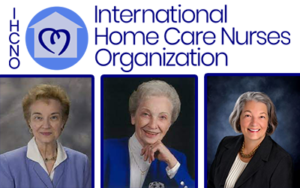
Barbara Piskor is the outgoing President of IHCNO. She started working as a nurse in 1964 and has held positions in home health nursing, clinical nursing, administration, national surveying with the Joint Commission, and consulting.

Marilyn Harris is the IHCNO Treasurer. She became a visiting nurse in 1960, was an administrator for the VNA, and spent 20 years as a hospital-based agency administrator.

Susan Hinck is the incoming President of IHCNO. She become a home health nurse in the 1980s and has been a clinician, educator, administrator, and advance practice nurse.

History of IHCNO

IHCNO started as a grassroots organization to serve the care needs of nurses. Between 2009 and 20012, there were concerns about teaching and practice. The industry was expanding and was in need of consistency. This launched the development of a communication network of home care nurses. Their mission is “To communicate, connect, and collaborate with home care nurses around the globe.”

The first members of IHCNO identified then-current home care nurse issues and developed action plans, a committee, and the first international conference event, which was attended by nurses from thirteen countries its inaugural year. They have since added webinars, outreach, and organizational development and are working on developing international guidelines and standards.

The Conversation

Rowan Report: “Barbara, as the outgoing President, what do you hope for the future of IHCNO?”

Barbara Piskor: “For IHCNO to be effective in helping to develop the area of global excellence in home-based nursing. To be recognized as the “go-to” organization for what’s happening in home-0based care related to nursing, from prenatal through to aging in place. To give the message that real health care is in the home; it’s a privilege to be a guest in the home, delivering care. It’s how you get to know the person, their family, and their home situation.

RR: “Susan, as the incoming President, what are your plans and goals for IHCNO for 2024 and beyond?”

Susan Hinck: “IHCNO has always been a volunteer organization, which comes with some challenges. We are contracting with a management company to provide stability and continuity for the organization. The same committed group of people working full0time to grow the organization will benefit from having a management company overseeing logistics so we can focus on additional projects and work more with home care nurses in different countries. There are some countries and continents where home care is not as well developed. For example, South America and Africa have well developed programs for maternity and pediatric home care, but not for older adults.”

RR: “Marilyn, the IHCNO has offers research grants in your name. Tell me about the IHCNO research.”

Marilyn Harris: “The Marilyn D. Harris research grant offers financial support for nurse researchers around the world. After the submission period, applications go through an international review board and one research topic is chosen. In the past, we have funded research on topics like the use of simulation tools in home care and the transition from home care to hospice. This year we will award our sixth research grant.

“We also have a very active internal research department. We are currently studying the scope and standards of home-based nursing around the world. All countries have scope and standards of practice for nursing, but they are not specific to nurses in home-based care. There are a lot of differences in practice across countries.”

RR: “You also have an award program, right?”

Harris: “Yes, that’s right. The Daisy Foundation was established by Bonnie and Mark Barnes to honor their sone. The Daisy award is given to home nurses for extraordinary compassion and care. It’s a worldwide initiative awarded through nomination and blind review. You can find the criteria and nomination forms on our website: https://www.ihcno.org/.”

RR: “Barbara, besides the research, are there other initiatives IHCNO is working on?”

Piskor: “A lot of our focus has been on short-term post-acute care for recovery and rehabilitation. But, custodial care, long-term skilled care, especially for younger adults who need long-term help is one of the fastest growing segments in the home care industry, but it is hampered by reimbursement. Intermittent visit programs are partially covered by Medicare and some Medicaid reimbursement, but isn’t covered by private insurance unless the patient is placed in a nursing home.”

Hinck: “The U.S. can learn a lot from other countries. We spend twice as much on healthcare but are in worse health and have higher mortality rates.”

Piskor: “That’s so true. Another initiative we have is working with provider, practice-based, and educational entities to let people know that home care is a thing. Clinical rotations in home care are necessary in nursing programs. More people need home-based care than ever before and there aren’t enough nursing students aware that home care is an option for them.”

RR: “Susan, IHCNO recently became a membership organization. Can you tell our readers about the member benefits you offer?”

Hinck: “That’s correct. As of January, 2024, IHCNO is a member organization. The biggest benefit of being a member is having a community of nurses to talk to who know what it’s like to be a home care nurse. You can check in and let people know how things are going in your part of the world. We are fostering communication and collaboration among home care nurses around the globe.

“Membership also gets you discounts for IHCNO hosted conferences and webinars and a discount for our multidisciplinary journal Home Health Care Now. We also have individual and corporate-level memberships available.”

RR: “Thank you all for taking the time to share your story with us.”

We will continue to bring you research and news from IHCNO, starting with some of the published works that have come from the past research grant winners. If you have any questions about membership, the grants, the Daisy award nominations, or any of the resources and support available through IHCNO, please reach out to them through their website: https://www.ihcno.org/

# # #

Kristin Rowan

Kristin Rowan has been working at Healthcare at Home: The Rowan Report since 2008. She has a master’s degree in business administration and marketing and runs Girard Marketing Group, a multi-faceted boutique marketing firm specializing in event planning, sales, and marketing strategy. She has recently taken on the role of Editor of The Rowan Report and will add her voice to current Home Care topics as well as marketing tips for home care agencies. Connect with Kristin directly kristin@girardmarketinggroup.com or www.girardmarketinggroup.com

©2024 by The Rowan Report, Peoria, AZ. All rights reserved. This article originally appeared in Healthcare at Home: The Rowan Report.homecaretechreport.com One copy may be printed for personal use: further reproduction by permission only. editor@homecaretechreport.com


Hospice Expert Talks About Her Own Grief Journey

Admin

by Tim Rowan, Editor Emeritus

[Editor’s note: this article is based on a recorded video interview with Barbara Karnes. To see the full conversation in her own words, click here.]

For longer than most of us have been in home care, in fact, for longer than some home care workers have been alive, Barbara Karnes has lived and breathed hospice. From young nurse in 1980 to administrator to author and video producer, she continues into her mid-80’s to teach young nurses and distraught families about the dying process and the grief experience.

Last autumn, however, she was suddenly transported to the other side of the classroom. The death of her husband, a longtime chain smoker, introduced her to cancer, hospice, death, and grief from the perspective of the heart, after decades of dealing with it only intellectually. Barbara graciously agreed to speak with me late last month. Having been through the experience myself, I thought it best to wait a few months after his death to extend my interview invitation.

“I have always been the kind of person who operates out of the head more than the heart,” she began. “Putting on the shoes of a spouse caregiver, and suddenly living what I have taught for decades, put a whole different perspective on it. Even though I knew better, I sometimes did things I tell people not to do.”

She told me about the urge to do those things. “I kept pushing food and the need for nutrition on him,” she remembered. “Then, one day, I finally realized I was trying to keep him alive while his body was trying to die. And with that realization, I began to do what I always recommend everyone else do, always offer and never force.”

“As a professional, I observe the dying and grieving processes. With my husband, I was feeling it. I was in the shoes, and I responded like a family member, not like a hospice expert.”

I Wanted to Know, But He Did Not

Barbara talked about the anguish of not knowing how much time her husband had left once he was diagnosed. “When he decided that he was not going to treat his cancer with chemotherapy, that included the decision not to bother with a lung biopsy just to see what type of cancer he had. ‘If I’m not fighting it, what difference does it make what kind it is?’ he said, and I couldn’t argue. There are fast and slow kinds [of lung cancer] and I wanted to know which it was so I could prepare myself. With my knowledge, I could have estimated how long his death process would take and known when to begin hospice care. I hoped it was one of the slow-growing types rather than small-cell carcinoma, but I realized that was a wish on my part, not realistic, and not what he wanted.”

Hospice Has Changed

In a side conversation, Barbara reminisced about the way hospice care was conducted in her early years as an RN and turned it into advice for today’s nurses.

“Our goal was always to be there with the family at the moment of the patient’s death. Today, hospice is much more medical, more medication oriented. I like the “End-of-Life Doula” movement today. Their companion model reminds me of the way we used to do hospice.”

As it turned out, he was diagnosed in May and passed away in September. He entered hospice right after Labor Day, even though she called to arrange services the Friday before. “Hospices should not do that,” she asserted. “When people are dying, holidays should not be a reason to delay starting care.” Nevertheless, due to this combination of circumstances, a fast-acting cancer and a slow-acting hospice, the husband of a foremost expert on death and grieving was in hospice for the all too common two weeks.

“To be fair, he was driving himself to massage appointment through August,” she clarified. “It was the day he was unable to get off the massage table that we knew it was time.”

Sometimes the Heart Wins

“It was as though I had a split personality,” she said, as I tried to gently encourage her with more personal questions. “There were parts of me that, from the day he was diagnosed, were thinking about him dying. There were parts of me, intellectually, that knew but didn’t want to see all that was unfolding. It’s a kind of confusion.”

Finally, the renowned Barbara Karnes offered the conclusion I had hoped to hear but was reluctant to directly ask. “I don’t know if my knowledge helped or not. There were signs, but I didn’t want to see them. When you’re in it, it is a different experience than when you’re teaching about it.”

# # #

Tim Rowan

 Tim Rowan is a 30-year home care technology consultant who co-founded and served as Editor and principal writer of this publication for 25 years. He continues to occasionally contribute news and analysis articles under The Rowan Report’s new ownership. He also continues to work part-time as a Home Care recruiting and retention consultant. More information: RowanResources.com
Tim@RowanResources.com

 ©2024 by The Rowan Report, Peoria, AZ. All rights reserved. This article originally appeared in Healthcare at Home: The Rowan Report.homecaretechreport.com One copy may be printed for personal use: further reproduction by permission only. editor@homecaretechreport.com


Somebody Messed Up!

Clinical

by Elizabeth E Hogue, Esq.,

After a hospitalized patient suffered a severe choking incident and was placed on life support, his family faced a difficult decision in response to a telephone call from the hospital. They were asked if they wanted to remove life support. The family told the hospital that they did. The hospital subsequently removed life support and the patient passed away. Then came something that no one expected: the patient who was allegedly deceased telephoned his family!

The mix-up started with a call to 911. Medics responded to a call about a choking incident involving a piece of steak. The man who choked was not breathing and was unconscious when they arrived. Somewhere along the line, the patient was misidentified and treated as another patient.

Mistaken Identity

Parents that were called to make life-ending decision for wrong person

The family of the living patient called non-emergency police services to notify authorities that the patient was not, in fact, deceased. The Medical Examiner’s Office retrieved the body from the funeral home, conducted an external examination, and used fingerprints to confirm the deceased patient’s identity. In a gross understatement, a member of the patient’s family said, “Somebody messed up.”

Although the consequences of decision-making by so-called “substitute decision-makers” are not usually so dire, the fact remains that providers and practitioners are obligated to seek informed consent from those authorized to give it when patients cannot consent for themselves.

Here are some questions that providers frequently ask about substitute consent:

If patients cannot consent, who can consent on their behalf?

The answer to this question varies depending on the laws of the state in which patients reside. Consent may be provided on behalf of incapacitated adults by:

  1. An attorney-in-fact, i.e., someone who has authority under a durable power of attorney
  2. Individuals authorized to consent under state substitute consent statutes
  3. Guardians or conservators of the person
  4. Courts

How old must patients be in order to be able to give valid informed consent?

Generally, patients must have reached the age of adulthood before they can give informed consent. The age at which individuals become adults, as opposed to minors, is defined by state law, so the age of adulthood varies from state to state. Practitioners who provide services in multiple states must take this fact into account when obtaining consent. When minors are unable to consent, the general rule is that their parents may give substitute consent on their behalf.

Are there any exceptions to this rule?

Yes. Patients who are not adults, but who seek certain types of care, such as treatment for sexually transmitted diseases, or who are “emancipated” may consent on their own behalf depending on the law in the state in which the patient resides.

What evidence of valid informed consent should practitioners obtain?

Providers may:

  1. Ask patients to sign a consent form
  2. Document consent in patients’ charts with or without patients’ signatures on the documentation
  3. Record consent
  4. Video the consent process
  5. Give patients a short written quiz on the material provided and, if patients answer the questions correctly, put a copy in patients’ charts
  6. Utilize any other credible forms of evidence of consent

The above case certainly illustrates the need to make sure that consent is obtained from appropriate givers of substitute consent and to document their authority.

©2024 Elizabeth E. Hogue, Esq. All rights reserved.

No portion of this material may be reproduced in any form without the advance written permission of the author.

A Beacon of Hope in Recruitment and Retention

Clinical

by The National Minority Health Association,

Embracing Change, Empowering Caregivers

In the ever-evolving world of homecare, recruitment and retention pose significant challenges, particularly in California. However, FACT – Family, Adult and Child Therapies, a southern California-based homecare agency, has emerged as a beacon of hope, leveraging the innovative Caring4Cal program to enhance its workforce and service quality.

The Rising Star of FACT

FACT, dedicated to supporting individuals with developmental disabilities, has a rich history dating back to the 1980s. Originating& from a collaboration of dedicated professionals and parents, FACT has been at the forefront of providing exceptional care and support to a diverse clientele, including minors, adults, and families grappling with a spectrum of diagnoses.Caring4Cal

Caring4Cal: A Game-Changer in Caregiver Recruitment and Training

Under the leadership of its Board of Directors and their executive team: Tina Castro (Director of Adult and Employment Services), Lethia Perry (Director of Operations and Human Resources) and Spencer Ludgate (Director of School-Based Services and Controller), FACT has fully embraced the Caring4Cal community health worker recruitment program. This initiative has seen remarkable participation, with 39 staff members taking advantage of the opportunities it offers.

Eligibility and Scope

To participate in Caring4Cal, caregivers must:

  • Reside in California.
  • Currently work in or aspire to join an eligible job role in home- and community-based settings.
  • Eligible roles include a wide array of healthcare professionals like HHA, CNA, RN, LVN, and more.

Partnership and Funding

The National Minority Health Association (NMHA), a pivotal entity in reducing health disparities among minorities, received a substantial grant under the Caring4Cal initiative. Spearheaded by the California Department of Healthcare Access and Information (HCAI), this program is a concerted effort to reinforce the workforce in home- and community-based care. With a strategic collaboration with Nevvon, a leader in e-training solutions for healthcare, this initiative is set to revolutionize caregiver training and retention.

FACT: A Legacy of Excellence and Adaptability

FACT’s enduring commitment to providing holistic, affordable, and quality mental health care is well-aligned with the Caring4Cal program. Their person-centered care approach, accessible locations, and advocacy for independence resonate deeply with the program’s objectives. For over twenty years, FACT has not only adapted to societal changes but has also been a vanguard in accepting and appreciating diverse abilities.

The Future Outlook

With the Caring4Cal program, FACT is not only addressing the immediate need for skilled caregivers but is also shaping a future where comprehensive and compassionate care is accessible to all Californians. This initiative stands as a testament to FACT’s unwavering dedication to its mission and philosophy.

A Call to Action

The success of FACT with the Caring4Cal program is a clarion call to all agencies in the sector. With available funding and training opportunities, it is an opportune time for other agencies to participate and enhance their capabilities. The program not only offers financial incentives but also ensures that caregivers are equipped with state-of-the-art skills to meet the growing demands of the sector.

FACT, working with the NMHA and its successful integration of the Caring4Cal program, exemplifies how strategic partnerships and innovative training initiatives can effectively address the twin challenges of recruitment and retention in the homecare industry.

###

About the NMHA: The National Minority Health Association is a 501c3 non-profit organization founded in 1988. The NMHA delivers on its mission of heath equity through innovative programs including Health is for EveryBODY™ (www.healthisforeverybody.org), Operation Healthy You™, Equityville™ and The Art Alliance, to name a few. The lack of health equity in underserved, marginalized and hard to reach communities translates into lost lives, adverse health outcomes, higher costs, diminished productivity and declines in quality of life and well-being for everyone. For more information visit www.thenmha.org 

Strategies to Increase Workforce

Admin

By Kristin Rowan, Editor

The workforce shortage across the country both in and out of home care is creating increasing demand on workers and added stress on organizations. Added to this is the increasing number of older adults living past retirement age. As more and more “boomers” reach that age, more of them are considering aging in place rather than moving to a facility. High turnover rates among care providers also contributes to the workforce shortage for care at home agencies.Graph moving up

One agency has a plan to increase its workforce by 50% by the end of the year. Right at Home, based in Omaha, Nebraska, has more than 700 franchise locations and employs more than 45,000 caregivers. They intend to add 26,000 additional caregivers to address the growing needs of our aging population.

Recruitment and retention issues are not specific to care at home, but the compounding factors of a larger aging population and higher turnover rates make it a pressing issue. It may seem like a lofty goal to increase an already large workforce by another 50% when many businesses are struggling to hire at all. Right at Home has implemented several strategies to reach this goal:

  • Preferred partnerships with job boards
    • Collaborations with local and national job platforms working directly with franchise owners
  • Technology solutions
    • Increased efficiencies in the office gives staff more time and energy for hiring and onboarding
      • Electronic onboarding resources and automated communication within applicant tracking systems to simplify hiring process
      • Engagement platforms to reward and recognize caregivers to lower turnover rates
  • Cultivating an appealing culture
    • Becoming the employer of choice in each demographic area
      • Breaking down the caregiver experience into micro elements for a better experience for caregivers

Creating partnerships with job boards and using automated processes for hiring are the simplest of these tasks to implement right away. Larger job boards like Indeed and Monster may not be willing to collaborate, but local colleges may be an easier route. They typically have job boards with smaller pools of applicants who are already partitioned into fields of study. No matter the size of your agency, there are technology solutions to reduce the time spent with onboarding and applicant tracking that are cost effective and increase efficiency. If you’re looking for one, we’ve reviewed several over the years.

Cultivating an appealing culture may be more difficult. An appealing culture is subjective and vague. Right at Home mentions breaking down the caregiver experience into micro elements. Even if you know what those micro elements are, improving the experience is the goal but not a plan. In a recent conversation with home care agency owner Bob Roth, he mentioned the difficulties of establishing leadership and creating culture in a dispersed workforce. This topic bears additional scrutiny and we will have some upcoming articles on creating culture in the next few weeks.

# # #

Kristin Rowan

Kristin Rowan has been working at Healthcare at Home: The Rowan Report since 2008. She has a master’s degree in business administration and marketing and runs Girard Marketing Group, a multi-faceted boutique marketing firm specializing in event planning, sales, and marketing strategy. She has recently taken on the role of Editor of The Rowan Report and will add her voice to current Home Care topics as well as marketing tips for home care agencies. Connect with Kristin directly kristin@girardmarketinggroup.com or www.girardmarketinggroup.com

©2024 by The Rowan Report, Peoria, AZ. All rights reserved. This article originally appeared in Healthcare at Home: The Rowan Report.homecaretechreport.com One copy may be printed for personal use: further reproduction by permission only. editor@homecaretechreport.com

Acute Hospital Care at Home

Clinical

By Kristin Rowan, Editor

Federal Waiver Program

In 2020, CMS launched a hospital care at home program to help increase patient capacity during the height of the Covid-19 pandemic. The study included 300 hospitals and thousands of patients receiving care in their home using a hospital at home waiver. Outcomes of the study showed that patients had greater ability to stand up and move around at home than would have had in a hospital and that in-home caregivers were better able to educate patients on home to care for themselves once they were able to see the social determinants of care in the home. CMS also reports only 7.2% of patients were required to be transferred to a hospital.

Hospital Study

Mass General Brigham conducted its own study alongside CMS and analyzing outcomes of diverse patients, including socially vulnerable and medically complex patients. The findings of their national analysis showed that within 30 days of discharge, 2.6% of patients used a SNF, 3.2% died, and 15.6% were readmitted. Findings were consistent among all groups, including those who generally have worse outcomes: patients of Black and Latine race and ethnicity, dual-eligible patients, and patients with disabilities.

Health System Study

In April of 2020, Kaiser Permanente conducted an 18-month study on the scalability of “Advanced Care at Home” (ACAH). The patients all required hospital-level care and were first admitted to the program through the emergency department. Some were admitted to the hospital, and some were instead admitted to the Kaiser ACAH program, where a team of nurses, physicians, nurse practitioners, and a pharmacist developed a care plan.

This study increased its daily census from 7.2 per day to 12.7 per day at the end of study. The average episode of care decreased from 7.43 days to 5.46 days and readmission rates dropped from 11.52 percent to 9.24 percent. These patients were less likely to experience delirium than patients admitted to traditional hospital settings. The researchers noted the limitation of the study as being too small to develop precise comparisons.

Limitations of Acute Hospital Care at Home

Currently, the only patients eligible for AHCaH are those who have been evaluated in a hospital or emergency department. Kaiser has extended this to patients seen in their own urgent care offices in areas where they don’t own a hospital. Kaiser has served a few thousand patients through this program, but they estimate there are more than 1.1 million eligible patients. Rural patients who don’t live near a hospital or emergency department have the same trouble accessing AHCaH that they do accessing hospital and physician care now.

The CMS waiver for AHCaH has been extended through December 2024. Beyond that, it is unclear how hospital care at home will be reimbursed. Some providers have offered hospital care at home to risk-based patients in a VBC model. Not all eligible patients will qualify for the waiver or VBC reimbursement. Without specific provisions from CMS to reimburse hospital care at home for all Medicare and Medicaid patients and coverage from private insurance, the hospital at home program will remain limited.

The current model for AHCaH includes technology support for the patient using a tablet, smartphone, or other device. This requires that the patient have a broadband internet connection in the home, which eliminates eligibility for rural patients who are already underserved.

Final Thoughts

There is a lot of support for Hospital Care at Home among providers, health systems, and consumer insurance companies. Support for home health, hospice, palliative care, and supportive home care has not been as strong. As these larger players start to see the cost and outcome benefits of care in the home, a few things may happen.

First, hospitals, payers, and physician groups may start to recognize the value of care at home and be more open to creating referral partnerships with care at home agencies. Home care is a small percentage of total care reimbursed by Medicare and Medicaid and we could see that increase.

Conversely, these providers may realize that care at home is lucrative and will extend their own AHCaH models to include post-acute and hospice care, cutting out home care agencies altogether. Care teams are constructed around a Hospital Care at Home patient. Including a post-acute nurse who is familiar with the patient history would provide additional continuity of care.

Either way, I see the support for the Hospital Care at Home program as beneficial to home health. Branches of health care that were previously averse to extending patient care into the home are now supporting it. Increased adoption of telehealth and other technology platforms increase the possibilities for integrating with home health and hospice providers. Interoperability between Hospital Care at Home and Post-Acute Care at Home may finally become a reality.

We will continue to report on the AHCaH waiver as the deadline to renew comes closer.

# # #

Kristin Rowan

Kristin Rowan has been working at Healthcare at Home: The Rowan Report since 2008. She has a master’s degree in business administration and marketing and runs Girard Marketing Group, a multi-faceted boutique marketing firm specializing in event planning, sales, and marketing strategy. She has recently taken on the role of Editor of The Rowan Report and will add her voice to current Home Care topics as well as marketing tips for home care agencies. Connect with Kristin directly kristin@girardmarketinggroup.com or www.girardmarketinggroup.com

©2024 by The Rowan Report, Peoria, AZ. All rights reserved. This article originally appeared in Healthcare at Home: The Rowan Report.homecaretechreport.com One copy may be printed for personal use: further reproduction by permission only. editor@homecaretechreport.com

 Sources:

CMS (2024) Acute Hospital Care at Home Data Release Fact Sheet. Retrieved from: https://www.cms.gov/newsroom/fact-sheets/acute-hospital-care-home-data-release-fact-sheet#:~:text=In%20response%20to%20challenges%20faced,inpatient%2Dlevel%20care%20at%20home.

Mass General Brigham (2024) Study of National Data Demonstrates the Value of Acute Hospital Care at Home. Retrieved from: https://www.massgeneralbrigham.org/en/about/newsroom/press-releases/study-of-national-data-demonstrates-the-value-of-acute-hospital-care-at-home#:~:text=In%20addition%2C%20within%2030%20days,and%20have%20fewer%20adverse%20events.%E2%80%9D

mHealth Intelligence (2023) Kaiser Permanente Study Shows Scalability of Hospital-at-Home model

Could Jimmy Carter’s Hospice Care Lead to Covered Palliative Care Services?

Clinical

By Kristin Rowan, Editor

The news this week has been filled with stories about former president Jimmy Carter, 99, who entered hospice care last year. His wife, Rosalynn Carter was in hospice care for only a few days before she passed away in November. Advocates and hospice providers are hoping that Carter’s length of care in hospice will help increase awareness of what hospice care really is.

Hospice care is a misunderstood service. Many people equate hospice care with dying. While it is true that patients are only eligible for hospice care if they have a life-ending illness with no hope of cure, hospice care involves a lot more than easing a patient through the end-of-life transition. Physical symptoms are eased with medicine and the patient’s emotional well-being is supported as well. Just as importantly, the family’s emotional needs are met through hospice care.

The Carter family’s high profile has shed some much needed light on hospice care in general. The vast difference in length of care between the former first lady (three days) and the former president (one year and counting) has also highlighted the degree to which hospice care can be administered.

The hope for many, in light of the public coverage of Carter’s hospice care, is a change in long-term care coverage to cover the gap between hospital care and hospice care. Medicare does not have a long-term care benefit, so patients either go without this needed care or pay for it out of pocket. Detractors argue that new taxes would have to be levied in order to fund this type of care, making the change politically difficult.

I would argue that long-term care benefits could be used to pay for step-down care instead of hospice care and would not need a separate budget. After all, isn’t that what palliative care aims to do? Home health care aids in recover and hospice care maintains quality of life during end-of-life care. Palliative care is the bridge that spans the two, when a patient is not going to recover, but isn’t ready or eligible for hospice care. Adding Medicare and Medicaid coverage for palliative would lower the overall cost of hospice care and add much-needed service for the patients that fall between the gap.

# # #

Kristin Rowan

Kristin Rowan has been working at Healthcare at Home: The Rowan Report since 2008. She has a master’s degree in business administration and marketing and runs Girard Marketing Group, a multi-faceted boutique marketing firm specializing in event planning, sales, and marketing strategy. She has recently taken on the role of Editor of The Rowan Report and will add her voice to current Home Care topics as well as marketing tips for home care agencies. Connect with Kristin directly kristin@girardmarketinggroup.com or www.girardmarketinggroup.com

©2024 by The Rowan Report, Peoria, AZ. All rights reserved. This article originally appeared in Healthcare at Home: The Rowan Report.homecaretechreport.com One copy may be printed for personal use: further reproduction by permission only. editor@homecaretechreport.com

NAHC Fights for Advocacy on Capitol Hill

Clinical

By Kristin Rowan, Editor

The National Association for Home Care and Hospice joined other advocacy groups this month on Capitol Hill to fight against the looming pay cuts from CMS. Some members of Congress joined the fight for “common sense policies” to expand access to care in the home for Americans.

Rep. Adrian Smith (R-NE-3), who spoke at the event, decried moves against home health, saying “there are cuts looming that are not based on reality” and “we want to make sure reimbursement policies are reflective of the actual realities.” Smith is also the representative who introduce the “Homecare for Seniors Act,” H.R. 1795, which would allow the use of Health Savings Accounts (HSAs) to be used for home care.

Rep. Terri Sewell (D-AL-7) has a personal connection to home care and spoke about how her mother cared for her father through a series of strokes he suffered. She expressed strong opinions about payment reductions that could see home health lose as much as $20 billion dollars over the next ten years. Sewell called the idea “frightening” and said, “I am a big fan of making sure that my constituents have access to quality, affordable health care.”

The Medicare program has admitted that home health is not just a bringing of great care and not just a more cost effective way to provide care, but is a service that provides dynamic value. Care in the home has decreased overall costs by $3.2 billion dollars just in the small segment of value-based payment model test cases. Patients who receive care in the home are re-admitted to the hospital 37% less frequently than those who do not and are 43% less likely to die than patients who do not receive care at home. Still, CMS is looking at additional pay cuts which bring the total payment reduction down 13.72% since 2019. The costs of everything else have increased in that time. According to the U.S. Bureau of Labor and Statistics, the average cost of living has increased 22% since 2019. NAHC President Bill Dombi said, “Where we’re headed in 2024 is that half of all home health agencies will be operating in the red with the cuts facing them in the Medicare program. It’s not a recipe for continued access to care.”

Dombi, along with many others, is predicting that 50 percent of agencies will be operating in the red after the next round of payment reductions and that without a reversal of these pay cuts we could see the end of care at home altogether with a collapse of the home health payment system.

The advocacy event on Capitol Hill helped raise awareness of the plight of care at home among some policymakers, but more help and advocacy is needed. Please, take a few minutes to click the link below and tell your members of Congress to support the Preserving Access to Home Health Act of 2023.

# # #

Kristin Rowan

Kristin Rowan has been working at Healthcare at Home: The Rowan Report since 2008. She has a master’s degree in business administration and marketing and runs Girard Marketing Group, a multi-faceted boutique marketing firm specializing in event planning, sales, and marketing strategy. She has recently taken on the role of Editor of The Rowan Report and will add her voice to current Home Care topics as well as marketing tips for home care agencies. Connect with Kristin directly kristin@girardmarketinggroup.com or www.girardmarketinggroup.com

©2024 by The Rowan Report, Peoria, AZ. All rights reserved. This article originally appeared in Healthcare at Home: The Rowan Report. One copy may be printed for personal use: further reproduction by permission only. editor@therowanreport.com

  • Please GO HERE to tell your members of Congress to support the Preserving Access to Home Health Act of 2023


Home Care No Different From Hotels and Cellular, Customer Service Creates or Destroys Loyalty

Clinical

by Tim Rowan, Editor Emeritus

Counter-intuitive but true. Over-the-top customer service, intended to delight rather than merely satisfy, creates no more customer loyalty than very good customer service.

Speaking to a crowded room at last week’s Home Care 100, Ian Goddard, of Challenger Performance Optimization, Inc., raised a lot of eyebrows when he presented findings of an extensive research project that surveyed 125,000 customers and 5,000 customer service reps across a range of unrelated industries.

  • Lousy customer service discourages return customers.
  • Good customer service increases customer loyalty.
  • Great service leads to a high level of loyalty, but that is as high as it goes.

Over-the-top, he called it “delight service,” results in the same level of loyalty as great service.

Most people have heard the stories. Anyone who has taken a sales training class know about the Nordstrom’s employee who refunded money to a customer who was dissatisfied with a tire. She had bought the tire at that location when the building housed a tire store, before it was a Nordstrom’s.

Goddard told a similar one about a stuffed giraffe that was left behind at a Ritz-Carlton when the family left for the airport. At bedtime, the giraffe’s poor little owner was distraught. Dad called the hotel and soon began to receive photos of the giraffe “on vacation” but coming home soon. The enthusiastic employee took pictures of the giraffe sunning himself by the pool, having a drink at the cafe, and sleeping in a big comfortable bed. The little guy was at peace and slept well. The father flooded social media, singing the praises of Ritz-Carlton. “I’ll never stay anywhere else,” he proclaimed.

According to the Challenger survey, that enthusiasm does last for a while, but not forever. If that grateful dad’s next vacation is in a city without a Ritz-Carlton, or if there is another upscale hotel with a better price, loyalty takes a back seat. His social media campaign, of course, has a long-lasting ripple effect. Word of mouth today is online, not over the backyard fence.

Effortless Customer Service

The survey discovered that there is, however, one customer service experience that impacts loyalty more than any other, even more than service that delights a customer. “Your customers do not want to talk to you,” Goddard asserted. “The most important experience is the one that requires the least effort on the part of the customer. The customer service rep who acts as your advocate cuts through red tape, solves your problem, and takes steps to avoid you having to call again about the same thing. Advocacy is the characteristic of the rep who creates loyalty. Think of your own customer service experiences. If you have to work, or wait on hold, to get a problem solved or to fix something broken, you come away unhappy, meaning less loyal to the brand, even if your issue is finally resolved.

Out of eight personality types typically found in customer service positions, Goddard said, the “controller” type is the most effective. This is the agent who says, “Hold on, I’m going to take care of this for you,” and then comes back a few minutes later with, “all done, problem solved.”

Avoid the Next Service Issue

Goddard told the story of the customer with a broken vacuum cleaner belt. The service rep recognized the issue and told him, “Your replacement part is already on its way.” When he received two belts instead of one, he called back. She said, “We have learned that some customers have trouble installing the belt and they break it the first time. So, we send two, hoping they will learn what they did the first time and install it correctly with the second part.”

“Thinking forward like this vacuum cleaner company does cost a few extra cents with every replacement, but avoids a far more expensive service rep interaction in the future and cements customer satisfaction,” Goddard explained.

Effortless Service in Home Care

Ryan Iwamoto, owner of 24 Hour Home Care, interpreted this way of thinking about customer loyalty for our industry. Asking, “How do we get effortless experience into our organization?” he partnered with a company called Tethr that listens to and analyzes phone conversations. It then coaches the customer service person on ways to improve effectiveness, think like an advocate, and improve satisfaction. Realizing that his caregivers are much like customers, he uses Tethr for them as well.

From the start of the Tethr implementation to the present, advocacy on all calls increased from 26.3% to 34.1%. Difficult calls decreased from 8.3% to 7.9%. Average call length decreased from 4 minutes, 15 seconds to 3 minutes, 52 seconds. Customer Effortless Score, which was tracked at the company, region, office, and individual level, increased 39 percent. Phone calls tracked came from all customers: clients, caregivers, and referral sources.


Tim Rowan, Editor EmeritusTim Rowan is a 30-year home care technology consultant who co-founded and served as Editor and principal writer of this publication for 25 years. He continues to occasionally contribute news and analysis articles under The Rowan Report’s new ownership. He also continues to work part-time as a Home Care recruiting and retention consultant. More information: RowanResources.com
Tim@RowanResources.com

 ©2024 by The Rowan Report, Peoria, AZ. All rights reserved. This article originally appeared in Healthcare at Home: The Rowan Report. One copy may be printed for personal use: further reproduction by permission only. editor@therowanreport.com