HIPAA Compliance Voice Activation

Admin

by Curantis Solutions

HIPAA Compliance for Voice Activated Technology

HIPAA (Health Insurance Portability and Accountability Act) compliance is critical in the healthcare field, particularly regarding any technology that handles patient information, including HIPAA-compliant voice technology. Understanding the implications of HIPAA is essential for ensuring that innovations in healthcare technology do not compromise patient data privacy regulations.

Patient Privacy Protection

HIPAA enforces strict privacy protections for all patient data, including voice recordings and summaries. Voice recognition technology in healthcare must ensure that data is only accessible to authorized personnel. Any voice-activated system must adhere to HIPAA security measures for handling Protected Health Information (PHI).

Data Security Requirements

Voice-activated systems must implement safeguards to protect patient information from unauthorized access and breaches. This includes both physical and electronic security measures, such as:
Voice Activation HIPAA
  • Encryption
    • Data should be encrypted both in transit and at rest to prevent unauthorized access.
  • Access Controls
    • Systems must restrict access to only those who need to know, using multi-factor authentication and role-based permissions.
  • Audit Trails
    • Voice-activated technologies should log all access activity, tracking who accessed data, when, and what specific information was retrieved.

HIPAA Training Requirements for Voice-Activated Systems

HIPAA emphasizes the need for staff training and awareness regarding handling PHI in voice-recognition software. Training programs should cover:

  • Best Practices
    • Staff should be instructed on correct voice command usage to minimize accidental PHI disclosures in public or unsecured environments.
  • Identifying PHI
    • Employees should learn to recognize and protect sensitive patient data when interacting with voice-activated systems.

Data Minimization Principles

Under HIPAA, organizations should limit data collection to only what is necessary for specific tasks. This includes:

  • Minimal Data Handling
    • Only essential PHI should be processed and stored.
  • Anonymization Processes
    • Voice-activated systems should anonymize data when full patient identification is unnecessary, reducing security risks.

Incident Response Protocol

In the event of a data breach involving voice-activated patient summaries, organizations must follow HIPAA-compliant response steps:

  • Incident Reporting
    • Immediate breach investigation and reporting per HIPAA timelines.
  • Notification Requirements
    • Patients must be notified if their PHI has been compromised, along with steps taken to mitigate risks.

Summary

HIPAA compliance directly impacts how voice-activated patient summaries are implemented in healthcare. Ensuring compliance requires:

  • Robust data security measures
  • Thorough staff training
  • Strict vendor agreements
  • Comprehensive privacy protections

By aligning voice-activated patient summaries with HIPAA regulations, healthcare organizations can enhance patient care, safeguard sensitive information, and build trust with patients and families.

# # #

About Curantis Solutions

Curantis Solutions was founded on a desire to put hospice and palliative care first. We are dedicated to radically transforming standard electronic health records into a refreshingly simple and intuitive experience so that providers can keep their focus where it matters most – on the patients and families they serve. 

With a genuine culture of caring, we have assembled a team of highly talented individuals who are passion-driven and feel connected to their role in supporting the bigger mission of enabling high-quality end-of-life care. From forward-thinking technologists to hospice and palliative care experts, and every role in between, our team works with great integrity, accountability and responsiveness to bridge the latest technology with smart design to keep patient care at the center of what we do.

©2025 This article was originally published by Curantis Solutions and is reprinted with permission. For additional information or to request permission, contact Curantis Solutions.


Evaluating QHINs Interoperability 3

Admin

by Ben Rosen, Sr. Client Success Manager, Netsmart

Interoperability

What you need to know and how it affects you Part 3

For over two decades, tech companies and government agencies have been moving toward the goal of interoperability in healthcare technology. At long last, standards and protocols are in place—and continually being improved—to support open data exchange networks. As a result, healthcare providers, including human services, post-acute providers and specialty practices, have more opportunities to participate in alternative payment models and adapt more readily to the evolving payment landscape.

This is part three of a four-part series covering the forces that are driving interoperability, as well as the future vision of open networks, and what it all could mean to your organization. Read Part One Here; Read Part Two Here.

Interoperability in Healthcare

Evaluating QHINs for your Organization

As outlined in Part Two of this series, all Qualified Health Information Networks (QHINs) must apply and be accepted according to the baseline requirements outlined by the Trusted Exchange Framework and Common Agreement (TEFCA). While the rigorous testing and project tasks for each QHIN are the same, they may differ in services offered, geographic focus, technical capabilities, pricing and specific target markets. This blog will explore similarities and differences between QHINs, to provide insights that will arm organizations with the knowledge needed to make informed decisions about selecting a QHIN.

How to choose the right QHIN for your organization

As with any major business decision, consider what your organization is currently doing for data exchange and connectivity and how these factors are likely to change in the next 18 to 24 months:

  • The services you provide today and with whom you exchange data.
  • The communities you serve.

Prospective QHINs should have experience in serving the technology needs of the communities you serve and exhibit an understanding of how your service lines could impact the types of data transactions you use. If your strategic plan calls for expanding your services or community footprint – either organically or through partnerships with other providers – you’ll need to consider how your current needs will evolve and how that will affect your QHIN criteria.

QHIN candidates should have experience working with your electronic health record (EHR) vendor and be able to manage a smooth integration with your existing technology. Compatibility with your

EHR will help simplify implementation and further establish the network as a good fit for your organization. Integration capabilities of the QHIN should lend well to your current EHR build, such as being able to integrate the QHIN data directly to your EHR workflows.

Consider technical requirements

Each QHIN will have to build to and abide by the same standards for exchange via TEFCA. These requirements are outlined in the Common Agreement and the QHIN Technical Framework documents. Differentiation among QHINs will come from doing an analysis of your organization’s data exchange requirements and then determining how well they match up with the technical infrastructure and capabilities of the QHINs.

If your service lines require special consent practices or you do business in a state with strict data laws, it is paramount that your QHIN be technically capable of handling your most complicated information sharing needs from day one. Network 

Technology

size and geographic coverage should also factor into your decision as well as the QHIN business itself. QHINs today fall into categories such as developer platforms, data exchanges, and EHRs.

Questions to ask your QHIN short list candidates

Use the previously mentioned factors to focus on your top candidates, then it’s time to start asking about specifics:

  • Cost structure and pricing
  • QHINs may charge a per-transaction fee for their connectivity services. The specific services they can charge for are outlined by TEFCA, but the amount they can charge is not. Be sure to ask about ongoing costs and transaction fees so you can accurately project costs.

  • Additional services, such as analytics or public health reporting
  • All QHINs can provide you with connectivity for data exchange. But you should also explore each QHIN’s ability to provide reporting, analytics and other value-added services that will help you relate that data to your organizational goals.

  • Customer support and ease of onboarding
  • Ask about the onboarding process, how long it typically takes and the level of support you can expect from start to finish.

  • Plans to implement FHIR
  • QHINs will all be held to the same FHIR (Fast Healthcare Interoperability Resources) standards for exchange via TEFCA. When evaluating FHIR capabilities for QHINs, it’s important to understand what the QHIN’s strategy is around subscription services and bulk data access. This also ties into the consideration that even though a QHIN may support FHIR standards, you need to evaluate how well those pieces of information are actually integrated so you receive the information in a usable form.

  • Ongoing compliance with TEFCA and security standards
  • Technology companies must meet strict standards to become a QHIN. But you should also inquire about further monitoring and safety measures that guard against breeches of security and other concerns.

  • Total transactions and how different kinds of transactions are managed
  • Ask vendors for metrics around total transactions facilitated on their network and how they manage the different exchange types that are available via TEFCA. You also should find out ratio of errors to successes they have with their current network participants.

Final Thoughts

Due diligence is always essential whenever you choose technology. Scrutinizing all the factors outlined above for QHINs is particularly important because of the potential they will have for enhancing data sharing throughout your organization. In the final part of this blog series, we will explore actual QHIN use cases and the benefits they may offer.

Coming soon in Interoperability Part 4:QHIN implementation, use cases, and benefits.

# # #

Interoperability Ben Rosen Netsmart

Ben Rosen is a senior client success manager and business unit owner for the interoperability solution suite at Netsmart. With more than a decade of healthcare experience, Ben has led numerous initiatives to integrate healthcare systems and enhance data sharing across the care continuum. His dedication to advancing healthcare interoperability drives his active involvement in industry initiatives and standards organizations, where he provides insight for frameworks such as HL7 FHIR, USCDI and others. Ben holds a Bachelor of Science in kinesiology from Kansas State University and a Bachelor of Science in nursing degree from the University of Nebraska Medical Center.

©2025 by The Rowan Report, Peoria, AZ. All rights reserved. This article originally appeared in the Netsmart blog and is reprinted here with permission. For more information or to request permission to print, please contact Netsmart.

Medicaid Cuts Still Looming

Clinical

by Tim Rowan, Editor Emeritus

Medicaid Cuts Looming

Terminal Prognosis

Let me tell you about my brother. In his early 30’s, Tom was diagnosed with a rare disorder, one of the 25 versions of Ataxia. A disorder that is sometimes genetic, sometimes of unknown cause. It damages the part of the brain stem that controls balance, eye-hand coordination, and speech. He was supposed to be confined to a wheelchair by age 45 and not make it to 60.

Medicaid to the Rescue

Tom will celebrate his 71st birthday next week. Some years back, an experimental drug appeared that happened to be effective with his variation of Ataxia. That medication, administered intravenously in his home, is ridiculously expensive. If not for Medicare and Medicaid, those early prognoses would have come true. With the treatments, the disorder does still progress, though much more slowly. During my visits to his home — yes, he still manages on his own for now — he and I talk about the Assisted Living or Skilled Nursing Facility that looms in his future. Always with his head low and a sigh, he says he knows that day will come.

One in 71 Million

The 20 percent of American citizens who qualify for Medicaid are as nervous as Tom is about a bill making its way through Congress. As of May 22, 2025, H.R. 1 passed the House of Representatives by one vote. Today, it is still under debate in the Senate, where several amendments are being considered.

Medicaid Pays More than Medicare

In a February report, the Kaiser Family Foundation explained it this way:

Medicaid road sign "cuts ahead"

Four in ten adults incorrectly believe that Medicare is the primary source of coverage for low-income people. For those who need nursing or home care, Medicaid is the primary payer. Medicaid covered two-thirds of all home care spending in the United States in 2022. With House Republicans considering $2.3 trillion in Medicaid cuts over 10 years, the availability of home care could be affected in future years. Home care cannot afford the loss of almost one-third of the entire Medicaid budget.

Medicaid Cuts Impact

The February report indicates that H.R 1 could fundamentally change how Medicaid financing works. This would consequently impact enrollees’ access to care. The authors assert that “cuts of this magnitude would put states at financial risk, forcing them to raise new revenues or reduce Medicaid spending by eliminating coverage for some people, covering fewer services, and/or cutting rates paid to home care workers and other providers.”

“Such difficult choices would have implications for home care because over half of Medicaid spending finances care for people ages 65 and older and those with disabilities, the enrollees most likely to use home care and related services.”

Mohamed, A.; Burns, A.; O'Malley Watts, M.

Authors, What is Medicaid Home Care (HCBS)?

Medicaid Cuts Proposals

The Center on Budget and Policy Priorities has been listening to Senate debates and reading proposed amendments. In a news release this week, CBPP offered a dismal assessment.

“The health provisions in the Senate Republican leaders’ plan are, alarmingly, even harsher and more damaging than the health provisions in [H.R. 1]. Under both plans, tens of millions of people would face substantially higher health care costs and millions would lose access to life-saving treatments, routine care, and medications they need.”

Medicaid Cuts

Higher Costs, Less Access

Home Care and the Work Requirement

There is much talk in Congress and in social media about able-bodied Medicaid beneficiaries who sit at home and play video games all day. Not only does this indicate a confusion between healthcare and welfare (you can’t eat or sleep in Medicaid), but it also tends to exaggerate the scope of this fraud/waste/abuse target. 

As KFF points out, most Medicaid adults under age 65 are already working but are paid low enough that they still qualify. Many who are not working (12%) serve as caregivers for a family members. If they are removed from the home to go to a job, someone else would have to take over caregiving duties, probably a home care agency. Thus, there would be a net loss to the system. 

Net Loss

The Congressional Budget Office found when examining the House version that work requirements would decrease federal spending by reducing the number of uninsured. However, in the same report, the CBO notes that there would be no increase in employment numbers.

On top of the uncertain benefit of the work requirement, the bill as it stands today would greatly increase reporting requirements. In place of “once qualified, always qualified,” Medicaid eligibility will require regular reporting to prove employment and annual re-qualification paperwork. The new red tape burdens will be especially difficult on seasonal workers or those who frequently change jobs.

Medicaid Cuts and Rural Hospitals

No one is quite sure what the impact on home care will be when Medicaid cuts force rural hospitals to close, as the CBO predicts. Longer journeys to receive hospital care and doctor visits may push more beneficiaries to home care while home care will be struggling to find caregiving staff.

Before the bill becomes law, rural hospitals are already in trouble. The American Hospital Association says that 48 percent of rural hospitals operated at a loss in 2023 and 92 closed their doors over the past 10 years. There are 16.1 million Medicaid beneficiaries living in rural communities, including 65 percent of nursing home residents. Can home care cover the losses if a portion of the estimated $800 billion in Medicaid cuts over 10 years hit home care just as hard?  

Medicaid Support in Congress

There are home care champions on the Republican side of the House and Senate. Some of them have already expressed their doubts about whether cutting home care would decrease or increase overall spending. In the “strange bedfellow” category, conservative icon Josh Hawley of Missouri swore he would “tank any bill that cuts Medicaid benefits.”

Senate Republicans can afford to lose only three votes to get this bill passed and sent back to the House. Today would be the time for all of them to hear from the care at home industry. Call your Senator. All phone numbers start with 202-224-

# # #

Tim Rowan The Rowan Report

Tim Rowan is a 30-year home care technology consultant who co-founded and served as Editor and principal writer of this publication for 25 years. He continues to occasionally contribute news and analysis articles under The Rowan Report’s new ownership. He also continues to work part-time as a Home Care recruiting and retention consultant. More information: RowanResources.com
Tim@RowanResources.com

©2025 by The Rowan Report, Peoria, AZ. All rights reserved. This article originally appeared in The Rowan Report. One copy may be printed for personal use: further reproduction by permission only. editor@therowanreport.com

UnitedHealth Bribes Nurses

Medicaid

United Health Bribery Update

In the weeks since the below article revealed allegations against UnitedHealth, members of Congress are calling for action. At least one US Senator and two Representatives are engaged in the allegations. Senator Wyden (D-OR) announced that his office is launching its own investigation. Senator Hawley (R-MO), who is on the investigations subcommittee said it was “alarming to hear these serious allegations. I look forward to securing justice for patients, policyholders, and whistleblowers alike who’ve been harmed by insurance companies.” Other Senators expressed similar sentiments.

“If these allegations are true, UnitedHealth must be held responsible for their gross abuse of patients. Patients should always come before profits.”

Buddy Carter

Chair of the House subcommittee on health, U.S. Representative, (R-GA)

Three U.S. Representatives, coming from both sides of the aisle, are calling on the DoJ to investigate. A letter to the DoJ reads:

“The Guardian’s findings reveal the need for a wide-ranging investigation by the Department of Justice into years, if not decades, of potential waste, fraud, and abuse at UnitedHealth.”

Here is another take on the breaking news story, published by whistlebloweraid.org

The Guardian has uncovered some truly disturbing information about UnitedHealth Group. As the investigation and reporting belongs to them, I have reprinted the first part of the article here. Read the full article here.

by George Joseph, The Guardian
Wed May 21, 2025

Revealed: UnitedHealth secretly paid nursing homes to reduce hospital transfers

A Guardian investigation finds insurer quietly paid facilities that helped it gain Medicare enrollees and reduce hospitalizations. Whistleblowers allege harm to residents

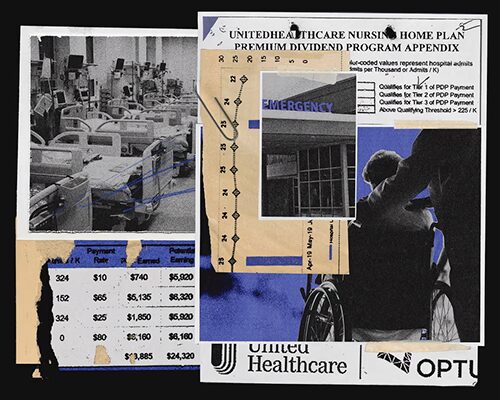
UnitedHealth Group, the nation’s largest healthcare conglomerate, has secretly paid nursing homes thousands in bonuses to help slash hospital transfers for ailing residents – part of a series of cost-cutting tactics that has saved the company millions, but at times risked residents’ health, a Guardian investigation has found.

UnitedHealth paid nursing homes

Those secret bonuses have been paid out as part of a UnitedHealth program that stations the company’s own medical teams in nursing homes and pushes them to cut care expenses for residents covered by the insurance giant.

In several cases identified by the Guardian, nursing home residents who needed immediate hospital care under the program failed to receive it, after interventions from UnitedHealth staffers. At least one lived with permanent brain damage following his delayed transfer, according to a confidential nursing home incident log, recordings and photo evidence.

“No one is truly investigating when a patient suffers harm. Absolutely no one,” said one current UnitedHealth nurse practitioner who recently filed a congressional complaint about the nursing home program. “These incidents are hidden, downplayed and minimized. The sense is: ‘Well, they’re medically frail, and no one lives for ever.’”

Confidential Investigation

The Guardian’s investigation is based on thousands of confidential corporate and patient records obtained through sources, public records requests and court files, interviews with more than 20 current and former UnitedHealth and nursing home employees, and two whistleblower declarations submitted to Congress this month through the non-profit legal group Whistleblower Aid.

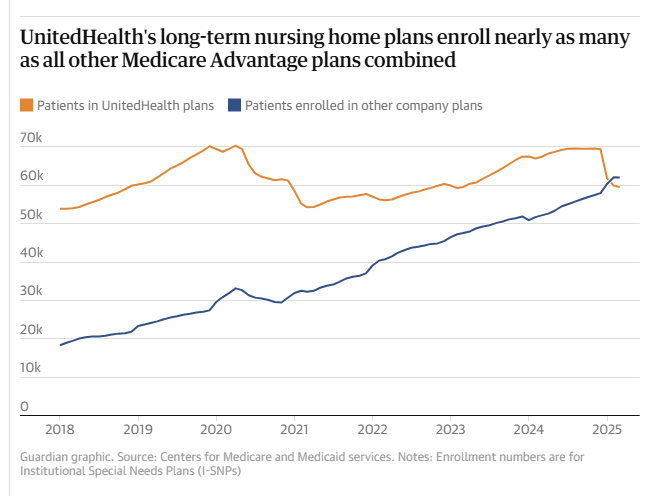
The documents and sources provide a never-before-seen window into the company’s successful effort to insert itself into the day-to-day operations of nearly 2,000 nursing homes in small towns and urban commercial strips across the nation – an approach which has helped UnitedHealth secure a vast stream of federal dollars from Medicare Advantage plans that cover more than 55,000 long-term nursing home residents.

UnitedHealth Responds

UnitedHealth said the suggestion that its employees have prevented hospital transfers “is verifiably false”. It said its bonus payments to nursing homes help prevent unnecessary hospitalizations that are costly and dangerous to patients and that its partnerships with nursing homes improve health outcomes.

Long-Term Profit

UnitedHealth Profit over Patients

Under Medicare Advantage, insurers collect lump sums from the federal government to cover seniors’ care. But the less insurers spend on care, the more they have for potential profit – an opportunity that UnitedHealth higher-ups have systematically sought to exploit when it comes to long-term nursing home residents.

To reduce residents’ hospital visits, UnitedHealth has offered nursing homes an array of financial sweeteners that sounded more like they came from stockbrokers than medical professionals.

Seven Years of Bribery and Threats

Over the past seven years, the company has shelled out “Premium Dividend” and “Shared Savings” payments that boosted nursing homes’ bottom lines. Through its “Quality and Shared Risk” program, UnitedHealth offered an even bigger cut to nursing homes that drove down medical spending, but threatened to claw back money from those that didn’t, according to former employees and internal corporate documents.

“You gain profitability by denying care, and when profitability suffers for the shareholders, that’s when people get crazy and do things that are not appropriate.”

Anonymous

Former National Executive, United Health

# # #

© 2025 This article is reprinted from The Guardian. The full article can be accessed here. For more information or for permission to reprint, please contact The Guardian directly.

Fraudsters Arrested, Oz Issues Warning

CMS

by Kristin Rowan, Editor

Fraudsters Arrested, Oz Issues Warning

Fraud in California

Fraudsters arrested in West Covina, CA this week were allegedly running a Medicare scheme. Authorities arrested hospice owner-operator Normita Sierra. They charged her with nine counts of health care fraud, one count of conspiracy, and four counts illegal remuneration (kick-backs) for health care referrals. The U.S. Attorney’s Office named co-conspirator Rowena Elegado. They also arrested her and charged her with one count of conspiracy and four counts of illegal remuneration for health care referrals.

Kickbacks

Sierra and Elegado worked together to pay marketers to recruit patients who did not have a hospice referral from their PCP and who were not terminally ill. Some of the kickbacks paid to marketers were as high as $1,300 per patient per month. After six months, the patients were referred out to Sierra’s home health company.

Medicare Claims

According to the U.S. Attorney’s Office, from 2018 to 2022, Sierra’s hospice agences submitted $4.8 million in fraudulent claims. Of those claims, Medicare paid approximately $3.8 million.

Dr. Oz Issues Warning

In a video statement, Dr. Oz explained how Medicare recipients are falling victim to scams. Sales people call, email, and even knock on your door, offering advice, free samples, and referrals. These marketers have one goal: get you sign a piece of paper. That paper signs you up for hospice care and agrees to allow a specific hospice agency to provide that care. The hospice agency then bills Medicare for services they never provide. Watch the video statement here.

HHS OIG Issues Consumer Alert

In a similar statement, HHS issued a consumer alert regarding DME companies. The alert warns that some DME companies are contacting Medicare beneficiaries. They claim to work for or on behalf of Medicare. Once they receive the patient’s Medicare number, they bill Medicare for unnecessary medical items. These items include urinary catheters, knee and back braces, orthotic braces, and prescription drugs, which may or may not ever be sent to the patient. HHS urges enrollees not to give their Medicare number to anyone. Further, they suggest regulary reviewing items charged to insurance, and refusing delivery of any medical supply not ordered by a physician.

Oz Issues Warning
Fraudsters Arrested

Combating Waste, Fraud, and Abuse

Dr. Oz and CMS have spoken numerous times about combatting the waste, fraud, and abuse withing the Medicare and Medicaid systems. Originally a strong proponent for Medicare Advantage, Oz has promised to audit MA after discovering the government pays more for MA than traditional Medicare. Oz also promised to reduce the amount of prior authorization requests needed before a patient gets services. Oz responded to the Republican-backed House bill requiring more oversight on Medicaid eligibility. Oz indicated that some Medicaid patients are enrolled in more than one state and that Medicaid is paying for able-bodied patients. The waste, fraud and abuse across Medicare and Medicaid is costing the government between $1 and $10 billion and Dr. Oz plans to find it and make significant changes to the management of the system.

A Cautionary Tale for Hospice Providers

You may be thinking, “What does this have to do with me?” Unfortunately, even the most scrupulous hospice agencies can fall prey to marketers running schemes. There are legitimate referral resources in the market who can help your agency get more referrals and more clients. There are also underhanded marketers who know how the system works. These predators will promise new referrals (for a fee) and then enroll uneligible patients without your knowledge. If you are working with or looking for a referral partner for your hospice agency, use one that is referred by someone you trust, and/or do a lot of research on the company history before working with anyone. Be especially wary of the ones who promise much more than what most referral companies offer.

# # #

Kristin Rowan, Editor

Kristin Rowan has been working at The Rowan Report since 2008. She is the owner and Editor-in-chief of The Rowan Report, the industry’s most trusted source for care at home news, and speaker on Artificial Intelligence and Lone Worker Safety and state and national conferences.

She also runs Girard Marketing Group, a multi-faceted boutique marketing firm specializing in content creation, social media management, and event marketing.  Connect with Kristin directly kristin@girardmarketinggroup.com or www.girardmarketinggroup.com

©2025 by The Rowan Report, Peoria, AZ. All rights reserved. This article originally appeared in The Rowan Report. One copy may be printed for personal use: further reproduction by permission only. editor@therowanreport.com


Delay HOPE Tool

Advocacy

by Kristin Rowan, Editor

Advocacy Groups to CMS:

Delay HOPE Tool Implementation

“Delay HOPE Tool Implementation,” say multiple hospice advocacy groups. LeadingAge, the National Alliance for Care at Home (The Alliance), and the National Partnership for Healthcare and Hospice Innovation (NPHI) are urging CMS to delay the transition from HIS to HOPE. The three groups sent a joint letter to Dr. Mehmet Oz, CMS Administrator, earlier this week.

“Our associations remain fully committed to the [Hospice Quality Reporting Program (HQRP)], including the payment penalties for non-compliance, and recognize the critical importance of accurate, timely data submission to inform the delivery of high-quality hospice care. However, we have serious concerns about the potential for successful implementation of the HOPE tool.”

LeadingAge, The Alliance, NPHI

Hospice Advocacy

The concerns over agency readiness to implement the new tool center on the new reporting platform. Hospice agencies state they don’t have all the necessary information to develop a workable tool for submission. Therefore, the agencies have asked CMS to delay the implementation of the HOPE tool. They have called on CMS to wait until six months after agencies have access to education, training, and final validation specifications.

Hospice Rule Penalty

The hospice program through CMS requires substantial reporting for payment. Hospices that do not submit the required 90% of records, they receive an annual payment penalty of 4%. Combined with lower than sustainable payment increases, the 4% penalty results in a lower reimbursement rate over prior years. The associations worry that the lack of information and education will lead to lower reporting. In turn, the lower reporting lowers reimbursement rates. For hospices that are already struggling to survive, the penalty is devastating. The letter to CMS asked to waive the timeliness requirement for two quarters after implementation.

HOPE Tool Lacks Validation

CMS will have a Validation Utility Tool that agencies will need to use in order to ensure their software can successfully submit their data. CMS has not released the tool and indicates they may not until sometime in September. The HOPE tool is scheduled for implementation in October. There is not enough time between release of the validity tool and implementation of the HOPE tool for proper testing.

Hospice Agencies Lack Validation

In addition to validating data submission, hospice agencies have to enroll in the new submission portal, iQUIES. Enrollment requires a privacy security official and other staff. Additionally, it requires an application to access the system, background checks, and other actions. Thus far, hospice agencies do not have access to begin this process and there is no indication of how long it will take. The associations are concerned that the process may also involve significant financial cost to hospice agencies.

Resources

CMS released the Hospice Outcomes and Patient Evaluation (HOPE) Guidance Manual v1.01, a 138 page PDF, available here. The manual includes links to other resources for hospice agencies. Namely, a webpage with information on HOPE Data Submission Specifications has a “final” version of data specs available for download. Additionally, there are links to the Main Page here and technical information and updates here. The document urges vendors to register to get updates and important announcements.

Final Thoughts

There is no information yet as to a response to the letter from CMS. Thus far, CMS is still planning on keeping the October 1, 2025 HOPE implementation date. We will continue to report on updates from CMS and the advocacy groups.

# # #

Kristin Rowan, Editor

Kristin Rowan has been working at The Rowan Report since 2008. She is the owner and Editor-in-chief of The Rowan Report, the industry’s most trusted source for care at home news, and speaker on Artificial Intelligence and Lone Worker Safety and state and national conferences.

She also runs Girard Marketing Group, a multi-faceted boutique marketing firm specializing in content creation, social media management, and event marketing.  Connect with Kristin directly kristin@girardmarketinggroup.com or www.girardmarketinggroup.com

©2025 by The Rowan Report, Peoria, AZ. All rights reserved. This article originally appeared in The Rowan Report. One copy may be printed for personal use: further reproduction by permission only. editor@therowanreport.com


Patient Data Access

Artificial Intelligence

by Kristin Rowan, Editor

Access to Patient Data

Tighter than Fort Knox

Access to patient data has always been tricky, even for the patient. Every doctor’s office, hospital, urgent care center, home health agency, and nursing facility uses their own system to house medical records. With concerns over HIPAA violations, that data is secured, sometimes in several ways simultaneously. A breach in that system could spell big trouble for the medical agency and the software company that provided it. Even in the age of electronic medical records, it is difficult to access those records without proof of identity, a signature in triplicate, and an oath punishable by death that you are allowed access to the information. (Okay, I may be exaggerating on that last one just a bit.)

3rd Party Access

Even more difficult than accessing patient data as the patient or the patient’s doctor or caregiver is accessing the data as a service provider:

  • Consultants who help agencies with operational efficiency, documentation, software implementation, etc.
  • QAPI advisors who help with reporting and training
  • Data analytics companies who interpret information and provide meaning behind numbers.

Who Owns the Data?

One of the big questions in these cases is who owns the data. Each party seems to claim some ownership. Medical agencies believe they own the data because the information doesn’t exist without inputing it during a patient visit. Electronic medical records claim ownership based on housing the information in the system they created, designed, and built. I, along with many others I assume, believe the data belongs to the patient. It is being used by the medical agency to perform services and housed by the software company much like a storage facility. But, the information should travel with the patient. 

It's a Bot!

Skilled nursing facilities and other providers often hire data analytics companies to help assess their business. One such company, Real Time, provides data analytics services using facility and patient data. Real Time accesses this data using log-in credentials provided by the facilities. Due to the volume of data and the time it takes to sift through a robust EHR system, Real Time uses bots to comb through the system and download the necessary information. 

Roadblock

This system works well for analytics companies and consultants to access more data quickly and provide faster, more thorough answers to their clients. The system doesn’t work well when the software housing the data enables CAPTCHA on its log-in page. CAPTCHA is specifically designed to keep bots out. In 2022, PointClickCare started using CAPTCHA on users they thought were bots. In 2023, PointClickCare used images so indecipherable that even humans couldn’t solve.

Request Denied

Real Time was losing access to its accounts. Agencies were losing the data analytics they contracted to receive. Real Time and PointClickCare entered discussion to provide access to the data. Real Time alleges that the solutions PointClickCare agreed to would only allow access to 30% of the data needed. Additional negotiations ended without an agreement. It seems PointClickCare ended the negotiations.

Fight for Your Right to...Data

In January of 2024, Real Time sued PointClickCare claiming unfair competition and tortious interference, among others. A district court issued an injunction to stop PointClickCare from using indecipherable CAPTCHA images and from deactivating Real Time’s accounts. PointClickCare appealed the decision to the Fourth Circuit.

Interpreting the Law

The Fourth Circuit upheld the district court ruling. The significance in the ruling is that the court interpreted some previously ambiguous language in the Cures Act exceptions to the information blocking rules. Specifically, the court interpreted the phrase “cannot reach agreeable terms” to mean that both parties attempt to reach an agreement in “good faith” using “reasonable” and “genuine” effort. The court also stated that the parties must have “articulable reasons why the parties cannot come to an agreement.” While this may seem like a minor ruling, the impact of the interpretation of the exceptions could reach much farther than this law suit.

I Object!

PointClickCare requested a rehearing after the Fourth Circuit decision. The American Hospital Assocition and Electronic Health Record Association filed briefs supporting PointClickCare in the lawsuit and in the petition for a rehearing. On April 23, 2025, The US Court of Appeals for the Fourth Circuit denied the petition for review. 

Paving the Way for Interoperability

The Fourth Circuit decision upholds the final rule from HHS implementing the Cures Act disincentives for information blocking. This decision and the denial of the petition for en banc review could have widespread implications. EHR companies must use the same access rules for every user. No more tricky images to stump consultants. No limiting access to 30% of the data.

The use of artificial intelligence-based software that can access EHR data without standard API connectivity could be the next step. Without needing permission to access and download data, switching software companies becomes easier. Sharing patient data with other medical providers is now a simple task. A patient could access their medical records with a single log-in.

Final Thoughts

I anticipate this will not be a decision that is accepted easily. I see more objections, lawsuits, and arguments from the AHA, the EHRA, and individual software providers and consultants. The decision has the potential to reach into other industries. AI will continue to evolve in ways we haven’t even anticipated. This certainly will not solve the issues of access to data or interoperability, but it’s a good first step.

Read the related articles on interoperability from Netsmart. Part 1 | Part 2

# # #

Kristin Rowan, Editor

Kristin Rowan has been working at The Rowan Report since 2008. She is the owner and Editor-in-chief of The Rowan Report, the industry’s most trusted source for care at home news, and speaker on Artificial Intelligence and Lone Worker Safety and state and national conferences.

She also runs Girard Marketing Group, a multi-faceted boutique marketing firm specializing in content creation, social media management, and event marketing.  Connect with Kristin directly kristin@girardmarketinggroup.com or www.girardmarketinggroup.com

©2025 by The Rowan Report, Peoria, AZ. All rights reserved. This article originally appeared in The Rowan Report. One copy may be printed for personal use: further reproduction by permission only. editor@therowanreport.com


Medicare Advantage Audits

CMS

by Kristin Rowan, Editor

CMS Strategy for Medicare Advantage Audits

Last week, The Centers for Medicare and Medicaid Services (CMS) rolled out a new, aggressive strategy to enhance and accelerate Medicare Advantage Audits under RADV. CMS will audit all eligible MA contracts in all newly initiated audits. The strategy will also invest additional resources to complete the audits for each payment year (PY) 2018 to 2024.

Falling Behind

CMS is several years behind in completing audits. In fact, the last payment year with any significant recovery was from PY 2007. Completed audits from 2011 to 2013 recovered 5%-8% in overpayments. Federal estimates put current overpayments at $17 billion annually. MedPAC‘s estimate is significantly higher at $43 billion annually.

“We are committed to crushing fraud, waste and abuse across all federal healthcare programs. While the Administration values the work that Medicare Advantage plans do, it is time CMS faithfully executes its duty to audit these plans and ensure they are billing the government accurately for the coverage they provide to Medicare patients.”

Dr. Mehmet Oz

Administrator, CMS

The Plan to Manage Medicare Advantage Audits

According to a press release from CMS, the plan is to complete all outstanding audits from PY 2018 to 2024 by early 2026. Here are key elements from the plan:

  • Enhanced Technology: CMS will deploy advanced systems to efficiently review medical records and flag unsupported diagnoses.
  • Workforce Expansion: CMS will increase its team of medical coders from 40 to approximately 2,000 by September 1, 2025. These coders will manually verify flagged diagnoses to ensure accuracy.
  • Increased Audit Volume: By leveraging technology, CMS will be able to increase its audits from ~60 MA plans a year to all eligible MA plans each year in all newly initiated audits (approximately 550 MA plans).  CMS will also be able to increase from auditing 35 records per health plan per year to between 35 and 200 records per health plan per year in all newly initiated audits based on the size of the health plan.  This will help ensure CMS’s audit findings are more reliable and can be appropriately extrapolated as allowed under the RADV final rule

CMS will also reportedly work with the Department of Health and Human Services Office of Inspector General (HHS-OIG) to recover uncollected payments identified in past audits. 

Impact of Medicare Advantage Audits on Providers

If CMS is able to audit as many plans and records as they are anticipating, Medicare Advantage payers could be looking at significant overpayments. CMS will aggressively seek repayment. When MA payers lose money, they tend to pass that loss on to providers and patients. We could see MA plans cutting benefits, denying procedures, and other cost-saving measures.

Providers who are aware of the unsupported diagnoses or who profited from them may be on the hook for overpayments. Law firm Ropes and Gray suggests that “[MA] plans should…minimize historical risk by correcting or deleting unsupported diagnoses for any time periods for which they are still able to do so.”

I suggest not using this particular law firm. I also suggest checking your payer contracts for clawback and indemnification clauses. When applicable, negotiate new and renewal contracts very carefully.

Medicare Advantage payers will push back on these audits, file lawsuits, and challenge how CMS is conducting audits. MA payers have historically denied treatments and medications that would be covered under traditional Medicare plans. They go to great lengths to avoid paying for services patients did receive. I’m certain they won’t be happy paying back money for services they never received.

CMS indicates it will start the new audit plan immediately. We will continue watching for updates through the end of the year to see if CMS reaches their goal. Of course, we will continue to report on changes at CMS and with Medicare Advantage payers as they happen.

# # #

Kristin Rowan, Editor

Kristin Rowan has been working at The Rowan Report since 2008. She is the owner and Editor-in-chief of The Rowan Report, the industry’s most trusted source for care at home news, and speaker on Artificial Intelligence and Lone Worker Safety and state and national conferences.

She also runs Girard Marketing Group, a multi-faceted boutique marketing firm specializing in content creation, social media management, and event marketing.  Connect with Kristin directly kristin@girardmarketinggroup.com or www.girardmarketinggroup.com

©2025 by The Rowan Report, Peoria, AZ. All rights reserved. This article originally appeared in The Rowan Report. One copy may be printed for personal use: further reproduction by permission only. editor@therowanreport.com


TEFCA and QHINs: Interoperability 2

Admin

by Ben Rosen, Sr. Client Success Manager, Netsmart

Interoperability

What you need to know and how it affects you Part 2

For over two decades, tech companies and government agencies have been moving toward the goal of interoperability in healthcare technology. At long last, standards and protocols are in place — and continually being improved — to support open data exchange networks. As a result, healthcare providers, including human services, post-acute providers, and specialty practices, have more opportunities to participate in alternative payment models and adapt more readily to the evolving payment landscape.

This is part two of a four-part series covering the forces that are driving interoperability, as well as the future vision of open networks, and what it all could mean to your organization. Read Part One Here.

Interoperability in Healthcare

The creation of TEFCA and QHINs

TEFCA (Trusted Exchange Framework and Common Agreement) is a national framework designed to enable seamless, secure sharing of health information across organizations. With respect to EHRs, this framework simplifies data exchange with other providers, payers and public health entities while enhancing compliance with interoperability requirements. TEFCA is touted as a nationwide federal and private data exchange network.

End goal

One of TEFCA’s main goals is to standardize data sharing, therefore reducing the complexity of managing multiple connections and enhancing the interoperability of your EHR with other systems nationwide.

TEFCA was created by the U.S. Department of Health and Human Services’ Assistant Secretary for Technology Policy (ASTP). The ASTP is contracting with the Recognized Coordinating Entity (RCE), The Sequoia Project. The RCE is tasked with governing and maintaining the operations of the entities who are electing to implement the TEFCA network, these entities are referred to as Qualified Health Information Networks (QHINs).

Interoperability
Interoperability TEFCA QHIN

QHINs

The certification process

QHINs are the entities that build the frameworks to allow data exchange as specified by TEFCA and facilitate the national exchange of health information. A single QHIN may represent dozens or even hundreds of healthcare providers, referred to as participants or sub-participants, across sectors (i.e., acute, human services, post-acute) public health agencies, health IT vendors and payers.

Applicants must build their TEFCA connection, which is then subjected to rigorous technology and security testing. QHIN applicants must also sign the Common Agreement that is countersigned by The Sequoia Project. These rigorous standards have a time limit: Each QHIN who applies must have their network built, tested and designated by the ASTP and RCE within 12 months of the application acceptance date. As of this writing there are eight designated QHINs and two candidate QHINs.

Benefits of participating in a QHIN

  • Streamlined Data Exchange
  • Compliance with Federal Interoperability Mandates
  • Access to Broader Patient Data
  • Improved Care Coordination

The market is already seeing regulatory rules and guidance tied directly to TEFCA. For instance, HTI 1 rule laid the groundwork for TEFCA and the HTI 2 rule is expanding on the process for designation, as well as codifying definitions and use cases to be exchanged via QHINs. Overwhelmingly, one of the biggest benefits to using a QHIN will be the increased types of data exchanged via the network.

The Same, but Different

Data exchange via TEFCA will look different than what we are used to with other nationwide networks today, such as Carequality, EHealthExchange or CommonWell. Via TEFCA, QHINs will exchange more robust types of data, referred to as Exchange Purposes, and will deal with higher volumes as a network. A few examples of these Exchange Purposes are clinical documentation (CCD-A), benefits determination data, public health research data, and even lab data, just to name a few.

Another benefit will be seamless connectivity. Other QHINs should integrate with EHRs to facilitate data exchange, acting as a hub that connects your system with other networks, providers and stakeholders.

Coming soon in Interoperability Part 3: Not all QHINs are created equal. How to choose the one that’s right for you.

# # #

Interoperability Ben Rosen Netsmart

Ben Rosen is a senior client success manager and business unit owner for the interoperability solution suite at Netsmart. With more than a decade of healthcare experience, Ben has led numerous initiatives to integrate healthcare systems and enhance data sharing across the care continuum. His dedication to advancing healthcare interoperability drives his active involvement in industry initiatives and standards organizations, where he provides insight for frameworks such as HL7 FHIR, USCDI and others. Ben holds a Bachelor of Science in kinesiology from Kansas State University and a Bachelor of Science in nursing degree from the University of Nebraska Medical Center.

©2025 by The Rowan Report, Peoria, AZ. All rights reserved. This article originally appeared in the Netsmart blog and is reprinted here with permission. For more information or to request permission to print, please contact Netsmart.

BREAKING NEWS: House Passes Bill

Breaking News

by Kristin Rowan, Editor

House Passes Bill

House passes bill in early-morning vote. The House of Representatives, predictably split along party lines, passed the “Big, Beautiful Bill” in a 215-214 narrow win. All but three Republican representatives cheered at its passing. Republicans who previously stated they would not vote for a higher deficit caved and voted along party lines. The House expects an uphill battling getting the bill passed through the Senate.

House Objections

All House Democrats and two House Republicans voted against the bill. One Republican voted “present.” Democrats were vocal in their opposition.

“Children will get hurt. Women will get hurt. Older Americans who rely on Medicaid for nursing home care and for home care will get hurt. People with disabilities who rely on Medicaid to survive will get hurt. Hospitals in your districts will close. Nursing homes will shut down. And people will die. That’s not hype. That’s not hyperbole. That’s not a hypothetical.”

Hakeem Jeffries

Representative, D-NY

Medicaid Changes

Work Requirement

One controversial change in Medicaid is the community engagement requirement for eligibility. Eligibility is at least one of the following:

  • Working at least 80 hours in a month
  • Completing at least 80 hours of community service
  • Participating in a work program for at least 80 hours
  • Enrolling at least part-time in an educational program
  • Any combination of the above totaling at least 80 hours
  • Having a monthly income greater than minimum wage for 80 hours per month

Exceptions

This rule applies to all eligible individuals at least 19 years old and is under 65 years old, is not pregnant, does not have children under age 7, and is not enrolled in or eligible for Social Security benefits. Mandatory exceptions to the community engagement requirement are:

  • Indian, Urban Indian, California Indian, or eligible as an Indian for the Indian Health Service
  • The parent, guardian, or caretaker of a disabled individual or dependent child
  • A veteran with a total disability rate
  • Medically frail or has special medical needs including those who:
    • are blind or disabled
    • have a substance use disorder
    • have a disabling mental disorder
    • live with a physical, intellectual, or developmental disorder that impairs 1 or more activities of daily living
    • live with a serious and complex medical condition
    • have any other medical condition approved, but not listed here
  • In compliance with requirements imposed by the State
  • The member of a household receiving SNAP benefits
  • Participating in a drug or alcohol rehabilitation program
  • An inmate of a public institution
  • Meet other criteria deemed appropriate

Senate Poised for a Fight

After the vote, the Senate made it clear that it will not send the bill to the President without “major changes.” The problem, however, is that different members of the Senate are calling for different changes. Some want even more spending reductions, others want to keep more of Biden’s green-energy incentives, and still others want to soften the Medicaid cuts. Here is some of the feedback from Senators:

Ron Johnson, Senator (R-Wis.) wants to take the bill “line by line” to find $6.5 trillion in cuts over 10 years.

Rand Paul, Senator (R-Ky.) supports the tax agenda, but not the debt ceiling hike.

Lisa Murkowski, Senator (R-Alaska) is expecting significant changes and wants to address the Medicaid cuts, call them “challenging.”

Patty Murray, Senator (D-WA) called the bill a “scam” and urged Republican senators to vote against it.

“House Republicans don’t want you to know they just passed a bill that makes health care MORE expensive and kicks MILLIONS off Medicaid, all to pass tax cuts for billionaires & giant corporations. We need to make sure America knows. And we need to kill this bill in the Senate.”

Patty Murray

Senator, D-WA

House Passes Bill to Senate

Because of the way the House presented the bill, designed to prevent a filibuster, there are constraints on what can be included.

First, everything included in the bill has to be about the budget. Challenges to parts of the bill and whether they are directly related to the budget go to the Senate parlimentarian. A non-partisan advisor, the parlimentarian advises the Senate if a provision is challenged. Elizabeth MacDonough is the current Senate parlimentarian and has served under Senate Majority Leaders from both parties.

Second, the Senate gets to make its own changes to the bill. If the House does not accept those changes, the debt ceiling will not go up. An impasse means the government defaults on its debt. Congress has to raise the debt ceiling by the summer to avoid default. This could put pressure on the House to accept whatever changes the Senate makes.

More to Come

This is an ongoing story and The Rowan Report will continue to provide updates as they become available. Read our accompanying article this week on organizations and courts attempting to stop Trump’s sweeping changes.

# # #

Kristin Rowan, Editor

Kristin Rowan has been working at The Rowan Report since 2008. She is the owner and Editor-in-chief of The Rowan Report, the industry’s most trusted source for care at home news, and speaker on Artificial Intelligence and Lone Worker Safety and state and national conferences.

She also runs Girard Marketing Group, a multi-faceted boutique marketing firm specializing in content creation, social media management, and event marketing.  Connect with Kristin directly kristin@girardmarketinggroup.com or www.girardmarketinggroup.com

©2025 by The Rowan Report, Peoria, AZ. All rights reserved. This article originally appeared in The Rowan Report. One copy may be printed for personal use: further reproduction by permission only. editor@therowanreport.com


Pushback on Trump Initiatives

Regulatory

by Kristin Rowan, Editor

Pushback on Trump Initiatives From All Sides

Pushback on Trump initiatives, including the steep cuts to Medicare, Medicaid, Social Security, and VA benefits erupted this week. Coalitions, associations, and members of Congress seek to stop the cuts before the new bill is passed. The Republican-backed bill, under direction from President Trump, called the “Big, Beautiful Bill” would cut federal spending by billions of dollars over ten years. Pushback on Trump’s executive orders is also making headway, with temporary and preliminary injunctions.

Protect Our Healthcare Coalition

Protect Our Healthcare Coalition is a group of consumer and non-profit organizations in Rhode Island. This week, they joined with Medicaid members and Senators Reed and Whitehouse to speak out against the Medicaid cuts in the bill. The coalition also released a report on the impact of Medicaid services in the state.

“Republicans…want to whack Medicaid so fewer people have coverage and costs go up. These cuts will do real harm, pushing seniors out of nursing homes, increasing hospital closures, and denying families access to preventative care. If you think the emergency room is crowded now, just wait until Trump’s Medicaid cuts happen.”

Jack Reed

Senator, (D) Rhode Island

Protecting Retirement and Health Benefits

Congresswoman Mikie Sherrill (NJ-11) introduced the Protecting Retirement and Health Benefits for Working Families Act. The bill is in response to the recent federal program and job cuts. The legislation requires that before any cuts are made to jobs or programs that the administration can prove those cuts won’t harm to benefits and those who rely on them. It also requires a study within one year of any mass layoffs or closures to ensure no harm was done.

Federal Judge Blocks...

DoE Layoffs

More than 1,300 employees of the Department of Education received notice of termination in March from then-Secretary of Education Linda McMahon. The layoffs reduced the staff by nearly half. McMahon initially said they were part of the plan to reorganize and streamline the department for efficiency and accountability. Trump later revealed the layoffs to be the first step in dismantling the Department of Education altogether. District Judge Myong Joun, a Biden appointee, said, “The record abundantly reveals that defendants’ true intention is to effectively dismantle the department without an authorizing statute.” Judge Joun issued an injunction blocking the mass layoff.

Sweeping Agency Changes

In February, the Trump administration issued an executive order, followed by a number of memos, instructing multiple federal agencies to cut staff. The executive order called for the immediate dismissal of temporary and reemployed annuitant staff members. Specifically, it called out those performing functions not mandated by statute or other law, not designated as essential, or is not suited to federal service due to failure to comply with federal employment requirements. The order also reduced hiring ratios to 1:4, permitting agencies not under a hiring freeze to hire one person for every four that leave.

U.S. District Judge Susan Illston, in San Francisco, as part of a lawsuit filed by labor unions, nonprofits, and local governments, issued a temporary block on the overhaul. The lawsuit alleges that Trump needs authorization from Congress to restructure the federal government. Judge Illston says the office of the president can seek changes to agencies, but only through Congress. Illston also issued a temporary restraining order barring agencies from any further implementation of the executive order. This includes the final dismissal of employees who have received layoff notices that have not yet been executed. The temporary restraining order expires May 23, 2025. Additionally, Illston ordered the administration to submit restructuring plans to the court.

Revoking Student Status

The administration attempted end the legal status of international students. This would effectively nullify their right to stay in the United States. Some individual students challenged the action successfully. On May 22, 2025, a federal judge in California blocked the action. He prohibited the administration from arresting or detaining foreign-born students on the basis of their immigration status. The administration insists the immigration status was only revoked for students who had criminal charges.

Pushback on Trump Initiatives is Ongoing

Along with the passing of the “Big, Beautiful Bill,” these issues are ongoing and The Rowan Report will provide updates as they become available.

# # #

Kristin Rowan, Editor

Kristin Rowan has been working at The Rowan Report since 2008. She is the owner and Editor-in-chief of The Rowan Report, the industry’s most trusted source for care at home news, and speaker on Artificial Intelligence and Lone Worker Safety and state and national conferences.

She also runs Girard Marketing Group, a multi-faceted boutique marketing firm specializing in content creation, social media management, and event marketing.  Connect with Kristin directly kristin@girardmarketinggroup.com or www.girardmarketinggroup.com

©2025 by The Rowan Report, Peoria, AZ. All rights reserved. This article originally appeared in The Rowan Report. One copy may be printed for personal use: further reproduction by permission only. editor@therowanreport.com


Shoot the Messenger

Admin

by Elizabeth E. Hogue, Esq.

Shoot the Messenger at Your Own Risk

Shoot the messenger of fraud and abuse at your peril. Providers must take seriously the concerns of employees about possible fraudulent and abusive practices. Most whistleblowers take their concerns to their employers first, especially if they are required to do so by employers’ Compliance Plans. When employers ignore their concerns or, even worse, retaliate against employees or contractors for raising issues in the first place, employees may turn to outside enforcers for assistance in addressing their concerns. Providers must take employees’ allegations seriously whether or not they are valid. Thorough investigations are required in order to demonstrate to employees that there is no problem or that the problem has been corrected.

Shoot the Messenger

Qui Tam

Private citizens may initiate so-called “whistleblower” or qui tam lawsuits to enforce prohibitions against fraud and abuse in the Medicare, Medicaid, and Medicaid Waiver Programs and other state and federal health care programs, such as VA and Tri-Care. 

False Claims Act

One of the federal statutes that allows for whistleblower actions is the False Claims Act (FCA). This Act generally prohibits providers from “knowingly” presenting or causing to be presented false or fraudulent claims for payment by the government. Whistleblowers continue to be a major source of information for government enforcers.

Whistleblower Requirements

In order to bring a qui tam action under the FCA, private parties must have direct and independent knowledge of fraud by providers against whom suits are filed. Thus, current or former employees who are familiar with providers’ practices may often initiate whistleblower actions under the FCA. As you can imagine, employees and contractors who are ignored or retaliated against when they bring possible violations to the attention of employers or partners by firing them, for example, are likely to initiate whistleblower suits.  

Here is an example:

In United States ex rel. Chorches v. American Medical Response [No. 15-3920 (2d Cir. July 27, 2017)], Paul Fabula worked as an emergency medical technician (EMT) for American Medical Response. Fabula realized that his employer fraudulently sought reimbursement from the Medicare Program by falsely claiming that ambulance services were medically necessary when they were not. Specifically, EMTs were asked to falsify electronic Patient Care Reports (PCRs) to make it appear that services were medically necessary. Supervisors printed copies of PCRs, revised them, and directed staff members to sign the revised forms.

In one instance, Fabula provided services with another staff member who prepared the PCR. A supervisor instructed the staff member to fraudulently revise the form. When the staff member refused, the supervisor directed Fabula to sign the revised form. When Fabula refused, he was fired.

Don't Shoot the Messenger

What did Fabula do? Why, of course, he filed a whistleblower suit! The message from this case and numerous others is clear: don’t shoot the proverbial messenger who brings information about possible fraud and abuse violations. Listen up!

# # #

Elizabeth E. Hogue, Esq.

Elizabeth Hogue is an attorney in private practice with extensive experience in health care. She represents clients across the U.S., including professional associations, managed care providers, hospitals, long-term care facilities, home health agencies, durable medical equipment companies, and hospices.

©2025 Elizabeth E. Hogue, Esq. All rights reserved.

No portion of this material may be reproduced in any form without the advance written permission of the author.

©2025 by The Rowan Report, Peoria, AZ. All rights reserved. This article originally appeared in The Rowan Report. One copy may be printed for personal use: further reproduction by permission only. editor@therowanreport.com

Interoperability

Clinical

by Ben Rosen, Sr. Client Success Manager, Netsmart

Interoperability

What you need to know and how it affects you

For over two decades, tech companies and government agencies have been moving toward the goal of interoperability in healthcare technology. At long last, standards and protocols are in place — and continually being improved — to support open data exchange networks. As a result, healthcare providers, including human services, post-acute providers, and specialty practices, have more opportunities to participate in alternative payment models and adapt more readily to the evolving payment landscape.

Interoperability in Healthcare

What's driving the need for change?

Government regulatory agencies, together with payers and healthcare organizations, have long recognized the need to improve care coordination among healthcare providers. Making it easier to share information via a nationwide data sharing network is a critical component of this effort.

End Game

The ultimate goal of providing access to complete, accurate patient information is to help drive down costs to providers and electronic health record (EHR) users. Through exhaustive work and years of innovation, we’re seeing the tangible outcome of this effort. Information now flows seamlessly across multiple healthcare networks. Using a concise view of the data, we can focus on broader population health initiatives that improve outcomes for chronic conditions, reduce emergency department (ED) visits, and prevent hospitalizations. The interoperability market is moving ahead at blazing speeds. Therefore, we must understand the players who are the driving forces behind the movement.

Interoperability

The Interoperability Highway

Who are the players and how do they work together?

Healthcare technology is complex. It’s not surprising, then, that getting the disparate systems to share information seamlessly and securely is a complicated process. In the last decade an increasing number of vendors, organizations, and healthcare players started working together to advance a useful interoperability market.

Some of the larger players in this space include government and regulatory agencies. To understand the role these entities play and how they coordinate with other organizations and efforts, let’s compare the process to building a national highway system.

Building an open data exchange network

  • Assistant Secretary for Technology Policy and Office of the National Coordinator for Health (ASTP/ONC): This federal agency sets the vision, rules and regulations for health information technology policy. Compare it to the Federal Highway Administration (FHWA), the federal agency that provides stewardship over the construction, maintenance, and preservation for all interstate highways.
  • Trusted Exchange Framework and Common Agreement (TEFCA): Established by the ASTP/ONC, TEFCA sets the rules for health data exchange over the network. This is similar to plans or blueprints for highway construction. This would also include engineering, construction and safety standards for the highway.
  • The Sequoia Project (RCE): The Sequoia Project is the Recognized Co-ordinating Entity (RCE) for TEFCA and is appointed by the ASTP/ONC. The Sequoia Project is a non-profit, public-private collaborative that leads the implementation project for nationwide data exchange. They approve and help regulate the TEFCA exchange, via QHINs. The Sequoia Project can be compared to a construction manager that approves contractors and oversees quality control measures to ensure standards are met.
  • Qualified Health Information Networks (QHIN)s: QHINs are data sharing networks built to operate the exchange network as outlined by TEFCA. In our analogy, QHINs are the highways, and the companies that build QHINs can be compared to the construction companies that physically build and maintain the roadways themselves.

Now that you’re familiar with the entities involved in developing the standards for interoperability and building the data exchange networks that make it a reality, we will next look at how these enhanced capabilities can impact your organization.

This is part one of a four-part series covering the forces that are driving interoperability, as well as the future vision of open networks, and what it all could mean to your organization. Check back for part 2, “How TEFCA affects your technology and what the heck is a QHIN?” coming soon.

# # #

Interoperability Ben Rosen Netsmart

Ben Rosen is a senior client success manager and business unit owner for the interoperability solution suite at Netsmart. With more than a decade of healthcare experience, Ben has led numerous initiatives to integrate healthcare systems and enhance data sharing across the care continuum. His dedication to advancing healthcare interoperability drives his active involvement in industry initiatives and standards organizations, where he provides insight for frameworks such as HL7 FHIR, USCDI and others. Ben holds a Bachelor of Science in kinesiology from Kansas State University and a Bachelor of Science in nursing degree from the University of Nebraska Medical Center.

©2025 by The Rowan Report, Peoria, AZ. All rights reserved. This article originally appeared in the Netsmart blog and is reprinted here with permission. For more information or to request permission to print, please contact Netsmart.

DOJ Rejects Plan

M&A

by Kristin Rowan, Editor

DOJ Rejects Plan to Divest Assets

DOJ rejects plans to divest assets from UnitedHealth and Amedisys to BrightSpring Health Services and the Pennant Group. Last week, we reported that Amedisys and UnitedHealth had entered an agreement to divest certain home health and hospice agencies to satisfy anti-trust concerns. The plan is contingent on the finalization of the merger between UnitedHealth and Amedisys.

Divesting Assets

The merger between UnitedHealth and Amedisys has been ongoing since last summer. Shortly after the announcement, the Department of Justice sued under anti-trust allegations to stop the merger. According to the DOJ, even if the companies offload the 120 planned locations, it would not safeguard competition in home health and hospice markets. The DOJ cited overlap in certain markets where UnitedHealth and Amedisys both currently have agencies.

This could spell T-R-O-U-B-L-E

Following the lawsuit, Amedisys and UnitedHealth started talks with VitalCaring to divest properties. That deal fell through after VitalCaring lost its own lawsuit last year. This latest blow could stall the merger altogether. The DOJ reportedly rejected the divestiture stating that it wasn’t enough. Unless Amedisys and UnitedHealth divest more properties in certain markets, the DOJ is unlikely to approve the merger. 

Mediation

The parties are scheduled to enter mediation on August 18th. The judge has now scheduled a follow-up mediation appointment on August 25th, anticipating that one day of mediation will not resolve the lawsuit. Amedisys and UnitedHealth have 90 days to secure additional divestiture that will satisfy the DOJ before mediation begins. 

DOJ Rejects Plan

This is an ongoing story and The Rowan Report will continue to bring you the latest news on the merger. Please see our accompanying articles this week on the new UnitedHealth CEO and the new DOJ investigation on UnitedHealth Group.

# # #

Kristin Rowan, Editor

Kristin Rowan has been working at The Rowan Report since 2008. She is the owner and Editor-in-chief of The Rowan Report, the industry’s most trusted source for care at home news, and speaker on Artificial Intelligence and Lone Worker Safety and state and national conferences.

She also runs Girard Marketing Group, a multi-faceted boutique marketing firm specializing in content creation, social media management, and event marketing.  Connect with Kristin directly kristin@girardmarketinggroup.com or www.girardmarketinggroup.com

©2025 by The Rowan Report, Peoria, AZ. All rights reserved. This article originally appeared in The Rowan Report. One copy may be printed for personal use: further reproduction by permission only. editor@therowanreport.com


Update is Not an Increase

Hospice

by Kristin Rowan, Editor

Updates to Hospice Rule

On April 11, 2025, the Centers for Medicare and Medicaid Services (CMS) issued their proposed rule for hospice rates, Conditions of Participation (CoPs) and face-t0-face encounter requirements for FY 2026. The proposed rule also includes a change in regulatory text for the Hospice Quality Reporting Program.

Following Executive Order 14192, an attempt to reduce the expense attached to following Federal regulations, CMS is seeking feedback on streamlining regulations and reducing expenses. The RFI to submit responses can be found here.

Payment Updates

The proposed update to the hospice payment rate yields a net increase of 2.4 percent. This change includes a 3.2 percent market basket increase based on the estimate cost increase for inpatient hospitalization. The 0.8 percent productivity adjustment offsets the market basket increase. The quality data penalty of 4 percent remains in place.

Market Basket Objections

Not for the first time, commentors on CMS proposed rules objected to the use of the hospital wage index in determining hospice pay rates. According to a report from the Federal Register, a few commenters on the FY 2025 payment update opposed using the IPPS wage index to determine the hospice wage index. According to the commenters, the hospital wage index uses cost report wage data that excludes hospice wage costs. The exclusion of hospice costs skews the accuracy of wage adjustments for hospice providers.

In response to the same proposed rule, MedPAC recommended that wage index policies be repealed and replaced by new Medicare wage index systems that use all-employer, occupation-level wage data; account for wage differences across geographical areas, and match wages in adjacent local areas. 

CMS Ignores Objections

Despite years of comments, objections, and suggestions to update the hospice wage index calculations using more accurate data, CMS continues to insist that using the pre-floor and pre-reclassified hospital wage index is the more appropriate for determining hospice payment rates. CMS states that this position is “longstanding and consistent with other Medicare payment systems.”

Productivity Adjustment

The productivity adjustment started with the Affordable Care Act. It’s stated purpose is to “reduce Medicare spending by recognizing that hospitals can improve their efficiency and productivity.” Average efficiency and productivity gains in all private non-farming businesses form the productivity adjustment.

The most recent document from CMS about the productivity adjustment comes from 2022, using data from 2019. The report shows that hospital growth falls far below the average growth of private non-farming businesses. Using two different methods of calculations, hospital growth falls between 0.2 and 0.3 percent. Non-farming business growth is 0.8 percent. 

Labor Productivity

CMS uses labor productivity as its measure for the productivity adjustment for Medicare hospitals and hospices. The estimate for labor productivity across all private non-farming businesses is 2.0 percent. The calculation for hospital labor productivity is 0.8 percent. This is the number used in this year’s productivity adjustment. Actual labor productivity growth in hospitals from 1993 to 2018 was 0.4 percent.

Quality Reporting Reduction

Hospices that do not submit the required quality data incur a payment reduction of 4 percent. This yields a 1.6 percent decrease over last year’s rates after factoring in the 2.4 percent increase. Quality data reporting includes the HIS tool, administrative data, and CAHPS hospice survey. The threshold to avoid the 4 percent reduction includes submitting at least 90 percent of HIS records within 30 days of an event date and ongoing monthly participation in CAHPS surveys.  The HOPE reporting tool replaces the HIS system beginning October 1, 2025. These requirements are not changing with the FY 2026 proposed rule, with the exception of the change from the HIS tool to the HOPE tool.

Comment from The Alliance

In last week’s newsletter, we summarized Dr. Steven Landers’s keynote address from the New England Home Care & Hospice Conference and Expo. Always passionate about care at home, and particularly about hospice, which he describes as “a national treasure,” Dr. Landers strongly stated that an “update is not an increase” when it doesn’t keep up with inflation and pay increases. 

Final Thoughts

Every year, CMS, MedPAC, and HHS make changes to hospice and home health payment rates based on faulty information that doesn’t account for the nature of the work or the person-centered requirements of the industry. Non-farming industries can increase efficiency and productivity in myriad ways that cut staff. We see it in grocery stores with the increasing number of self-checkout lines. We see it in restaurants with QR code menus, ordering kiosks, and payment kiosks. There is no substitute for one-on-one contact in a home setting for care at home, particularly in hospice. Nurses can’t take on enough more patients in a day to make a meaningful impact on efficiency and productivity without sacrificing quality of care.

AI for Efficiency and Productivity

I’ve been speaking for some time now on the advantages of using augmented and generative intelligence in care at home. As long as CMS continues to lower reimbursement rates using the collective productivity rates of impertinent industries, care at home has to embrace the technology that increases productivity and efficiency in the office and in the field. Talk to text, documentation, scheduling, onboarding, and data analytics are readily available through AI platforms and drastically reduce costs across departments.

You can read about some of the AI tools here. For more information or to engage our consulting services for AI adoption, contact me directly.

# # #

Kristin Rowan, Editor

Kristin Rowan has been working at The Rowan Report since 2008. She is the owner and Editor-in-chief of The Rowan Report, the industry’s most trusted source for care at home news, and speaker on Artificial Intelligence and Lone Worker Safety and state and national conferences.

She also runs Girard Marketing Group, a multi-faceted boutique marketing firm specializing in content creation, social media management, and event marketing.  Connect with Kristin directly kristin@girardmarketinggroup.com or www.girardmarketinggroup.com

©2025 by The Rowan Report, Peoria, AZ. All rights reserved. This article originally appeared in The Rowan Report. One copy may be printed for personal use: further reproduction by permission only. editor@therowanreport.com