CMS Ransomware Attack: Breach of PII

Admin

by Kristin Rowan, Editor

CMS Ransomware Attack

In mid-2023, a planned file transfer went awry when Clop claimed to have breached hundreds of companies that they later listed on a data leak site. Among the companies listed were Shell, UnitedHealthcare Student Resources, The University of Georgia, and Putnam Investments. Also compromised were government entities including the U.S. Department of Energy. According to Clop, data from military sources, children’s hospitals, and other .gov sites was also copied. The ransomware group alleges they deleted all information from government, military, and children’s hospital sites.

Unfortunately, there is no way to confirm whether all that information was indeed deleted. Earlier this year, Change Healthcare suffered a similar widespread breach that caused massive payment delays for months. CMS provided guidance during those delays. 

Underreporting of Attack

Many of the companies impacted by this attack chose to disclose the breach rather than negotiate with the ransomware attackers to retrieve the stolen data. When Bleeping Computer reached out to those companies immediately following the attacks, a number of them indicated that only a small number of people were effected and that no financial or identifiable information had been stolen. It seems, now, though that not all companies involved in the attack were on the initial list.

Wisconsin Physicians Service (WPS) health insurance corporation was among the companies not listed when news of this attack was first published. WPS provides Medicare administrative services to CMS, including handling Medicare Part A/B claims. In the first week of September, nearly 3-1/2 months after the attack, CMS and WPS started notifying beneficiaries whose protected health information (PHI) or other personally identifiable information (PII) may have been stolen during the attack.

1,000,000 Notifications

On July 28, 2023, CMS estimated 612,000 Medicare beneficiaries may have had PHI and/or PII exposed in the breach. That number has increased to almost 1 million. CMS and WPS are sending notifications to more than 950,000 people whose information has been compromised. The letter explains further:

May 31, 2023, MOVEit disclosed the breach to the public and released a patch.

June 2, 2023, WPS notified CMS of a data breach that occurred sometime between May 27 and May 31, 2023.

According to WPS, they applied the patch but did not observe any evidence of any files having been copied.

July 28, 2023 CMS sends an initial letter to beneficiaries whose information may have been affected.

May 2024, WPS acted on new information that led them to discover copied files from before the patch was deployed.

Of the portion of breached files that WPS studied, none were found to have personal information.

June 8, 2024, a different portion of the files showed personal information was contained in those files. This information includes:

  • Name
  • Social Security Number or Individual Taxpayer Identification Number
  • Date of Birth
  • Mailing Address
  • Gender
  • Hospital Account Number
  • Dates of Service
  • Medicare Beneficiary Identifier (MBI) and/or Health Insurance Claim Number

CMS Clop Ransomware Attack

Note: in the initial letter sent to beneficiaries in July of 2023, CMS also listed Healthcare Provider, Prescription Information, Insurance Claims, Policy Information, Subscriber Information, Health Benefits, and Enrollment Information as possibly having been leaked. These items were removed from the list in the September 2024 version of the same letter.

For those who received this notification, CMS and WPS offered a complimentary year of credit monitoring from Experian. CMS also advised members to request their free credit report from each of the credit reporting companies.

The letter also informed members that they would soon receive a new Medicare card with a new Medicare Number. 946,801 people received this notice.

CMS Ransomware Attack Victims Not Notified

On September 24, 2024, Bleeping Computer reported that on the same day CMS sent more than 900,000 letters to members, they also reported to the Department of Health and Human Services that the total number of people with information stolen was 3,112,815. CMS explains the difference by saying the larger number includes Medicare beneficiaries, people who are deceased, and people who were covered by other providers but whose information was included in WPS data collection used for provider audits in their role as Medicare Administrative Contractors (MACs).

New MBIs and What it Means For You

According to a blog post dated September 26, 2024 from SimiTree, starting in mid-October, CMS will issue new Medicare cards with new Medicare Beneficiary Identifiers to the 946,801 Medicare beneficiaries who were previously identified as at risk and were notified of the breach. This may cause undue delays and other issues for home health and hospice providers.

Claim Rejection

If these beneficiaries use their existing MBI after the new one has been issued, providers could see rejections on NOAs, NOEs, OASIS submissions, and claims.

Urgent Reverification

Providers will need to reverify eligibility and update patient records in their EMR systems. Because providers were not notified of which beneficiaries were impacted, agencies will need to verify MBIs for every Medicare patient.

Possible Disruption

The full impact of reassigning MBIs to nearly 1 million Medicare beneficiaries is not yet known. Medicare has not clarified what will happen with claim processing for patients whose MBIs change during the claim processing for active patients. There are possibilities for delayed processing, delayed payments, and incorrect denial of services or payments due to the volume of MBIs changing at once.

How to Prepare

Our friends at SimiTree have some suggestions for how home health and hospice providers can prepare in advance for the MBI change coming around October 15-16, 2024.

  • Take Immediate Action – start reverifying eligibility for all Medicare patients now
  • Update Systems – ensure your EMR and other solutions in your tech stack are updated and ready to handle the changes
  • Train your Staff – make sure everyone on your team knows this change is coming and teach them new verification procedures so their patients aren’t left without care

CMS has not issued a statement about the impact of the MBI changes, but this story is ongoing and we will continue to monitor and report on any updates from WPS and CMS as well as look for additional information on the changes expected with the new MBIs.

# # #

Kristin Rowan, Editor

Kristin Rowan has been working at Healthcare at Home: The Rowan Report since 2008. She has a master’s degree in business administration and marketing and runs Girard Marketing Group, a multi-faceted boutique marketing firm specializing in event planning, sales, and marketing strategy. She has recently taken on the role of Editor of The Rowan Report and will add her voice to current Home Care topics as well as marketing tips for home care agencies. Connect with Kristin directly kristin@girardmarketinggroup.com or www.girardmarketinggroup.com

©2024 by The Rowan Report, Peoria, AZ. All rights reserved. This article originally appeared in Healthcare at Home: The Rowan Report. One copy may be printed for personal use: further reproduction by permission only. editor@therowanreport.com


BREAKING NEWS: Blumenauer Proposes Hospice Overhaul

Breaking News

FOR IMMEDIATE RELEASE

Contact:      Portland District Office
503-231-2300

blumenauer proposes overhaul to hospice benefit

If enacted, the legislation would be the single most significant update to the hospice benefit and payment structure since its inception in 1982

WASHINGTON, D.C., SEPTEMBER 26, 2024 – Today, Congressman Earl Blumenauer (D-OR), a senior member of the Ways and Means Committee, introduced the Hospice Care Accountability, Reform and Enforcement Act (Hospice CARE Act) to modernize Medicare’s hospice benefit, which has remained largely unchanged since its inception in 1982. The proposal comes as egregious reports of fraud and abuse within the benefit persist, despite action from Centers for Medicare & Medicaid Services (CMS). The legislation is the product of years of collaboration between stakeholders, lawmakers, and industry leaders. It builds on Blumenauer’s decades-long commitment to ensure the federal government supports families at a time of great stress and vulnerability: the end of life. 

“The United States spends significantly more on health care than other developed nations for worse outcomes. Nowhere is this more egregious than in the hospice industry,” said Congressman Earl Blumenauer. “Patients and families deserve better. We need a reset. It is past time for Congress to act to end the fraud, waste, and abuse within the hospice benefit and bring it into the 21st century.”

To protect patients and taxpayers, the Hospice CARE Act would institute a number of long overdue reforms to crackdown on fraud while incentivizing high-quality care. Critically, it would:

    • Reform the payment structure: The underlying hospice per-diem payment structure—which generally pays hospices for each day of care regardless of if care is provided on a given day—rewards bad actors who exploit the benefit for financial gain. The legislation revises the payment structure to ensure that providers are incentivized to deliver high-quality care and meet the current needs of individuals and their families.
    • Bolster program integrity: Additional safeguards and oversight is needed to prevent fraudulent providers from enrolling in Medicare, especially for new hospices. That includes temporarily preventing new hospices from enrolling in Medicare, with exceptions where additional access to care is needed, increasing survey frequency, and increasing ownership transparency

A one-page fact sheet can be found here. Bill text here

“The hospice benefit, while unique, is ripe for change. This legislation is a first-of-its-kind opportunity to improve it,” said Katie Smith Sloan, president and CEO, LeadingAge, the association of nonprofit providers of aging services, including hospice, on the Hospice Care Accountability, Reform and Enforcement (CARE) Act of 2024. “Revising a benefit that has not been altered significantly since its creation in 1982 is a formidable undertaking – but a necessary one. Done right, changes will expand the benefit to support the realities of modern-day hospice care and address vulnerabilities that are currently being exploited.  There is more work to do and we look forward to continuing our productive partnership to ensure this bill achieves these goals.” 

 “The National Partnership for Healthcare and Hospice Innovation (NPHI) is thankful for the work of Congressman Blumenauer, his staff, and the Ways and Means Committee staff who worked with the hospice and advanced illness community to put forward the Hospice Care Accountability, Reform, and Enforcement (CARE) Act. This legislation is an encouraging and unique opportunity to consider reforms that would strengthen the Medicare hospice benefit by ensuring it continues to support patients, families, and the non-profit providers who were the original foundation of hospice care,” said Tom Koutsoumpas, CEO and founder of NPHI. “We look forward to continuing to work closely with Congress and relevant stakeholders on efforts to modernize the hospice benefit and improve care of those at the end-of-life.

“The Coalition to Transform Advanced Care (C-TAC), truly appreciates the introduction of the Hospice Care Accountability, Reform, and Enforcement (Hospice CARE) Act. We commend Representative Earl Blumenauer (D-OR-3rd) for this important work and for his decades of support for compassionate end-of-life care and for bringing policies to the national stage with bi-partisan support,” stated Jon Broyles, C-TAC CEO.  “We have had the privilege to work with the Congressman, his staff, Ways & Means Committee staff and other advocates on this bill and it is an important starting point for ideas that will lead to modernizing the hospice program and improving the lives of people with serious illness and their family caregivers.”

# # #

This press release was issued by the office of U.S. Congressman Earl Blumenauer, representing the 3rd district of Oregon. The original press release can be found here. The Rowan Report has reached out to The Alliance for Care at Home for comment.

Home Health in a Post-Chevron World

Admin

by Elizabeth E. Hogue, Esq.

The "Wicked Witch" Chevron is Gone

On June 28, 2024, the U.S. Supreme Court overturned a decision of the Court in 1984 often referred to as “Chevron.” The Chevron case said that Courts must defer to administrative actions that are reasonable interpretations of ambiguous statutory language.

 In Loper Bright Enterprises v. Raimondo, however, the U.S. Supreme Court abandoned the decision in Chevron and said that:

    • The “deference that Chevron requires of courts reviewing agency action cannot be squared with” the Administrative Procedure Act (APA). The APA “specified that courts, not agencies, will decide ‘all relevant questions of law’ arising on review of agency action…even those involving ambiguous laws – and set aside any such action inconsistent with the law as they interpret it.” 
    • The framers of the U.S. Constitution envisioned that the final “interpretation of the laws” would be “the proper and peculiar province of the courts.” 
    • The views of the executive branch should inform the judgment of the judiciary, not supersede it. 
    • “Chevron’s presumption is misguided because agencies have no special competence in resolving statutory ambiguities. Courts do.”

What Does it Mean for Providers?

The short answer is that we don’t know yet. It is unclear how the new standards of the Loper Bright decision will be applied and affect health care providers. The Supreme Court said that the recent Court decision does not call past cases into question that were based on Chevron, but existing regulations are not insulated from challenges. It is likely that several providers will “swing for the fences” for favorable rulings based on Loper Bright!

One possible “candidate” for disruption is the reliance of administrative law judges (ALJs) on Chapter 8 of the Medicare Program Integrity Manual. This section offers an overview of use of inferential statistics and statistical sampling to estimate overpayments in Medicare audits. Chapter 8 of the Manual is only nine pages long. ALJs routinely use this section of the Manual to hamper providers’ ability to mount a compelling defense that challenges auditors’ methods using widely accepted standards within the statistical community. Challenges to this practice based on Loper Bright may prevent ALJs from reliance on these sections of the Manual.

Chevron Deference Gone

Another possible target is the use of sub-statutory and even sub-regulatory guidance from the Centers for Medicare and Medicaid Services (CMS) and the Medicare Administrative Contractors (MACs) by fraud and abuse enforcers to make determinations about illegal conduct, especially under the False Claims Act (FCA). Defendants arguably now have a better chance to challenge the basis of claims of illegal conduct in light of Loper Bright. 

The story of Loper Bright has not been written by any means. Surely providers should use this significant change in the law to their benefit whenever possible.

# # #

Elizabeth E. Hogue, Esq.

Elizabeth Hogue is an attorney in private practice with extensive experience in health care. She represents clients across the U.S., including professional associations, managed care providers, hospitals, long-term care facilities, home health agencies, durable medical equipment companies, and hospices.

©2024 by The Rowan Report, Peoria, AZ. All rights reserved. This article originally appeared in Healthcare at Home: The Rowan Report. One copy may be printed for personal use: further reproduction by permission only. editor@therowanreport.com

©2024 Elizabeth E. Hogue, Esq. All rights reserved.

No portion of this material may be reproduced in any form without the advance written permission of the author.

What are You Hiding?

Admin

by Elizabeth E. Hogue, Esq.

Bring on the Fraud Enforcers

We Have Nothing to Hide!

Oh, but you do! Statements like this from providers are cringe-worthy. If you have said it before, please don’t ever say it again.

Here’s why:

Fraud Enforcement

First, many providers think that when fraud enforcers are required to show intent they must show that providers sat down at their desks on a Friday afternoon, for example, and decided to engage in fraud. On the contrary, enforcers can demonstrate intent by showing that there was fraudulent conduct that providers knew about or should have known about. This is a game changer! It’s not hard to imagine fraudulent conduct that providers should have known about, but have not identified and corrected.

In addition, George Will points out in his Washington Post column, “Have you committed a felony yet? Probably so.” that the volume of legal requirements has skyrocketed. Here is what Mr. Will says:

“Less than a century ago, …a single volume contained all federal statutes. By 2018, they filled 54 volumes – about 60,000 pages. In the past 10 years, Congress has enacted about 2 million to 3 million words of law each year. The average length of a bill is nine times what it was in the 1950s. Agencies publish their proposals and final rules in the Federal Register, which began at 16 pages in 1936, and now expands by an average of more than 70,000 pages annually. By 2021, the Code of Federal Regulations filled about 200 volumes. And in a recent 10-year span, federal agencies churned out approximately 13,000 guidance documents.”

Mr. Will goes on to point out that ignorance of the law is, therefore, inevitable. Congress has added an average of 56 new federal crimes each year so that there are not more than 5,000 federal statutory crimes. In addition, at least 300,000 regulations of federal agencies include criminal sanctions.

 Here are some common examples:

Fraud Enforcement George Will
    • If you are a discharge planner/case manager in a hospital or skilled nursing facility you may not know about guidance from the Office of Inspector General of the U.S. Department of Health and Human Services that says you can’t accept gift cards from post-acute providers that want referrals.
    • If you are a home care/private duty provider and accept payments from the Medicaid Program, you may have repeatedly violated technical requirements, such as recording the time caregivers arrive and leave patients’ homes.
    • If you provide home health services and use the services of consulting physicians as Medical Directors, chances are very good that fraud enforcers will demonstrate that you violated at least one of a multitude of requirements that govern these relationships.
    • Finally, hospice providers know all too well that enforcers are going to claim that their patients are not terminally ill.

Mr. Will says in his column that James Madison predicted our current situation in which laws are “so voluminous that they cannot be read, or so incoherent that they cannot be understood” and “undergo such incessant changes that no man, who knows what the law is today, can guess what it will be tomorrow.” 

So, don’t even think that you have nothing to hide, much less say it!


# # #

Elizabeth E. Hogue, Esq.

Elizabeth Hogue is an attorney in private practice with extensive experience in health care. She represents clients across the U.S., including professional associations, managed care providers, hospitals, long-term care facilities, home health agencies, durable medical equipment companies, and hospices.

©2024 by The Rowan Report, Peoria, AZ. All rights reserved. This article originally appeared in Healthcare at Home: The Rowan Report. One copy may be printed for personal use: further reproduction by permission only. editor@therowanreport.com

©2024 Elizabeth E. Hogue, Esq. All rights reserved.

No portion of this material may be reproduced in any form without the advance written permission of the author.

Another One Bites the Dust

CMS

by Kristin Rowan, Editor

Essentia Drops Medicare Advantage

Essentia Health is an integrated health system with locations in Minnesota, North Dakota and Wisconsin. The health system offers 285 different services across more than 1,700 locations. They employ more than 2,700 doctors. Essentia also includes 14 hospitals, emergency care, same-day care for mental health crises, and multiple specialties.

This is all to say that Essentia Health is not a small player. They contract with the largest payers in the industry.

Re-Evaluation

Recently, the health system began re-evaluating its participation in some Medicare Advantage plans. According to the chief medical officer for population health at Essentia, Cathy Cantor, M.D., M.B.A., too often deny or delay care. Cantor said in a statement:

“This was not a decision we made lightly. The frequent denials and associated delays negatively impact our ability to provide the timely and appropriate care our patients deserve. This is the right thing to do for the people we are honored to serve.”

Essentia informed patients that they will no longer be an in-network provider for MA plans through UnitedHealthcare (UHC) or Humana beginning January 1, 2025. The health system claims that UHC and Humana delay and deny approval of care at more than twice the rate of other Medicare Advantage plans.  They are encouraging its patients to choose a different plan during open enrollment that is in-network with Essentia.

UHC Responds

UnitedHealthcare responded to the press release that Essentia issued. According to their statement, the two parties extended their contract just this past July. Negotiations included a number of items on which they agreed to collaborate, but Medicare Advantage was not specified among them.

“Essentia Health didn’t raise concerns regarding its participation in our Medicare Advantage network until last week. We have since met with Essentia on Sept. 9 and are committed to working with the health system to explore solutions with the goal of renewing our relationship. We hope Essentia shares our commitment toward reaching an agreement.”

Essentia Drops Medicare Advantage

Following Suit

Essentia’s departure from Medicare Advantage is just one in a recent mass exodus.

Sanford Health of South Dakota ended its Humana MA participation due to “ongoing challenges and concerns that negatively effect patients including ongoing denials of coverage and delays in accessing care.”

HealthPartners out of Minnesota announced over the summer that “UnitedHealthcare delays and denies approval of payment for MA claims at an exceptionally high rate…up to 10 times higher than other insurers….  After over a year of being unable to persuade UnitedHealthcare to change their practices, we’ve determined that we can no longer participate in the UnitedHealthcare Medicare Advantage network.”

Mercy, the official medical provider of the St. Louis Cardinals, announced its year-end departure from the Anthem Blue Cross Blue Shield network. This includes all Medicare Advantage, ACA marketplace, and managed Medicaid plans. They cited administrative tasks that create a barrier to timely, appropriate patient care. Mercy also complained that Anthem has raised its rates for patients and employers, increased its profits, and still has not raised reimbursement rates to providers. Like Essentia, Mercy is encouraging its patients to consider whether the health care plan they choose during open enrollment will list Mercy as one of its in-network providers.

Final Thoughts

CMS reimbursement rates, Medicare Advantage denials, payment delays, and other interruptions are impeding patient care. As Tim mentions in his editorial this week, we are in an election year and we urge you to research how each party might impact our industry.

If more providers and payors continue to drop Medicare Advantage from their offerings, will we see more patients returning to traditional Medicare plans with an affordable Medicare Supplement or MediGap coverage? One can only hope!

# # #

Kristin Rowan, Editor

Kristin Rowan has been working at Healthcare at Home: The Rowan Report since 2008. She has a master’s degree in business administration and marketing and runs Girard Marketing Group, a multi-faceted boutique marketing firm specializing in event planning, sales, and marketing strategy. She has recently taken on the role of Editor of The Rowan Report and will add her voice to current Home Care topics as well as marketing tips for home care agencies. Connect with Kristin directly kristin@girardmarketinggroup.com or www.girardmarketinggroup.com

©2024 by The Rowan Report, Peoria, AZ. All rights reserved. This article originally appeared in Healthcare at Home: The Rowan Report. One copy may be printed for personal use: further reproduction by permission only. editor@therowanreport.com

NonCompete Agreements and What to do About Them

Admin

by Elizabeth E. Hogue, Esq.

What to do About Noncompete Agreements

The Federal Trade Commission (FTC) published a final rule earlier this year that banned noncompete agreements. The final rule was effective on September 4, 2024.

 Requirements of the rule included:

    • A ban on new concompete agreements with all workers, including senior executives
    • Existing noncompete agreements could remain in force for senior executives if
      • they make more than $151,164 per year including salary, commissions, and performance bonuses but not including benefits, board and lodging; and
      • senior executives have authority to make policy decisions for the entire company
    • Existing noncompete agreements with workers other than senior executives are unenforceable after the rule is effective

There are a number of exceptions to the rule.

In the meanwhile, litigation

On July 23, 2024, a federal court in Pennsylvania refused to issue a preliminary injunction to prevent implementation of the final FTC rule. The U.S. District Court for the Eastern District of Pennsylvania said that the statutory authority of the FTC to prevent unfair methods of competition under Section 5 of the FTC Act is not limited to procedural rules for adjudications and extends to substantive rulemaking [See ATS Tree Servs. v. Fed. Trade Comm’n, No. 24-1743 (E.D. Pa. July 23, 2024)].

Noncompete Agreements

But...

In early July, a federal court in Texas granted a preliminary injunction that delayed the effective date of the final rule. The Court declined to issue a nationwide injunction [See Ryan LLC v. Federal Trade Comm’n, No. 3:24-CV-00986-E (N.D. Tex. July 3, 2024)]. 

Then, on August 20, 2024, the Judge issued an order in the Ryan case that included a nationwide prohibition on implementation of the FTC rule. The basis of this decision is that the FTC does not have authority to order a ban, and that the rule was arbitrary and capricious. Based on this ruling, employers may continue to enter into and enforce non-compete agreements with workers.


Another but...

A number of state legislatures have enacted restrictions on use of noncompete agreements. As of August 21, 2024, four states ban the use of noncompete agreements and thirty-three states plus the District of Columbia restrict the use of these agreements. 

Providers must comply with applicable requirements in the states in which they conduct business. Providers who fail to do so risk enforcement action.  

Comfort Keepers, for example, agreed to pay $500,000 to resolve claims that it unfairly restricted workers’ mobility according to the California Department of Justice. Comfort Keepers’ Client Care Agreement that clients were required to sign before receiving care prevented clients from using, hiring, or soliciting current and former Comfort Keepers’ caregivers for up to one year after the termination of services. Violations required payment of $12,500.

So...

The current bottom line is that the FTC rule banning noncompete agreements is not in effect, but providers must comply with applicable state requirements or risk enforcement action.

Stay tuned for more!

# # #

Elizabeth E. Hogue, Esq.

Elizabeth Hogue is an attorney in private practice with extensive experience in health care. She represents clients across the U.S., including professional associations, managed care providers, hospitals, long-term care facilities, home health agencies, durable medical equipment companies, and hospices.

©2024 by The Rowan Report, Peoria, AZ. All rights reserved. This article originally appeared in Healthcare at Home: The Rowan Report. One copy may be printed for personal use: further reproduction by permission only. editor@therowanreport.com

©2024 Elizabeth E. Hogue, Esq. All rights reserved.

No portion of this material may be reproduced in any form without the advance written permission of the author.

Hospice Fraud Oversight

Admin

by Kristin Rowan, Editor

CMS Oversight in Fraud-Ridden States

In 2023, The Centers for Medicare and Medicaid Services (CMS) cited research suggesting that hospices profit from fraud far too often. CMS has identified cases of hospices certifying benficiaries who are not terminally ill, providing little to no services, and still billing CMS. Four states have had rapid growth in fraudulent hospices: Arizona, California, Nevada, and Texas.

Churn-and-Burn

Some of the registered hospices had non-operational addresses. This information led to an investigation that resulted in evidence of the fraud dubbed “Churn and Burn.” This scheme involves registering a new hospice and billing for services until there is an audit or the agency maxes out on yearly payments. Then, the hospice closes, keeps the money, registers for a new Medicare billing number, and starts all over again.

Program Integrity Strategy

As a result of  the findings of this research, CMS put more effort behing the hospice program integrity strategy to find and address fraudulent activity. Part of the strategy was unannounced visits to hospices nationwide. Hospices not active at listed addresses were deactivated and Medicare billing privileges were revoked. Of the more than 7,000 hospices visited, 400 had potential administrative action pending.

Enhanced Oversight

In the four states identified as having higher instances of fraud, CMS implemented a provisional period of enhanced oversight. During the provisional period, CMS conducted a medical review prior to payment for hospices in these states that have identified problems.

Nationwide Pilot Project

In addition to the provisional period for the four identified states, CMS started a pilot project to review hospice claims after a patient’s intitial 90 days of hospice care. This pilot project was not limited to the four states, but was implemented nationwide. CMS launched the program to help inform medical reviews in determining whether hospices are submitting claims for eligible patients.

Regulatory Changes

CMS also proposed some regulatory changes to combat hospice fraud. Some of these regulatory changes were initially suggested by hospice providers. The proposals include:

Hospice Fraud
    • Prohibiting the transfer of Medicare billing privileges of a new hospice for 36 months
    • Clarifying the definition of “Managing Employee” to include the administrator and medical director of a hospice
    • Implementing a Special Focus Program to increase oversight on poor-performing hospices that have ongoing health and safety deficiencies
    • Adding criminal background checks for owners when they initially enroll for Medicare billing privileges.

Prepayment Review Expanded

CMS has just announced that they will expand the prepayment review process in the four states beginning in September, 2024. Information from CMS is limited and states that prepayment review volume will start low to protect compliant hospices, but will increase if a hospice is found to be non-compliant. Consequences for non-compliance includes delays in payment, extended review, or additional administrative actions.

According to preliminary information we received from a hospice consultant, the expanded program puts all new hospices or hospices with ownership changes into prepayment review even if they have not had identified problems. 

We have reached out to both CMS and some of our expert hospice consultants to get more information and will update this story as information becomes available.

# # #

Kristin Rowan, Editor

Kristin Rowan has been working at Healthcare at Home: The Rowan Report since 2008. She has a master’s degree in business administration and marketing and runs Girard Marketing Group, a multi-faceted boutique marketing firm specializing in event planning, sales, and marketing strategy. She has recently taken on the role of Editor of The Rowan Report and will add her voice to current Home Care topics as well as marketing tips for home care agencies. Connect with Kristin directly kristin@girardmarketinggroup.com or www.girardmarketinggroup.com

©2024 by The Rowan Report, Peoria, AZ. All rights reserved. This article originally appeared in Healthcare at Home: The Rowan Report. One copy may be printed for personal use: further reproduction by permission only. editor@therowanreport.com

NHPCO and NAHC Announce New Name and Website

Advocacy

by Kristin Rowan, Editor

The Alliance

Since the announcement that the National Hospice and Palliative Care Organization and the National Association for Home Care and Hospice would merge, the default name for the combined entities has been “The Alliance.” NAHC President Bill Dombi and Interim NHPCO CEO Ben Marcantonio, along with a transition board and other members have been working since August of 2023 on the merger. In June of 2024, the two organizations signed an official affiliation agreement.

Alliance Updates

In the last year, the two organizations have spoken about the work they’ve been doing to create the new affiliation. They jointly hosted a town hall to answer questions, and Bill Dombi has spoken at state and national association meetings about the merger. On August 26, 2024, The Alliance named its inaugural CEO, Dr. Steven Landers.

National Association for Care at Home (NACH)

Our industry loves its acronyms and this one rolls off the tongue like we’ve been using it for years. Although, we may all need to perfect the German guttural sound to differentiate it from NAHC.

In a press release on Sept. 5, 2024, the two associations officially announced that The National Alliance for Care at Home (NACH) is the new name of the combined organizations. Along with this announcement, The Alliance has also launched its new logo (below) and new website at www.AllianceForCareAtHome.org.

From The Alliance

Statements from both organizations outline the path forward and the mission and vision for the new affiliation:

    • The National Alliance for Care at Home will Combine the Strengths of the Two Largest National Organizations Representing Healthcare Providers Delivering Care Primarily in Homes
    • The Alliance Will Provide Unparalleled Resources and Representation to Support the Care-at-Home Community
    • This Alliance will be the leading authority on transforming care in the home. We will implement that mission under a new name that welcomes providers across the care continuum to join – the National Alliance for Care at Home
    • The Alliance will be your advocate, your resource, and your network to help you reach your goals

The new logo for NACH is, according to the press release, both an homage to the past and a symbol for the future. It creates a visual representation of both NAHC and NHPCO. The star shape of the logo is representative of the stars on the American flag, part of the NAHC logo. The visual aesthetic of the logo is reminiscent of the lotus flower from the NHPCO logo. The individual sections of the logo represent people holding hands, the visual representation of the coming together of types of care. The white space in the middle is meant to symbolize a house or home.

The logo is based on guidance from a workgroup comprised of members from both organizations, whose input has helped shape the Alliance brand.

The National Alliance for Care at Home

About Us

This press release also included a new boilerplate, describing the National Association for Care at Home, rather than two separate descriptions of each organization. This is probably still a temporary description, as it mentions that they are still in the process of combining operations and Communications Officers from both separate organizations are listed as press contacts. 

More to Come

Despite the announcement of the new CEO and the new name, the merger is far from over. There are logistical and operational hurdles still to overcome, a new board to enstate, the combining of assets and competencies, and a restructuring of existing employees. We will continue to report on press releases coming from NACH.

# # #

Kristin Rowan, Editor

Kristin Rowan has been working at Healthcare at Home: The Rowan Report since 2008. She has a master’s degree in business administration and marketing and runs Girard Marketing Group, a multi-faceted boutique marketing firm specializing in event planning, sales, and marketing strategy. She has recently taken on the role of Editor of The Rowan Report and will add her voice to current Home Care topics as well as marketing tips for home care agencies. Connect with Kristin directly kristin@girardmarketinggroup.com or www.girardmarketinggroup.com

©2024 by The Rowan Report, Peoria, AZ. All rights reserved. This article originally appeared in Healthcare at Home: The Rowan Report. One copy may be printed for personal use: further reproduction by permission only. editor@therowanreport.com

HHA to pay Nearly $4 Million after False Claims Act Violations

Regulatory

by Kristin Rowan, Editor

False Claims Act Violations

According to allegations in U.S. es rel. Jones v Intrepid U.S.A. Healthcare Inc. and U.S. es rel. Rigney v Intrepid U.S.A. Inc., Intrepid U.S.A. Inc. (Intrepid) violated the False Claims Act multiple times over five years.

Intrepid is based in Texas and includes more than 80 Personal Care, Home Health, Palliative Care, and Hospice Care agencies across 18 states. Intrepid describes their services as “concierge medical home healthcare, hospice at home, private duty home care, and independent living support.”

Whistleblowers

Whistleblowers filed Civil cases against Intrepid under the whistleblower provisions of the False Claims Act. A former travel nurse and a former Director of Quality and Improvement for Intrepid filed the first case. A former Director of Clinical Excellence and Integrity and a former Regional Manager of Clinical Excellence for Intrepid filed the second. Under the False Claims Act, a private party can file an action against a company on behalf of the United States. Should there be a settlement or resolution, the filing party(ies) receive a portion of any recovery.

Allegations

Each of the cases addresses different lines of business for Intrepid. The first case alleges that Intrepid knowingly submitted home healthcare Medicare claims for patients who did not qualify for the home healthcare benefit, or where services did not qualify for reimbursement. The second case alleges that Intrepid knowlingly submitted Medicare claims for patience who did not qualify for the hospice benefit.

More Allegations

Additionally, the United States claims that from 2016 to 2021, Intrepid submitted claims for services that were not reasonable or medically necessary, services provided by untrained staff, and services that were never provided at all. Separately, the United States alleges that Intrepid admitted patients who were ineligible for hospice benefits because they were not terminally ill and continued providing services to patients who should have been discharged because they no longer met the requirements to qualify for the hospice benefits.

Settlement

The Justice Department’s Civil Division, Commercial Litigation Branch, Fraud Section, the U.S. Attorney’s Office for the Western District of Kentucky and U.S. Attorney’s Office for the District of Minnesota worked together to investigate and resolve these matters. According to the Department of Justice report, no liability or admission of guilt was determined and the settlement resolved allegations only.

Repeat Offender

It seems this is not the first run-in with the law that Intrepid U.S.A. has faced.

2014: a class action suit alleged unpaid wages.

2019: Intrepid settled a class action suit where employees alleged unpaid overtime.

2021: William Buchanan filed a civil right – employment discrimination suit against Intrepid in Indiana.

Intrepid in Minnesota and North Carolina faced similar Medicare fraud charges as well.

Intrepid USA False Claims Act

Not Alone

Intrepid U.S.A. Inc. is not the only home health or hospice agency to face these types of allegations.

Evolution Health LLC

In July, 2024, Guardian Health Care, Inc., Gem City Home Care LLC, and Care Connection of Cincinnati LLC, together with their parent company Evolution Health LLC, settled a False Claims Act case in which the Companies were accused of providing illegal kickbacks to ALFs and physicians in exchange for referrals. That settlement totaled almost $4.5 million dollars.

Halo Home Healthcare

Similarly, in June, 2024, the former owner of Halo Home Healthcare pled guilty to billing more than $8.5 million in fraudulent claims to Medicare, Medicaid, and Veterans Affairs from 2015 to 2021. Halo Home Healthcare hired more than 50 employees with criminal backgrounds that should have excluded them from providing home health services, one of whom was charged with a quadruple murder during their employment at Halo. The former owner also hid her ownership of the company because she had been convicted in 2013 of passing forged and fraudulent prescriptions for oxycodone and hydrocodone.

Atlantic Home Health Care

In January, 2024, Atlantic Home Health Care was accused of falsely billing the Energy Employees Occupational Illness Compensation Program. The claim alleges Atlantic charged for in-home nursing and personal care when employees weren’t providing services and paying kickbacks for patient referrals. The Arizona-based company paid almost $10 million to resolve that case.

Speak Up, Speak Out

Fraudulent billing, up-coding, and other illegal acts from home health and hospice agencies put additional strain on the already stretched CMS budget for reimbursement. The millions of dollars recovered just this calendar year is just a portion of fraudulent claims filed. Whistleblower laws protect employees from retaliation by their employers. Fraudulent practices that send money directly to an agency without benefitting a patient hurts the whole industry. The only way the Department of Justice can address and stop these billing practices and keep that money going directly to patient care is with the help of whistleblowers.

# # #

Kristin Rowan, Editor

Kristin Rowan has been working at Healthcare at Home: The Rowan Report since 2008. She has a master’s degree in business administration and marketing and runs Girard Marketing Group, a multi-faceted boutique marketing firm specializing in event planning, sales, and marketing strategy. She has recently taken on the role of Editor of The Rowan Report and will add her voice to current Home Care topics as well as marketing tips for home care agencies. Connect with Kristin directly kristin@girardmarketinggroup.com or www.girardmarketinggroup.com

©2024 by The Rowan Report, Peoria, AZ. All rights reserved. This article originally appeared in Healthcare at Home: The Rowan Report. One copy may be printed for personal use: further reproduction by permission only. editor@therowanreport.com

HHVBP Model Payments Begin January 1, 2025

Admin

by Kristin Rowan, Editor

Background on the HHVBP Model

The Home Health Value Based Purchasing (HHVBP) Model, implemented by CMS in 2016, began in nine states. The goal is “to provide incentives for better quality care, to study new quality and efficiency measures, and to enhance the reporting process.” It may also provide new avenues for payment models.

According to the CMS website, the original HHVBP Model, launched in nine states, improved an average of 4.6 percent HHA performance scores and saved Medicare $141 million. Additionally, the model lowered unplanned hospitalizations for acute care and reduced skilled nursing facility (SNF) stays.

HHVBP Model Expansion

From the initial study, CMS surmised that expanding the model would increase performance, increase savings, and further reduce hospitalizations and SNF stays. Early in 2021, CMS announced the nationwide expansion of the HHVBP Model.

The expanded model started on January 1, 2022. In its first expansion year, CMS provided training and allowed HHAs time to adjust practices based on HHVBP expectations and requirements. During the transition year, HHA performance did not risk future payment rates.

HHVBP Model Performance Year

January 1, 2023 marked the beginning of the performance year, in which all HHA results would impact future payments. CMS will adjust fee-for-service payments based on performance relative to other HHAs. CMS groups HHAs into cohorts determined by beneficiary count the previous year. Cohorts include large- and small-volume for agencies above and below 60 unique HHCAHPS eligible beneficiaries, respectively.

Using data already reported by HHAs through the Home Health Quality Reporting Program (HH QRP) and HHCAHPS surveys, CMS compares an HHAs data to similar agencies. Based on this comparison, CMS adjusts future payments between -5% and 5% for fee-for-service payments.

Interim Performance Report

The Interim Performance Report (IPR) is a quarterly report with performance data for all HHAs participating in the HHVBP Model. Active HHAs that were Medicare certified before January 1, 2022, are eligible for payment adjustment, and meet the minimum threshold of data for at least one quality measure receive the reports. Reports are available at iQIES. Registration on the portal is required.

CMS publishes new reports every quarter and eligible HHAs should receive an email when a new report is available. 

Points System

Payment adjustments for the next calendar year are based on an HHAs performance in the last report. For CY 2025, payment adjustments will use the Final Annual Performance Report, published 30 days prior to each payment year.

The process to determine your HHAs ranking in relations to the other HHAs in your cohort can be confusing and has many steps. Payment adjustments are based on “Care Points”, which are calculated on a weighted scale, using the higher of the agency’s earned achievement points or improvement points. An HHA must have at least 20 quality stays for claims-based measures and at least 40 surveys for the HHCAHPS survey-based measure.

Achievement Points

Achievement points are earned by scoring above the median performance on each quality measure (better than half of the agencies in your cohort) and dividing that by the difference between your score and the top 10 percent in your cohort.

HHVBP Model Calculate Achievement Points
Improvement Points

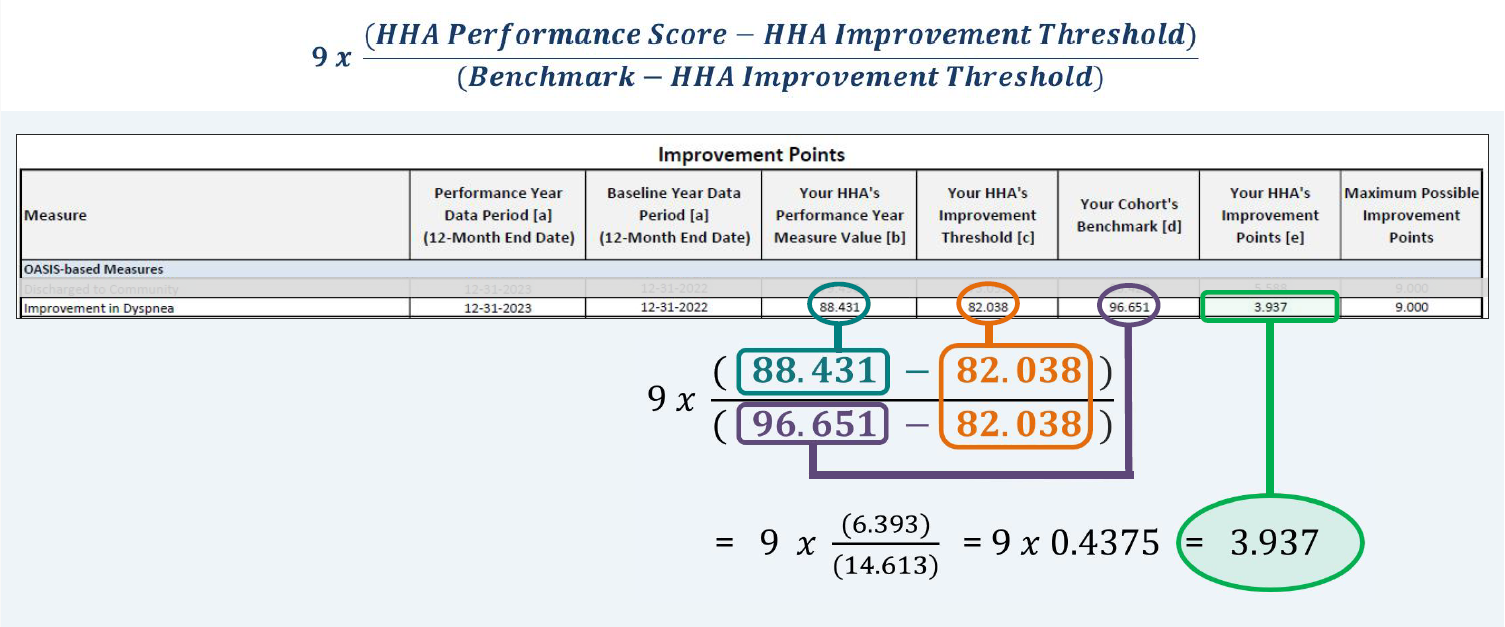
Improvement points are calculated using an HHAs prior year performance measure, current measure and the mean score of the top 10 percent of agencies in your cohort.

HHVBP Model Calculate Improvement Points
Care Points

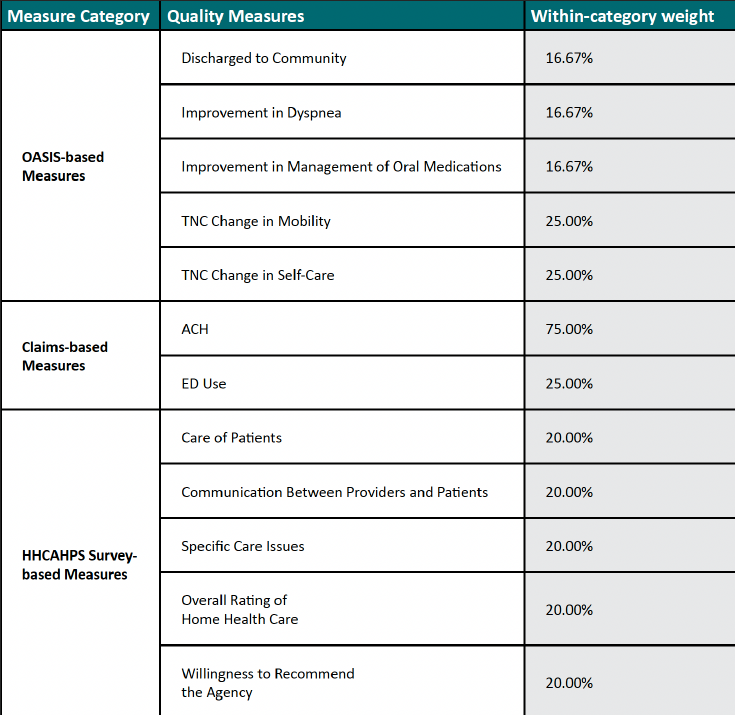
Care points are the higher of Achievement Points or Improvement Points for each quality measure. Each quality measure is weighted differently in each category of OASIS-based Measures, Claims-based Measures, and Survey-based Measures.

The higher of each agency’s achievement and improvement scores is multiplied by its assigned weight to calculate the weighted score within each measure. Each measure then has its own weight. OASIS- and Claims-based measures each count for 35% of the total score while Survey-based measures make up 30% of the final score.

The HHA score is measured against all HHAs in the cohort to determine your rank. Where your weighted points fall in comparison with the rest of your cohort determines whether your next payment cycle will go up or down by as much as 5 percent. 

HHVBP Model Weighted Scores

Public Reporting

Your scores will not only be used to determine your payment increase or decrease. These reports will be made public as well. CMS will publicly report each quality measure’s benchmark and achievement threshold. For every HHA that qualifies for a payment adjustment, CMS will also publish:

      • Measure results and improvement thresholds
      • Total Performance Score and Percentile Ranking
      • Payment adjustment percentage

Scoring well on the Achievement and Improvement markers for each measure may offer an HHA an opportunity to gain more referrals, recruit talented clinicians, and gain a reputation for quality care.

On the other hand, scoring low may hurt an agency irreparably. HHAs who think there is an error in the initial reporting can submit a recalculation request within 15 days of the publishing of a preview report. Based on CMS’s decision, HHAs have 15 days to submit a reconsideration request if they submitted a recalculation request and are not happy with the decision. If the HHA is still not in agreement with the decision of the reconsideration request, they have seven days to submit a request for administrative review.

Next Steps

According to the information we can find on CMS, these reports will be published quarterly. Logically, then, the recalculation requests can also be submitted quarterly along with reconsideration and administrative review requests. We will continue to follow this and provide updated deadlines to submit requests as we find them.

# # #

Kristin Rowan, Editor

Kristin Rowan has been working at Healthcare at Home: The Rowan Report since 2008. She has a master’s degree in business administration and marketing and runs Girard Marketing Group, a multi-faceted boutique marketing firm specializing in event planning, sales, and marketing strategy. She has recently taken on the role of Editor of The Rowan Report and will add her voice to current Home Care topics as well as marketing tips for home care agencies. Connect with Kristin directly kristin@girardmarketinggroup.com or www.girardmarketinggroup.com

©2024 by The Rowan Report, Peoria, AZ. All rights reserved. This article originally appeared in Healthcare at Home: The Rowan Report. One copy may be printed for personal use: further reproduction by permission only. editor@therowanreport.com

Medicare Advantage Predatory Marketing

CMS

by Kristin Rowan, Editor

Leading Associations Attempt to Curb Medicare Advantage Marketing Practices that Prey on the Unsuspecting

For some time now, we’ve been reporting on the marketing practices that Medicare Advantage uses to lure new members. And, it’s working, as more than 50% of eligible patients are now on Medicare Advantage plans. From federal lawsuits to fraud, to upcoding, Medicare Advantage has made headlines more often than almost any other topic in the industry in the last few years. A joint move last week by two national associations may bring the issue to a head once and for all.

The National PACE Association (NPA) and LeadingAge wrote to the Centers for Medicare and Medicaid Services (CMS) urging them to employ stricter oversight on Medicare Advantage marketing practices. The letter, dated July 25, 2024, cited the impact of these marketing tactics on adults served by Programs for All-Inclusive Care for the Elderly (PACE). They called the marketing “aggressive and misleading” and called upon CMS to protect PACE beneficiaries from harm.

 One of the selling points in the marketing of Medicare Advantage is the supplemental benefits. Medicare Advantage plans are allocated nearly $64 billion dollars to pay for dental, vision, gym memberships, and other benefits that are not available with traditional Medicare. However, the government has no idea where this money is going, who is using it, and what it’s for. Limited available data suggests that a very low number of Medicare Advantage enrollees are using these supplemental benefits. The rest of the money just sits with the payers at taxpayer expense.

The false promise of cash benefits draw even more of this population away from traditional Medicare and into Medicare Advantage plans. Cash benefits from MA plans are only available to dual eligible members. What they don’t tell you, though, is that if you are dual eligible and you switch from Medicare to Medicare Advantage, you are subject to prior authorization rules, care denials, and smaller networks, meaning you may lose your physician when you switch plans. Some of those cash benefits are restricted to use in particular stores. For example, Aetna restricts the use of cash benefits to stores owned by CVS Health. If there isn’t a CVS Health near you, the cash benefits can’t be used.  

PACE Programs

Programs of All-Inclusive Care for the Elderly (PACE) are typically traditional Medicare and Medicaid joint programs that provide medical and social services in home and community-based care settings. The programs cover prescriptions, dental care, emergency services, home care, meals services, primary care providers, nurses, social workers, and more. The program’s goal is to keep patients at home or in their communities and get the health care they need. There is no out-of-pocket costs to these programs for dual eligible members. Medicare only members have a monthly premium and prescription drug (Part D) premium. There are no additional deductibles or copayments for any service or level of care.

Bait and Switch

The marketing messages from Medicare Advantage are pulling PACE eligible members into dual MA and Medicaid plans, which significantly reduce the level of care, access to care, and continuity of care. The MA/Medicaid programs also have higher out-of-pocket costs to members, despite having no monthly premium. Research shows that Medicare Advantage is targeting healthier individuals who will use the provided benefits less often and that when Medicare Advantage patients become sicker, they switch back to traditional Medicare plans if they can.

Your content goes here. Edit or remove this text inline or in the module Content settings. You can also style every aspect of this content in the module Design settings and even apply custom CSS to this text in the module Advanced settings.

PACE LeadingAge MA ReformThe financial and health implications of uninformed disenrollment from PACE to conventional MA plans are significant. The needs of PACE beneficiaries, most of whom have multiple complex medical conditions, cognitive or functional impairments – or all three – are not comprehensively addressed by MA plans. The loss of PACE services is harmful and, in some cases, can be life-threatening.

Katie Smith Sloan

president and CEO, LeadingAge

Dire Need for Change

In their letter to CMS, NPA and LeadingAge called for the following changes to be made:

  • Require MA plans to explain, clearly and without embellishment, all out-of-pocket costs and network/coverage limitations. using easy to understand terms
  • When a member disenrolls from a PACE program, additional steps should be taken to ensure the disenrollment is voluntary and that the member is fully informed of the differences in coverage before leaving the PACE program.
  • Increased leniency in re-enrolling in PACE programs after leaving a Medicare Advantage program by allowing re-enrollment mid-month.
  • Require MA brokers, when providing comparative benefit information of their current coverage (e.g., PACE) to an alternate MA plan, to also inform them, in plain language, if the new plan does not cover or coordinate their Medicaid benefits; and any benefits the individual would “lose” under the new plan (e.g., transportation to groceries).

Pace LeadingAge MA ReformWe share CMS’ stated desire that people have access to accurate and complete information when they make health care choices. We have numerous examples of vulnerable seniors being induced to enroll in MA plans without being fully-informed of what they are giving up when they enroll.

Shawn Bloom

president and CEO, National PACE Association

The Rowan Report reached out to LeadingAge to see if CMS has responded to their letter.

Updates will be provided when we have them.

# # #

Kristin Rowan, Editor

Kristin Rowan has been working at Healthcare at Home: The Rowan Report since 2008. She has a master’s degree in business administration and marketing and runs Girard Marketing Group, a multi-faceted boutique marketing firm specializing in event planning, sales, and marketing strategy. She has recently taken on the role of Editor of The Rowan Report and will add her voice to current Home Care topics as well as marketing tips for home care agencies. Connect with Kristin directly kristin@girardmarketinggroup.com or www.girardmarketinggroup.com

©2024 by The Rowan Report, Peoria, AZ. All rights reserved. This article originally appeared in Healthcare at Home: The Rowan Report. One copy may be printed for personal use: further reproduction by permission only. editor@therowanreport.com

Cat on a Hot Tin…Keyboard?

Admin

by Elizabeth E. Hogue, Esq.

HIPAA Violation

HIPAA violation: Trent James Russell was convicted in federal Court on charges of obtaining another person’s health care information in violation of the Health Insurance Portability and Accountability Act (HIPAA). Russell was employed by an organ transplant organization. As a transplant coordinator, he had access to electronic medical records at George Washington University Hospital in Washington, DC.

Justice Ginberg

In January of 2019, Russell accessed the medical records of U.S. Supreme Court Justice Ruth Bader Ginsburg even though Justice Ginsburg had not been referred as a possible organ donor. He took a screenshot of the records and then posted them on a message board called “4chan.” Ginsberg’s records quickly appeared on Twitter and YouTube, including her name and the exact dates and times when she received radiology, oncology, and surgical treatments at the Hospital between 2014 and 2018.

Hospital officials traced the search of Ginsburg’s records to one of Russell’s home computers. As soon as Russell was identified as a suspect, his access was denied by the Hospital. His request to have access restored was also denied. 

Tall Tales RBG

The Cat Made me Violate HIPAA Laws

Russell initially told federal agents that his “cats had run across his keyboard.” He later characterized this statement as a “nervous joke.” Russell said that he had no idea how his computer searched terms that produced the Justice’s records and that “everyone makes typos.”

Online users who viewed Ginsberg’s records promoted various antisemitic conspiracy theories. One theory was that Ginsburg had died in late 2018 and that democrats were hiding her death in order to deny President Trump an opportunity to appoint her replacement. A search of Russell’s computer also revealed a search for the term “dirty jew.”

An FBI agent said that she found an image on Russell’s hard drive that mimicked a poster for the film “Weekend at Bernie’s.” The caption said “Weekend at Ginsburg’s” and showed leaders of the U.S. House of Representatives propping Ginsburg up from both sides in a morbid play on how the movie characters covered up Bernie’s death so that they could use his beach house.

Ignorance of HIPAA Law is not a Defense

But, he didn’t even have that. The Chief Executive Officer of the transplant organization at the time the access occurred testified that coordinators like Russell had “no business being inside the chart” of patients who had not been referred to the organization. The CEO said that Russell was certainly aware of this prohibition because of numerous agreements he signed with his employer and the extensive training he received.

Lessons Learned

There are several important takeaways from this case. First, it is important to note that Russell had extensive training about the requirements of the HIPAA Privacy Rule. He also agreed to comply with these requirements. The temptation is great, but employees must be reminded not to succumb. In addition, practitioners should take note of the fact that Russell was criminally prosecuted. Since he was convicted, he faces up to twenty-two years in prison and fines in the tens of thousands of dollars. Serious business!

# # #

Elizabeth E. Hogue, Esq.

Elizabeth Hogue is an attorney in private practice with extensive experience in health care. She represents clients across the U.S., including professional associations, managed care providers, hospitals, long-term care facilities, home health agencies, durable medical equipment companies, and hospices.

©2024 by The Rowan Report, Peoria, AZ. All rights reserved. This article originally appeared in Healthcare at Home: The Rowan Report. One copy may be printed for personal use: further reproduction by permission only. editor@therowanreport.com
©2024 Elizabeth E. Hogue, Esq. All rights reserved.

No portion of this material may be reproduced in any form without the advance written permission of the author.

NAHC NHPCO Town Hall

Advocacy

by Kristin Rowan, Editor

The Alliance

On June 18, 2024, the National Association for Home Care & Hospice (NAHC) and the National Hospice and Palliative Care Organization (NHPCO) announced they had met in Washington D.C. to formally sign an affiliation agreement between the two organizations. After 18 months of meetings, conversations, and compromises, the two groups announced their “Alliance” would be the leading authority of the care at home community.

Bill Dombi Ken Albert Town Hall Alliance

During the opening keynote address at the NAHC Financial Management Conference in July, Bill Dombi, President of NAHC and interim President of The Alliance, and Kenneth Albert, Chair of the Transition Board of Directors overseeing the merger, spoke about the progress they have made.

Albert spoke of the thoughtful consideration the board and members of both organizations have put into this change. They are focusing on the biggest concerns of home health and hospice providers both now and in the future. The unification will create one voice as they advocate for home health and hospice in Washington D.C.

New Leadership

Albert and Dombi shared the stage at the NAHC Financial Management Conference about the ongoing search for a CEO of the new organization. According to Albert, there were some candidates who were very excited about the role, but whom the board did not feel there was a great fit. Contrarily, there were candidates the board eagerly wanted to move forward with who declined to continue the process. According to Dombi, the search has gone outside care at home as they look for the right fit from qualified candidates from multiple industries. Both agreed that they felt the search was close to over and they should have an announcement about the new CEO, and possibly the new name, sometime in August of this year.

New Resources

The conjoined organization promises more than just new leadership. Currently under construction is a new logo and website to encompass both groups. Dombi alluded to new resources for providers, training for quality care, and other tools for the industry. While the organization’s name and leadership are forthcoming, the website is projected to launch sometime in the spring of 2025. 

Operating as One

Since the announcement of the merger last year, and even before the deal was inked, NAHC and NHPCO have already been integrating. Dombi told The Rowan Report in a previous interview that the two groups have already been lobbying together, working on policy together, and integrating the management of the two associations. 

The Last NHPCO Conference and the First Alliance Conference

September, 2024 marks the final standalone event for the NHPCO. The 2024 NHPCO Annual Leadership Conference runs September 16-18, with a pre-conference September 14-15 in Denver, CO. The conference will have on-demand access until December 31, 2024. NAHC members will receive member rates to the NHPCO conference. 

The “2024 Home Care and Hospice Conference and Expo” will be the last conference held solely by NAHC, but we are seeing quite a few hospice companies on the exhibitor list and expect this to be a sneak peek at future conferences. The national conference is scheduled for October 20-24, 2024 in Tampa, Florida. This will also mark the final conference for Bill Dombi as President. Dombi announced earlier this year that he will retire at the end of 2024.

NAHC NHPCO Alliance Town Hall

Town Hall

With quite a few remaining unanswered questions about the future of the two organizations, NAHC and NHPCO hosted a virtual Town Hall on July 31, 2024. With more than 250 association members from both groups in attendance, Bill Dombi and Ben Marcantonio, interim-CEO for NHPCO, along with Kenneth Albert and Melinda Gruber, Vice Chair of the Transition Board of Directors.

Naming "The Alliance"

Albert mentioned that there has been some success using the term Alliance, but it is not a long term solution. The finalization of the name is awaiting some trademark issues to be ironed out and that announcement, which they had hoped to be able to make in July, is coming soon.

CEO Search Update

Gruber thanked the search committee and recruiting firm for their work on the CEO search. Gruber reiterated that they are nearing the final selection phase and after board approval, an announcement will be made. 

Website

Ben Marcantonio, current interim CEO of NHPCO and future CIO of The Alliance confirmed that the new website will allow access to both legacy websites (the current NAHC and NHPCO websites). The new website will have a preliminary version this fall with a fully completed version next spring.

Members of either organization will have full access to the preliminary version of the website this fall. Currently, members can only access information from their own organization, but Marcantonio stressed that if there is information you need, they can help you access it.

Integration

There are eleven committees working together to integrate the two associations. advocacy, programs, education, and HR are a few of these workgroups that each have two to three high priority goals that will most effectively bring about the integration of the two groups. Work plans are now in place to create significant integration by the end of the calendar year. 

Policy and Advocacy

Bill Dombi presented an updated on the joint policy and advocacy issues The Alliance is undertaking. “What stands out for the immediate term has been how the resources have been employed of the two legacy organizations under the banner of The Alliance, focusing on hospice and palliative care,” Dombi said, “In a matter of weeks we saw significant regulatory and legislative action taking place.”

Hospice

The Hospice Final Rule 2025 has undergone an intense review and indepth analysis by members of both teams. The rule will have “tremendous impact” under the Medicare hospice program.

According to Dombi, the two organizations have come together to jointly fund a research project for the Special Focus Program to understand the impact and targeting. Dombi is hopeful that U.S. Representative Earl Blumenauer’s (D-OR) discussion draft will serve as a stepping stone for Hospice reform.

Home Health

The ongoing battle in Congress against CMS is gaining momentum. Dombi said there is a “tremendous amount of support” in Congress to role back the authority of CMS to institute rate changes and rate cuts under the Patient Driven Groupings Model (PDGM). “We have gained a seat at the table, which really helps,” Dombi said. We are continuing with litigation challenging Medicare’s validity of the regulation which has set all these rate cuts in motion.

Medicaid Home and Community-Based Services

The Final Rule modified in a positive way the 80/20 requirement. “We agree with the intentions of improving the status of direct care workers who positively impact so many lives. But in the absence of additional funding, it’s very very difficult to support this rule,” Dombi said. The modification stepped back from the more “draconian” interpretation, but The Alliance is not yet satisfied with the result. There is talk of a joint lawsuit challenging the validity of that rule.

Private Duty

The Private Duty Home Care world, one of the less regulated in the industry, is gaining a lot of attention from Fair Labor Standards as well as Non-Compete Laws. There is currently a joining of forces around solutions that will help Private Duty in the workforce arena, more specifically the Credit for Caring Act, which is gaining some traction, and would offer some financial support for family members who are paying for home care services directly.

The Alliance Needs You

Bill Dombi’s final statement in the Town Hall meeting centered on advocacy. He called for everyone who was in attendance and every member of both legacy organizations to join the fight. Everyone needs to part of that team of advocacy.

Final Thoughts

There is much more news to come out of these to associations as we near the end of 2024, and still more through the first quarter of 2025. The Rowan Report expects additional announcements to be made at both the NHPCO and NAHC annual conferences and we will be there to update everyone on the progress and statements coming out of those two meetings. 

# # #

Kristin Rowan, Editor

Kristin Rowan has been working at Healthcare at Home: The Rowan Report since 2008. She has a master’s degree in business administration and marketing and runs Girard Marketing Group, a multi-faceted boutique marketing firm specializing in event planning, sales, and marketing strategy. She has recently taken on the role of Editor of The Rowan Report and will add her voice to current Home Care topics as well as marketing tips for home care agencies. Connect with Kristin directly kristin@girardmarketinggroup.com or www.girardmarketinggroup.com

©2024 by The Rowan Report, Peoria, AZ. All rights reserved. This article originally appeared in Healthcare at Home: The Rowan Report. One copy may be printed for personal use: further reproduction by permission only. editor@therowanreport.com
2025 Hospice Final Rule

CMS

by Kristin Rowan, Editor

2025 Hospice Final Rule Update

On July 30, 2024, CMS issued its final rule for the 2025 Hospice Final Rule Update (CMS-1810-F), with updates to HQRP and HOPE. The rule also finalizes a proposal to change the statistical area delineations. This will impact the hospice wage index. The rule includes clarifications on the hospice election statement and notice of election as well as clarifying language around hospice admission and certification of terminal illness.

Wage Decrease for Some Hospices Assigned to a New Area

The change in area delineations will have a negative impact on some hospices. They will see a decrease in payments based on their new area. However, CMS emphasizes that, regardless of the area change, the maximum change is a 5% decrease from the 2024 wage index, as there is a 5% cap on any decrease to the wage index. 

2025 Hospice Final Rule Routine Annual Rate Setting Changes

Just one month after proposing additional deduction to the home health payment rate, the 2025 hospice final rule increases the base rate by 2.9%. This is an aggregate of a 3.4% inpatient hospital increase and a 0.5% productivity decrease. The quality data reporting requirement remains. Hospices that do not submit quality data would still see a 4% decrease in payment rates, yielding an aggregate 1.1% decrease. The payment update also includes an aggregate cap of $34,465.34 per individual per year.

Hospice Quality Reporting Program (HQRP)

The new rule includes two new process measures to HQRP:

    • Timely Follow-up for Pain Impact
    • Timely Follow-up for Non-Pain Symptom Impact 

These two measures are expected to begin in 2028 and address hopsice care delivery documentation on whether a follow-up visit occurred with 48 hours of the first assessment. The measures include visits where there was an impact of moderate to severe symptoms, both with and without pain.

Adoption and Implementation of HOPE

Hospice Outcomes and Patient Evaluation (HOPE) will replace the current Hospice Item Set (HIS) structure. The gradual roll-out will begin in FY 2025 and will collect data at different time points throughout a hospice stay. In contrast, HIS only collected data at admission and discharge.

New or expanded categories of HOPE relative to HIS include:

Hospice Payment Rule 2025

Changes to CAHPS Survey

CMS conducted an experiment in 2021 surrounding the Hospice CAHPS Survey. Based on those results, the final rule will implement these change to the survey:

    • The addition of a web-mail mode (email invitation to a web survey, with mail follow-up to non-responders).
    • A shortened and simplified survey.
    • Modifications to survey administration protocols to include a pre-notification letter and extension of the field period from 42 to 49 days.
    • The addition of a new, two-item Care Preferences measure.
    • Revisions to the existing Hospice Team Communication measure and the existing Getting Hospice Care Training measure.
    • The removal of three nursing home items and additional survey items impacted by other proposed changes in this rule.

Hospice Special Focus Program (SFP)

The SFP allows CMS to monitor those hospices that are identified as poor performers based on quality indicators from the CAHPS surveys. Additional oversight from CMS will “enable continuous improvement” for those hospices identified. The four measures used to determine poor performance are Help for Pain and Symptoms, Getting Timely Help, Willingness to Recommend this Hospice, and Overall Rating of this Hospice.

According to CMS, the final rule includes changes to the Overall Rating of this Hospice measure. CMS states that these changes are not substantive and will not impact the SFP algorithm. “CMS adjusts measure scores for mode of survey administrations, so the introduction of a new mode should not impact measure scores.” 

NAHC previously submitted comments to CMS stating that some aspects of the Hospice Special Focus Program are flawed and need to be adjusted for accuracy and fairness. NAHC/NHPCO has created a research project to understand the impact and validity of the Hospice Special Focus Program.

2025 Hospice Final Rule Conditions of Participation and Payment Requirements

There are language discrepancies in existing hospice requirements for medical director and physician designee, physician member, and payment requirements for the certification of the terminal illness and admission to hospice care. Therefore, CMS is making technical changes to the CoPs by adding the physician mmever of the hospice IDG as someone who can review technical information and provide certification of life expectancy. 

# # #

Kristin Rowan, Editor

Kristin Rowan has been working at Healthcare at Home: The Rowan Report since 2008. She has a master’s degree in business administration and marketing and runs Girard Marketing Group, a multi-faceted boutique marketing firm specializing in event planning, sales, and marketing strategy. She has recently taken on the role of Editor of The Rowan Report and will add her voice to current Home Care topics as well as marketing tips for home care agencies. Connect with Kristin directly kristin@girardmarketinggroup.com or www.girardmarketinggroup.com

©2024 by The Rowan Report, Peoria, AZ. All rights reserved. This article originally appeared in Healthcare at Home: The Rowan Report. One copy may be printed for personal use: further reproduction by permission only. editor@therowanreport.com

MA Past, Present, and Possible Future: Nothing Good to Report

CMS

by Tim Rowan, Editor Emeritus

Past

For at least the last five years, every Home Health conference this reporter has attended has featured at least one keynote speaker or expert panelist complaining about sparse and shrinking payments from Medicare Advantage plans. As thousands of seasonal TV ads convince more and more Medicare beneficiaries to enroll in what insurance company executive-turned-whistleblower Wendell Potter called “neither Medicare nor an advantage,” the calls from Home Health executives to turn away MA members, following the lead of many hospitals, have grown louder and more frequent.

Originally designed to extend the lifespan of the Medicare Trust Fund by bringing managed care practices to the federal healthcare program for seniors and disabled, Medicare Advantage has failed to do so. As long ago as 2021, an exposé by Fred Schulte in Kaiser Family Foundation Health News found that MA costs to taxpayers began to explode in 2018 and today equal 119 percent of what traditional Medicare should cost. We looked at more recent studies and found similar reports.

From the Experts

Referencing a study by Richard Kronick, a former federal health policy researcher and a professor at the University of California-San Diego, Schulte said, “his analysis of newly released Medicare Advantage billing data estimates that Medicare overpaid the private health plans by more than $106 billion from 2010 through 2019 because of the way the private plans charge for sicker patients. A third of that overpayment occurred in 2018 and 2019.”

Since Kronick’s 2021 report, more beneficiaries have opted in to Medicare Advantage. So far, just over half have switched from straight Medicare, with or without a supplement, and that number may reach 100 percent if those who profit most from the option have their way.

Present

In recent months, we have investigated and reported on the insurance industry’s practice of exaggerating MA member health conditions and denying care that traditional Medicare would have covered, collecting from both ends of the CMS trough. We have also mentioned several federal and state lawsuits piling up against insurance companies for both of those practices. One of our sources, The Center for Economic and Policy Research, said this in the Executive Summary of its detailed, September 2023 study:

Profiting at the Expense of Seniors: The Financialization of Home Health Care

“The nonpartisan Medicare Payment Advisory Commission (MedPAC) estimates that upcoding by MA plans that make enrollees appear to be sicker than they are costs CMS 106 percent of what traditional Medicare costs; adding in the quality bonus payments brings it to 108 percent. MA plans also enroll healthier Medicare beneficiaries, increasing their operating surplus by another 11 percent, making the payments to MA plans 19 percent higher than the payments to traditional Medicare. 

CMS’s announced goal for traditional Medicare beneficiaries is to move all of them to Accountable Care Organizations, which use the valued-based payment model, or other similar care arrangements, by 2030. CMS’s leading model to accomplish this shift is ACO REACH — a gentler, kinder version of the Trump administration’s backdoor enrollment of traditional Medicare beneficiaries in a capitated payment model.”

The Center for Economic Policy Research

Future

Past Present Future Medicare Advantage

Depending on results in the unpredictable world of politics later this year, CMS may or may not see its shift to value-based ACO models come to fruition. Kaiser News‘ Schulte examined the Heritage Foundation’s “Project 2025,” the conservative think tank’s blueprint for any possible future Republican administration, and found an entire section on the Department of Health and Human Services.

Within its “Mandate for Leadership,” the authors identify Medicare and Medicaid as “the principal drivers of our $31 trillion national debt.” While admitting that Medicare and Medicaid “help many,” the authors assert that the programs “operate as runaway entitlements that stifle medical innovation, encourage fraud, and impede cost containment, in addition to which their fiscal future is in peril.”

Rebuttal

Commenting on the Heritage Foundation’s claim, researcher Sonali Kolhatkar, writing for “OtherWords.org,” counters that this opinion is often used to justify ending social programs, but actual CMS data indicates that per person Medicare spending has plateaued for more than a decade and represents one of the greatest reductions to the federal debt. Even with 10,000 to 11,000 Boomers reaching Medicare eligibility every day, total per beneficiary expenditures have stopped climbing, hovering around $12,000 per year since 2010. Before reaching that 2010 plateau, per beneficiary spending had steadily risen from $2,000 at the program’s 1965 inception.

Medicare Advantage for All

Project 2025 proposes making Medicare Advantage the default enrollment option rather than a choice beneficiaries can opt into. With 100 percent of seniors on MA plans, already historic insurance profits will skyrocket further. But will Medicare beneficiaries benefit as well?

The Center for Economic and Policy Research cites multiple lawsuits that have proven eight of the ten largest MA plans routinely add chronic conditions – some non-existent – to patient assessments at enrollment…or later. We reported recently that UnitedHealth Group, operator of the largest MA plan, recently began sending nurses into homes to search for additional health conditions that would raise company payments from the trust fund. The report we quoted included evidence that these home visit upcodes do not lead to any treatments. The Center added that MA’s “heavily restricted networks damage one’s choice of provider along with introducing dangerous delays and denials of necessary care.”

As we have mentioned before, Medicare Advantage is neither Medicare nor an Advantage.

Medicaid also Attacked

Project 2025 also proposes restrictions on Medicaid eligibility by imposing work requirements. The blueprint sees the program for low-income Americans as a  “cumbersome, complicated, and unaffordable burden on nearly every state.” Their plan includes bringing private insurance companies in to “manage” care.

A June, 2024 report by the Center on Budget and Policy Priorities concluded that the ACA’s expansion of Medicaid helped millions of Americans who would otherwise be uninsured, and that its enabling and encouragement of preventive care actually saved money in state budgets. Last month’s report asserted “the people who gained coverage have grown healthier and more financially secure, while long-standing racial inequities in health outcomes, coverage, and access to care have shrunk.”

Project 2025 authors make no mention of a KFF News report from April 2023 that said most Medicaid-eligible people are already working. Nor does it take into account a Government Accountability Office report to Congress October 2020 and again in 2023 that determined that hourly wages in many large companies are low enough to keep even full-time workers eligible for Medicaid and SNAP. Walmart and McDonalds, to name two, land in the top five in almost every state for having Medicaid-eligible workers.

EVEN THE WALL STREET JOURNAL IS CRITICAL

Under the front page Headline “Medicare paid $50 billion to insurers for untreated ills,” a detailed WSJ investigation highlighted a number of findings, including:

  • “The questionable diagnoses included some for potentially deadly illnesses, such as AIDS, for which patients received no subsequent care, and for conditions people couldn’t possibly have, the analysis showed. Often, neither the patients nor their doctors had any idea.”
  • “Instead of saving taxpayers money, Medicare Advantage has added tens of billions of dollars in costs, researchers and some government officials have said.”
  • “Medicare Advantage has cost the government an extra $591 billion over the past 18 years, compared with what Medicare would have cost without the help of the private plans, according to a March report of the Medicare Payment Advisory Commission, or MedPAC, a nonpartisan agency that advises Congress. Adjusted for inflation, that amounts to $4,300 per U.S. tax filer.”
  • “The Journal reviewed the Medicare data under an agreement with the federal government. The data doesn’t include patients’ names, but covers details of doctor visits, hospital stays, prescriptions and other care.”
People voting

Now it is in the Hands of Voters

Home Health, Hospice, and Home Care owners, management, and workers will be voting in November. Consideration of what four years under a Project 2025-friendly administration will mean to businesses dependent on Medicare and Medicare will weigh heavily on their minds as they enter their polling booths.

# # #

Tim Rowan, Editor Emeritus

Tim Rowan is a 30-year home care technology consultant who co-founded and served as Editor and principal writer of this publication for 25 years. He continues to occasionally contribute news and analysis articles under The Rowan Report’s new ownership. He also continues to work part-time as a Home Care recruiting and retention consultant. More information: RowanResources.com
Tim@RowanResources.com

©2024 by The Rowan Report, Peoria, AZ. All rights reserved. This article originally appeared in Healthcare at Home: The Rowan Report.homecaretechreport.com One copy may be printed for personal use: further reproduction by permission only. editor@homecaretechreport.com