HIS to HOPE Help

by Curantis Solutions

HIS to HOPE Help

HOPE visit types

The HOPE (Hospice Outcomes & Patient Evaluation) model introduces a new rhythm to hospice documentation, one that centers on the patient’s evolving experience of care. To meet HOPE’s standards with confidence, it’s critical to understand the different visit types and their timing.

Let’s break down the three visit types defined by HOPE: INV, HUV, and Symptom Follow-Ups, so your team knows exactly what’s required, when, and why it matters.

HIS to HOPE Help Curantis Solutions

INV

Initial Nursing Visit

What it is: The first clinical touchpoint in the HOPE timeline. The INV marks the beginning of structured data collection and sets the baseline for all subsequent updates.

When it’s due: As soon as possible after admission, ideally within the first day.

What it captures:

  • Key demographic and clinical data
  • Initial symptom impact ratings
  • Observations that may trigger a future follow-up

HUV

HOPE Update Visits

HOPE requires two follow-up check-ins to capture how the patient’s condition is changing over time. These are called HOPE Update Visits—HUV1 and HUV2.

HUV1

When it’s due: Days 6–15 after admission
Purpose: Reassess symptoms and update the patient’s status.

HUV2

When it’s due: Days 16–30 after admission
Purpose: Continue tracking trends and changes, especially as patients stabilize or begin to decline.

Pro tip: Even if the visit wasn’t originally intended as a HOPE Update Visit, clinicians can update their response at visit close ensuring the right file is created.

Symptom Follow-Up Visits

What they are:
Special visits required when certain symptoms (e.g., pain, shortness of breath, anxiety) are rated as having a moderate or severe impact on the patient’s well-being.

When they’re due:
Time-sensitive, must occur within days of the symptom being flagged.

Why they matter:
These follow-ups are the heart of HOPE’s patient-centered approach. They ensure that care plans are adapted quickly and that patients don’t suffer in silence.

Symptom follow-ups should be:

  • Automatically evaluated after each visit
  • Clearly flagged with alerts across the system
  • Auto-documented into the HOPE record upon completion and QA

HOPE Hub

To support you every step of the way, Curantis Solutions has created the HOPE Hub—a dedicated resource center designed to guide your team through a seamless transition to HOPE-based documentation. For more HOPE Resources, visit here.

# # #

About Curantis Solutions

Curantis Solutions

Curantis Solutions was born from a desire to put hospice and palliative care first. With a genuine culture of caring, our team is dedicated to creating a refreshingly simple software experience that utilizes emerging technology, smart design and a cloud-native/serverless architecture to create an experience that is congruent with the technology you utilize in your everyday life. It’s time for hospice and palliative care software to make life easier vs creating arduous workarounds and added frustration. It’s time you experience Curantis Solutions!

Medicaid Enrollees Sent to ICE

by Kristin Rowan, Editor

UPDATE

The Rowan Report originally published this article on August 7, 2025. This update is as of August 15, 2025.

After HHS began providing access to personal data on Mediciad enrollees to the Department of Homeland Security (DHS), 20 states filed to sue the department for violating privacy laws. Shortly thereafter, CMS entered into a new agreement to give DHS daily access to view the same data.

Federal Judge Vince Chhabria of California ordered HHS to stop giving DHS access to personal information. The ruling grants a preliminary injunction, stopping HHS from sharing Medicaid data with ICE in the 20 states that participated in the lawsuit. The injunction will last until 14 days after the two agencies complete and submit a reason for the decision to share information. The reasoning must comply with the Administrative Procedure Act. The injunction can also end if litigation is concluded (a formal hearing and decision).

Chhabria noted that there is no formal law preventing government agencies from sharing information, he cited agency policy as his reasoning for the injunction. ICE has a well-publicized policy against using Medicaid data for immigration enforcement. Judge Chhabria wrote in his ruling:

“Given these policies, and given that the various players in the Medicaid system have relied on them, it was incumbent upon the agencies to carry out a reasoned decisionmaking process before changing them. The record in this case strongly suggests that no such process occurred.”

August 7, 2025

Associated Press Confirms

Enrollee Information Given to ICE

In a surprise announcement on July 17, 2025, investigative reporter Kimberly Kindy and reporter Amanda Seitz filed a report. They uncovered information confirming Medicaid enrollee information given to ICE from CMS. ICE will use this to find “aliens” across the country. The health and personal information disclosed includes home addresses, birth dates, Social Security numbers, and ethnicities.

Department of Homeland Security Responds

DHS Assistant Secretary Tricia McLauglin said, “…CMS and DHS are exploring an intitiative to ensure that illegal aliens are not receiving Medicaid benefits….”

DHS Spokesperson Andrew Nixon said, “With respect to the recent data sharing between CMS and DHS, HHS acted entirely within its legal authority—and in full compliance with all applicable laws….”

Opposing Viewpoints

Senator Adam Schiff (D-CA) said, “The massive transfer of the personal data of millions of Medicaid recipients should alarm every American. This massive violation of our privacy laws must be halted immediately. It will harm families across the nation and only cause more citizens to forego lifesaving access to health care.”

Similarly, CA Governor Gavin Newsom said, “This potential data transfer brought to our attention by the AP is extremely concerning, and if true, potentially unlawful….”

HHS and DHS Sued

State Attorneys General from 20 states, led by California Attorney General Rob Bonta have filed suit. They are suing the Department of Health and Human Services (HHS), the Department of Homeland Security (DHS), HHS Secretary Robert F. Kennedy Jr., and DHS Secretary Kristi Noem.

The Associated Press found a Medicaid internal memo and emails. Subsequently, the AP reported that Medicaid officials tried to stop the data transfer due to legal and ethical concerns. The objection was unsuccessful. CMS had 54 minutes to comply with an order coming from two advisors within Secretary Kennedy Jr’s camp.

Disclosure Focuses on Violation of Laws

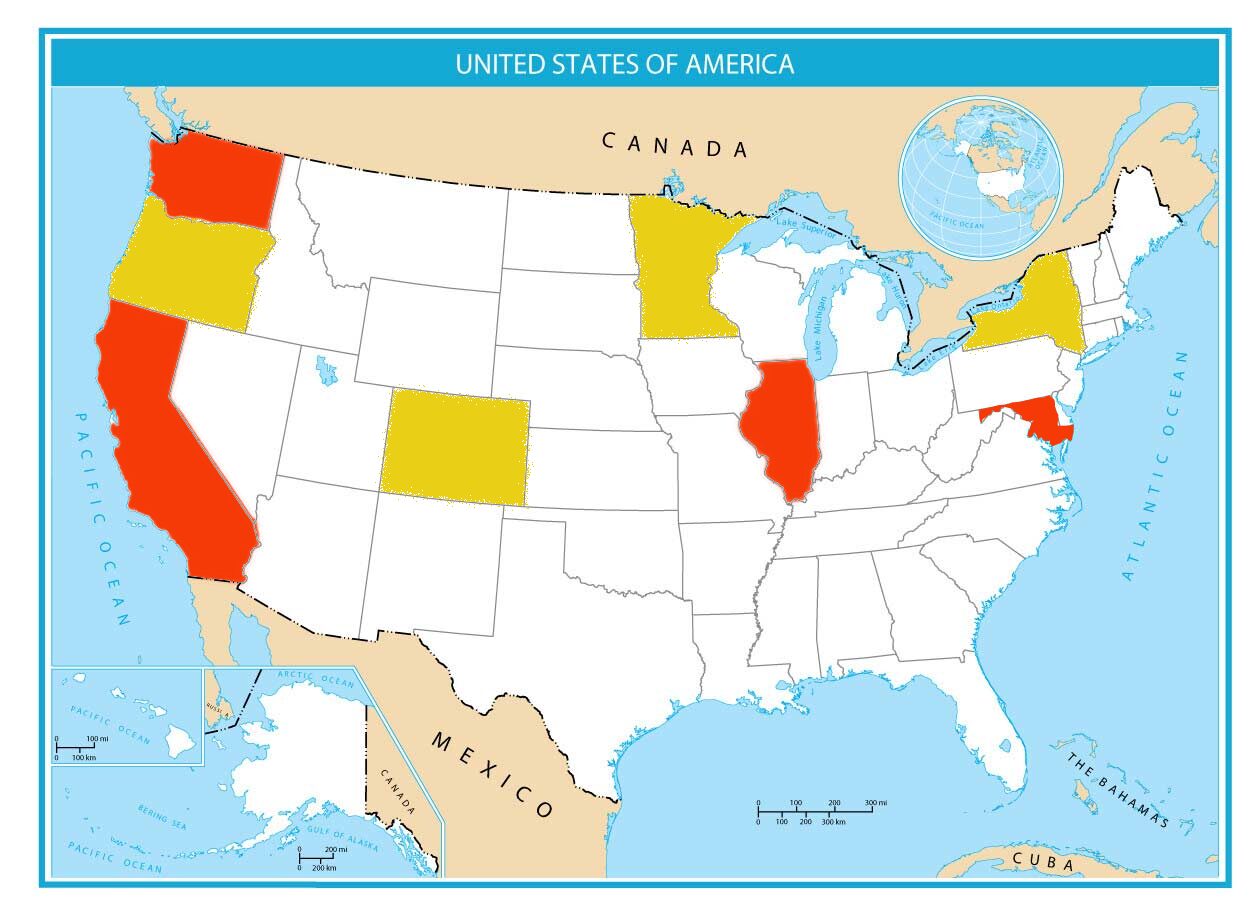
Current laws provide that states can create their own health plans, eligibility standards, and coverage, as long as the plan follows federal criteria. Medicaid laws also provide for emergency coverage for non-citizens. Seven states and D.C. started programs that offer full Medicaid coverage to non-citizens.

Four of the seven states, New York, Oregon, Minnesota, and Colorado, never submitted identifiable information about Medicaid recipients to CMS. The data shared with ICE came from the remaining three states; California, Illinois, & Washington State; and Washington D.C.

Map of U.S. States Compromised by CMS and DHS

The Allegation

The lawsuit was filed in the U.S. District Court for the Northern District of California. It alleges that the federal government is allowing the personal data of Medicaid recipients to be used for purposes unrelated to the Medicaid program.

Further, the coalition of states alleges that the disclosures violate several federal data privacy laws. These  include Health Insurance Portability and Accountability Act (HIPAA), Federal Information Security Modernization Act (FISMA), and the Privacy Act. 

Additionally, the Attorneys General state that the disclosures are contrary to the Social Security Act and a violation of the Spending Clause.

The lawsuit calls upon the court to bar CMS from sending additional PII to DHS and to bar DHS from using any of the information it has already received.

“In the seven decades since Congress enacted the Medicaid Act to provide medical assistance to vulnerable populations, federal law, policy, and practice has been clear: the personal healthcare data collected about beneficiaries of the program is confidential, to be shared only in certain narrow circumstances that benefit public health and the integrity of the Medicaid program itself.”

Attorneys General

Coalition of States

Final Thoughts

This lawsuit is the latest of many against the current administration. The Rowan Report will continue to update this and other stories impacting care at home as the lawsuits continue.

# # #

Kristin Rowan, Editor

Kristin Rowan has been working at The Rowan Report since 2008. She is the owner and Editor-in-chief of The Rowan Report, the industry’s most trusted source for care at home news, and speaker on Artificial Intelligence and Lone Worker Safety and state and national conferences.

She also runs Girard Marketing Group, a multi-faceted boutique marketing firm specializing in content creation, social media management, and event marketing.  Connect with Kristin directly kristin@girardmarketinggroup.com or www.girardmarketinggroup.com

©2025 by The Rowan Report, Peoria, AZ. All rights reserved. This article originally appeared in The Rowan Report. One copy may be printed for personal use: further reproduction by permission only. editor@therowanreport.com


Research Institute Joins Alliance

FOR IMMEDIATE RELEASE
August 20, 2025

Contact:                                                                   Elyssa Katz
571-281-0220
communications@allianceforcareathome.org

Research Institute for Home Care and National Alliance for Care at Home Ink Affiliation Agreement

Alexandria, VA and Washington, DC, August 20, 2025 – The Research Institute for Home Care (the Institute) and the National Alliance for Care at Home (the Alliance) have entered into an affiliation agreement to strengthen and expand research efforts while further unifying the care at home movement. The agreement is effective immediately. 

Research Institute for Home Care

Since its founding in 2008, originally as the Alliance for Home Health Quality & Innovation, the Institute has invested in research and education about home care and hospice and its ability to deliver quality, cost-effective, patient-centered care, demonstrating the value proposition for patients and the entire U.S. healthcare system. With this affiliation, the Institute will remain an independent research organization, continuing to pursue its mission of funding and promoting research to inform policy and identify best practices and care models that expand access to healthcare in the home. Its vision remains clear: promoting healthy patients and communities through home care research, education, quality, and innovation. 

Research Institute for Home Care

The Institute’s Board of Directors will continue to independently oversee its research agenda and initiatives. The Alliance will provide comprehensive management support for the Institute’s operations. At the launch of the affiliation, Dr. Steve Landers, CEO of the Alliance, will also serve as the President of the Institute. Jennifer Schiller, the former Executive Director of the Institute, has joined the Alliance leadership team and will continue to support Institute initiatives along with other Alliance leaders. Jennifer Sheets, Founder and CEO of Carezzi, will remain the Board Chairman of the Institute.   

The enhanced collaboration and amplification opportunities provided by this affiliation elevate and unify the care at home movement. Together, the strengthened Alliance and Institute leadership will continue to invest in and focus on critical home care and hospice industry research and data to inform effective policy, clinical practice, and underscore the value of home-based care. 

In Their Own Words

“We are thrilled to announce our affiliation with the Research Institute for Home Care. The Institute’s more than decade-long commitment to rigorous research perfectly complements our mission. This affiliation strengthens our ability to further demonstrate that care at home is the preferred choice for patients and families and the highest-value option for our healthcare system.” 

Dr. Steve Landers

CEO, National Alliance for Care at Home

“This is an important milestone for the Institute that will amplify our research impact while preserving our integrity and academic rigor. By joining forces with the Alliance, we ensure that evidence-based findings continue to inform policy and best practices that benefit patients, families, and the entire healthcare system.”

Jennifer Sheets

Chairman of the Board, Research Institute for Home Care

Director Agreement

The decision, reached by both organizations’ independent Boards of Directors, reflects the shared recognition that care at home is at a pivotal juncture. By combining the Alliance’s resources with the Institute’s research expertise, the partnership positions both organizations to influence policy, strengthen clinical practice, and advance innovation in care at home.  

“The timing of this affiliation reflects a shared recognition that care at home stands at a critical juncture. By bringing together the Alliance’s resources with the Institute’s research expertise, we are better positioned to navigate today’s complex healthcare landscape and drive meaningful policy change. This partnership represents a strategic investment in the future of home-based care that will benefit providers, patients, and policymakers alike,” said Ken Albert, Board Chair for the Alliance. 

# # #

About the National Alliance for Care at Home

The National Alliance for Care at Home (the Alliance) is the leading authority in transforming care in the home. As an inclusive thought leader, advocate, educator, and convener, we serve as the unifying voice for providers and recipients of home care, home health, hospice, palliative care, and Medicaid home and community-based services throughout all stages of life. Learn more at www.AllianceForCareAtHome.org.  

About the Research Institute for Home Care

The Research Institute for Home Care (the Institute) is a non-profit, national consortium of home care providers and organizations. The Institute invests in research and education about home care and its ability to deliver quality, cost-effect, patient-centered care across the care continuum. The Institute is committed to conducting and sponsoring research and initiatives that demonstrate and enhance the value proposition that home care has to offer patients and the entire U.S. healthcare system. 

Alliance Responds to Hospice Final Rule

by Kristin Rowan, Editor

The Alliance Responds to CMS Hospice Final Rule

CMS Issues FY 2026 Hospice Final Rule

On August 1, 2026, CMS issues the FY 2026 Hospice Wage Index and Payment Rate Update and Hospice Quality Reporting Programs Requirements Final Rule. Here are the high-level changes in this year’s final rule:

  • Rate Setting Changes
    • A 3.3% inpatient hospital market basket percentage increase
    • A 0.7% productivity adjustment (read decrease)
    • Statutory cap increases from $34,465.34 to $35,361.44
  • Hospice Care Admission
    • The physician member of the interdisciplinary group (IDG) may recommend admission to hospice care
  • Face-to-Face Attestation
    • Signature and date requirements restored
    • Eliminated requirement for attestation to be a separate and distinct document
    • Attestation requirement can be a section or addendum to recert form, or part of a signed and dated clinical note
  • Hospice Quality Reporting Program
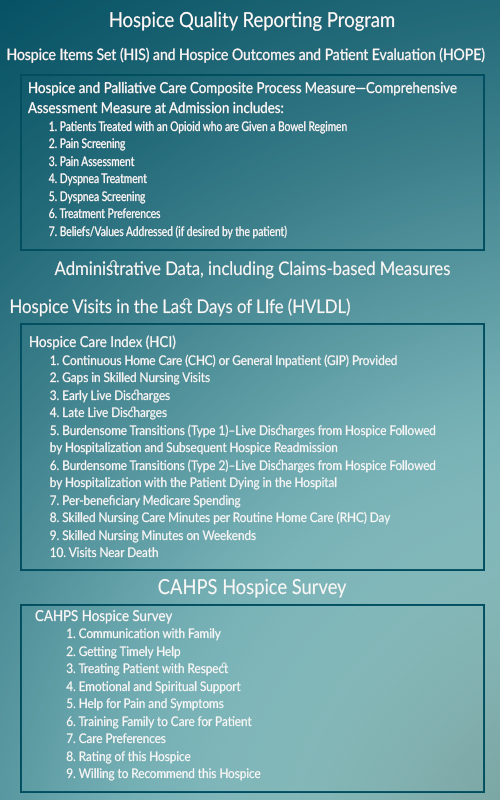
  • The HOPE tool will replace the HIS tool on October 1, 2025, despite comments to delay implementation
  • CMS published a HOPE Technical Information webpage ,an HQRP training library, and a Requirements and Best Practices webpage
  • CMS recognized the error in their HOPE burden calculations. The burden is 21.1% higher than initially reported. The difference will be “taken into consideration” in the next PRA package submission.
  • The separate reporting tool (QIES) and reports tool (CASPER) will sunset and iQIES will replace both tools.
FY 2026 Hospice Quality Reporting Program

National Alliance for Care at Home Statement

After CMS issued the final rule, the Alliance responds with a statement addressing the wage adjustment, HOPE tool implementation, and sttestation changes. Read the full press release here.

Wage Adjustment

The Alliance recognizes that the 2.6% wage update is higher than the proposed 2.4% adjustment issued earlier this year. However, The Alliance maintains its position that the update does not go far enough to offset the very high and very real operational costs that hospices across the country face.  

Regulatory Relief

Both the physician member of the IDG recommending hospice admission and the inclusion of a clinical note to serve as attestation of a face-to-face were welcome changes to hospice regulations. The Alliance thanked CMS for these changes.

HOPE Tool Implementation

The Alliance was among the many commenters to CMS about the October 1, 2025 implementation date for the HOPE tool. Alliance CEO Dr. Steve Landers had this to say:

Despite responsiveness in other areas, the Alliance is deeply disappointed that CMS did not heed recommendations and delay the October 1, 2025 implementation of the Hospice Outcomes and Patient Evaluation (HOPE) tool nor waive the timeliness completion requirement for HOPE record submission. We expect providers to face a burdensome transition and urge CMS to remain responsive to real-world challenges, offering flexibility as providers navigate the change.  

Dr. Steve Landers

CEO, National Alliance for Care at Home

The Alliance is committed to working with CMS to reduce spending and strengthen the Medicare hospice benefit. They also continue to support the CMS initiative to reduce fraud, waste, and abuse.

Final Thoughts

The Hospice Final Rule is not what we hoped for. The wage update was increase, but not by enough to make a real impact on the operational burden hospices face. CMS has provided technical training and education for the HOPE tool, but severely underestimated the financial burden connected to the transition. CMS continues to use outdated, incorrect, or faulty information in its calculations of wage rate updates and ignores the repeated comments from advocacy groups and hospice providers. 

# # #

Kristin Rowan, Editor

Kristin Rowan has been working at The Rowan Report since 2008. She is the owner and Editor-in-chief of The Rowan Report, the industry’s most trusted source for care at home news, and speaker on Artificial Intelligence and Lone Worker Safety and state and national conferences.

She also runs Girard Marketing Group, a multi-faceted boutique marketing firm specializing in content creation, social media management, and event marketing.  Connect with Kristin directly kristin@girardmarketinggroup.com or www.girardmarketinggroup.com

©2025 by The Rowan Report, Peoria, AZ. All rights reserved. This article originally appeared in The Rowan Report. One copy may be printed for personal use: further reproduction by permission only. editor@therowanreport.com


Tell CMS not to Kill Home Health

by Kristin Rowan, Editor

The Alliance to Care at Home:

CMS needs your comments

CMS needs your comments on the home health proposed rule for FY 2026. Advocacy is a cornerstone of the mission of The National Alliance for Care at Home. From The Hill to the home, The Alliance fights for the future of the industry. But, they can’t do it alone. 

Proposed Rule

The CMS proposed rule for FY 2026 has a net 6.4% decrease in payments to home health providers. Industry experts warn that this change will cause home health agencies to shutter their doors and it will leave many rural areas in a home health desert.

The Alliance Call to Action

At last week’s 2025 Financial Summit in Chicago, policy and industry experts provided ways to adjust how to write comments to CMS. According to Mary Carr, Vice President for Regulatory Affairs at National Alliance for Care at Home, it’s not enough for a few agencies and organizations to advocate for home health. Everyone has to submit comments about this. Carr says if done effectively, sending comments on proposed rules is one of the most powerful ways to stop these policy changes. The way you write your comment letters is important if you want them to have an impact.

Carr provided this guidance and tips on how to right an effective comment to CMS:

Remember that CMS is not looking for an agree/disagree statement

Provide good reasons for not keeping the proposed rule as is

Address very specific reasons why any part of the proposed rule is bad

Include the direct impact the proposal will have on your business, your staff, and your patients

Provide an alternative recommendation

Mention studies on how much less home health costs compared with SNFs and ALFs

Don’t let fear, anger, and anxiety detract from your message

Maintain professionalism and respect

Mention and thank CMS for any good aspects of the proposed rule

Include impact statements on reduction in services, delays to getting care, and areas that would be without any available home health care should the proposed rule stand

Mention the Other Side

No matter what side of the aisle you are usually on, we all must agree that care at home is an industry issue, not a Democrat or Republican issue. Hillary Loeffler, Vice President of policy and regulatory affairs at the Alliance, reluctantly mentions that the clawbacks, reductions, and methodology used to determine rates were put in place by the previous administration. 

“It’s a new administration. I hate to say it, but I’m going to say, ‘This methodology was created by the Biden administration, and the Trump administration needs to do something about this.’ So, hopefully they take a fresh look at it.”

Hillary Loeffler

Vice President of Policy and Regulatory Affairs, National Alliance for Care at Home

Loeffler also suggests going directly to Congress with comments and letters in addition to CMS. The recent trend of lowering reimbursement rates causing fewer visits, less coverage, and longer wait times is untenable and complete reform of the home health benefit at the federal level is needed to ensure its survival, added Loeffler.

Illogical Arguments

Whether you are publishing comments on the home health proposed rule or writing a letter to your senators and representatives, steer clear of logical fallacies. These errors in reasoning are easy to fall prey to when you have an emotional investment in the issue at hand.

Ad Hominem

The very common Ad Hominem fallicy happens when the argument moves from the problem to the person. Blaming your representative or accusing CMS of hating home health rather than focusing on the impact of the pay cut will weaken our standing.

Slippery Slope

This fallicy involves stretching the consequences of an action beyond reality. Cutting home health payment rates will decrease care and increase start-of-care delays. It will not cause homelessness, mass hysteria, or a small pox outbreak. 

Fallacy of Composition

If you’re familiar with standard contracts, you’ve read the clause that goes something like, “if any part of this contract is illegal, the rest is still intact.” The composition fallacy assumes that the whole of something matches its parts. The CMS proposed rule for FY 2026 has improvements, such as allowing physicians to do face-to-face appointments even if they are not the certifying physician. Don’t throw out the entire proposed rule. Rather focus on those parts that are clearly devastating to the industry.

Fallacy of Origin

Criticizing the rule based on its authors (CMS) as adversaries to care at home also negates the impact of our advocacy. CMS has been charged with maintaining government payments for health care in hospitals, physician groups, hospices, SNFs, and more. They have also been directed to cut costs, decrease spending, and maintain budget neutrality. The proposed rule is a death sentence for home health not because it came from CMS, but because of the flawed math. Address the calculations, the methodology, the assumption that care at home is more expensive than hospital or SNF care, and the number of people who will lose access to quality care.

CMS needs your comments now

Now that you know what issues to address and how to frame your argument, reach out. Contact CMS and your Congresspeople and submit your comments today. Comments are due by August 29th.

# # #

Kristin Rowan, Editor

Kristin Rowan has been working at The Rowan Report since 2008. She is the owner and Editor-in-chief of The Rowan Report, the industry’s most trusted source for care at home news, and speaker on Artificial Intelligence and Lone Worker Safety and state and national conferences.

She also runs Girard Marketing Group, a multi-faceted boutique marketing firm specializing in content creation, social media management, and event marketing.  Connect with Kristin directly kristin@girardmarketinggroup.com or www.girardmarketinggroup.com

©2025 by The Rowan Report, Peoria, AZ. All rights reserved. This article originally appeared in The Rowan Report. One copy may be printed for personal use: further reproduction by permission only. editor@therowanreport.com


First Joint Event for NAHC & NHPCO

FOR IMMEDIATE RELEASE
July 30, 2025
PHOTO LINK

National Alliance for Care at Home Hosts Inaugural Financial Summit

Over 700 industry leaders gather in Chicago for three-day event focused on financial leadership and innovation in home-based care

(Alexandria, VA and Washington, DC) — The National Alliance for Care at Home (the Alliance) successfully hosted its inaugural event, the 2025 Alliance Financial Summit, July 27-29 in Chicago, IL. The Summit brought together financial leaders from across the care at home community, with expert-led sessions, peer collaboration, and insights into market shifts and emerging technologies.

Arrival in Chicago

Welcome

The Summit officially launched Sunday evening with an opening keynote by Wendy Sue Swanson, MD, MBE, Founder and CEO of Skin Metal and Author of “Mama Doc Medicine.” Dr. Swanson delivered a forward-looking presentation on the intersection of medicine and technological innovation. The evening concluded with a Welcome Reception in the Exhibit Hall. 

Keynote

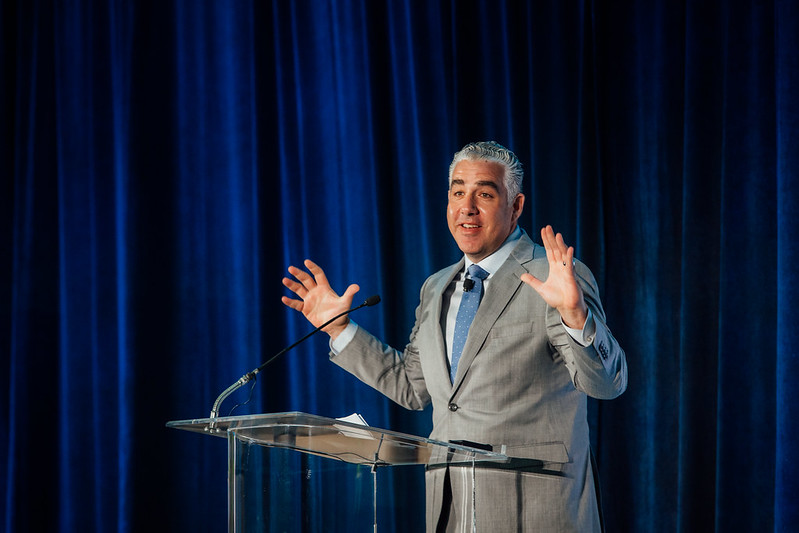
The day’s keynote session featured Alliance CEO Dr. Steve Landers alongside a panel of experts including Ken Albert, President and CEO of Andwell Health; Trisha Crissman, President and CEO of CommonSpirit Health at Home; and Hillary Loeffler, Vice President of Policy & Regulatory Affairs for the Alliance. Panel discussions addressed the potential impact of payment cuts in the Centers for Medicare & Medicaid Services Calendar Year 2026 Home Health proposed rule, hospice policy developments, workforce challenges and solutions, and actionable strategies for providers to protect the future of home-based care. Attendees then moved into a full day of concurrent sessions before an evening reception on the Chicago River.  

Steven Landers, CEO, The Alliance, Financial Summit
The Alliance Financial Summit Riverwalk Reception
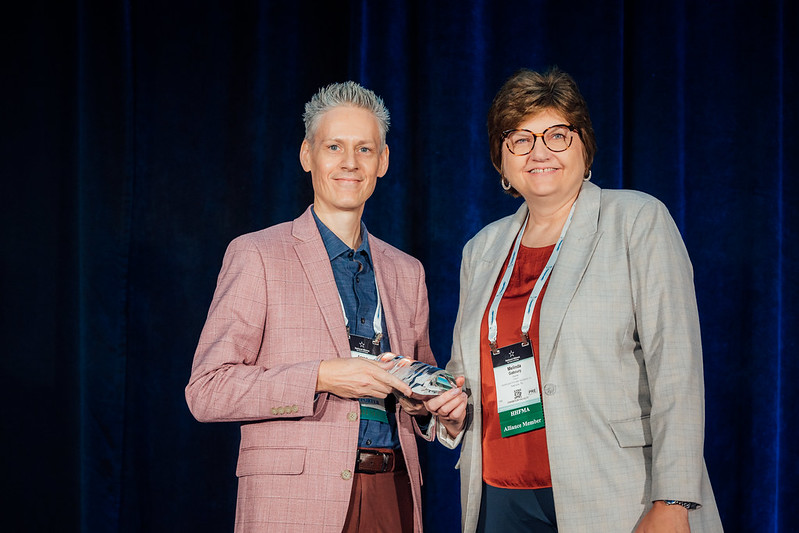
The Alliance Financial Summit Awards
The Alliance Financial Summit Attendee Map

Networking and Education

Tuesday featured dedicated peer-to-peer networking sessions, allowing for informal conversation and knowledge sharing, before the opportunity for more concurrent sessions. The Summit concluded with a closing keynote expert panel featuring leaders from the Alliance’s Home Health and Hospice Financial Managers Association (HHFMA). 

“This first Alliance event exceeded our expectations, bringing together care at home leaders from across the nation to connect, learn, and recommit to our shared vision of an America where everyone has access to the highest quality, person-centered healthcare wherever they call home,” said Alliance CEO Dr. Steve Landers. “The content was both practical, grounded in the day-to-day challenges and successes of providers, while incorporating innovation and aspiration to drive future growth and success.”  

The Alliance has announced two additional events for 2025: Alliance Advocacy Week, September 8-11 in Washington, DC, and the National Alliance for Care at Home Annual Meeting and Exposition, November 1-4 in New Orleans, LA.  

# # #

About the National Alliance for Care at Home

The National Alliance for Care at Home (the Alliance) is the leading authority in transforming care in the home. As an inclusive thought leader, advocate, educator, and convener, we serve as the unifying voice for providers and recipients of home care, home health, hospice, palliative care, and Medicaid home and community-based services throughout all stages of life. Learn more at www.AllianceForCareAtHome.org

Press Contact
communications@allianceforcareathome.org
Elyssa Katz | 571-281-0220

HHAeXchange Expands in Manhattan

FOR IMMEDIATE RELEASE

Contact:                                 Hollie Barnridge
Alloy, on behalf of HHAeXchange
855-300-8209
hhaexchange@alloycrew.com

HHAeXchange Unveils New Corporate Headquarters in New York City

New location reaffirms the company’s commitment to its employees and customers with expanded office space to support enhanced collaboration, creativity, and innovation

NEW YORK, June 3, 2025 – HHAeXchange, a leader in homecare management solutions for providers, caregivers, managed care organizations (MCOs), and state Medicaid programs, today announced the opening of its new corporate headquarters in New York City. 

Located in the heart of Midtown Manhattan, the reimagined workspace is a reflection of the company’s recent growth and its commitment to delivering advanced solutions for the home and community based services (HCBS) industry. The new space also marks an important step in uniting teams from HHAeXchange’s recent acquisitions of Sandata, Cashé Software, and Generations Homecare System. Efforts to foster stronger collaboration across functions will accelerate the delivery of a more connected, efficient experience for customers nationwide. 

“We are always striving to better meet the needs of our customers, and bringing our employees together at our new headquarters will support greater collaboration that drives product innovation. New York has been our home base since 2008, and we’re proud to grow the HHAeXchange footprint locally while creating a welcoming work environment for our network of employees, customers, and partners from across the nation.”

Paul Joiner

CEO, HHAeXchange

For more than 15 years, HHAeXchange has been at the forefront of homecare technology, innovating software solutions that empower personal care providers, self-direction program administrators, MCOs, and state Medicaid agencies to achieve operational efficiency, increased compliance, and improved member outcomes. The new central office space reflects HHAeXchange’s focus on supporting its teams and customers, helping to advance care delivery for all members.

HHAeXchange

In addition to the office’s collaborative workspace, HHAeXchange’s new headquarters features state-of-the-art employee training rooms and flexible meeting spaces designed to foster engagement with customers, prospective clients, and partners.

In His Own Words

We sat down with Paul Joiner, CEO of HHAeXchange, to talk about the new office space, how its impacting the company culture, and what’s next for the company. See our accompanying article here.

About HHAeXchange

Founded in 2008, HHAeXchange is the leading technology platform for homecare and self-direction program management. Developed specifically for Medicaid home and community-based services (HCBS), HHAeXchange connects state agencies, managed care organizations, providers, and caregivers through its intuitive web-based platform, enabling unparalleled communication, transparency, efficiency, and compliance. In 2024, HHAeXchange expanded through the strategic acquisitions of Sandata, Cashé Software, and Generations Homecare System, strengthening its commitment to advancing the industry. For more information, visit hhaexchange.com or follow the company on XLinkedIn, and Facebook.

Patients’ Right to Freedom of Choice

by Elizabeth E. Hogue, Esq.

Patient's Right to Freedom of Choice of Providers

U.S. Supreme Court Weighs In

Patient’s rights to freedom of choice of providers who will render care to them is currently based on four key sources:

  • Court decisions that establish the right of all patients, regardless of payor source and the setting in which services are rendered, to control treatment, including who provides it
  • Federal statutes for both the Medicare and Medicaid Programs that establish the right of patients whose care is paid for by these programs to choose providers to render care – Specifically, Section 1802 (42 U.S. C. 1395a) states as follows: “(a) Basic freedom of choice.- Any individual entitled to insurance benefits under this title may obtain health services from any institution, agency, or person qualified to participate under this title if such institution, agency or person undertakes to provide him such services.”
  • The Balanced Budget Act of 1997 (BBA), which currently requires hospitals to provide a list of home health agencies and hospices to patients. According to the BBA, the list must meet the following criteria: (a) Providers that render services in the geographic area in which patients reside, are Medicare-certified, and request to be included must appear on the list given to patients. (b) If hospitals have a financial interest in any provider that appears on the list, this interest must be disclosed on the list.
  • Conditions of Participation (COP’s) of the Medicare Program that are the same as the provisions of the BBA described above

Supreme Court Decision

The U.S Supreme Court has now issued a decision about the federal statute for the Medicaid Program described above in Medina v. Planned Parenthood South Atlantic, et al. [No, 23-1276 (June 26, 2025)]. This case involves the any-qualified-provider provision in the statute above that requires states to ensure that any individual eligible for medical assistance may obtain it from any provider qualified to perform the service who undertakes to provide it. The question is whether individual Medicaid beneficiaries may sue state officials under the above statute for failing to comply with the any-qualified-provider provision. 

Exclusions on "any-qualified-provider" provision

The State of South Carolina excluded Planned Parenthood from the Medicaid Program. An enrollee in the Medicaid Program sued the State based on the above statute because she said that she wanted to receive Medicaid services from Planned Parenthood.

Federal enforcement; not private

The Court said that spending power statutes, such as Medicaid Programs, are especially unlikely to create the right for individuals to sue the states. The typical remedy for state noncompliance is federal funding termination. Private enforcement, such as suits by individuals, requires states to voluntarily and knowingly consent to private suits based on clear and unambiguous alerts from Congress to the states that private enforcement is a funding condition.

The Court concluded that the above statute does not permit individuals to sue the States for violation of their right to freedom of choice of providers.

# # #

Elizabeth E. Hogue, Esq.

Elizabeth Hogue is an attorney in private practice with extensive experience in health care. She represents clients across the U.S., including professional associations, managed care providers, hospitals, long-term care facilities, home health agencies, durable medical equipment companies, and hospices.

©2025 Elizabeth E. Hogue, Esq. All rights reserved.

No portion of this material may be reproduced in any form without the advance written permission of the author.

©2025 by The Rowan Report, Peoria, AZ. All rights reserved. 

Paul Joiner: On the Record

by Kristin Rowan, Editor

Paul Joiner

On the Record

Paul Joiner, CEO of HHAeXchange, sat down with The Rowan Report Editor Kristin Rowan to discuss the company’s new headquarters in Manhattan, the company culture he’s creating, his dedication to support those helping our most vulnerable populations.

In His Own Words

The Rowan Report: Paul, thank you for taking the time to talk to us. HHAeXchange is going through some significant growth recently. And now you’ve moved your headquarters from Long Island to Manhattan, correct? How did that decision come about?

Paul Joiner: HHAeXchange has been in Manhattan for a long time. Sandata, who we acquired earlier this year, was in Long Island. But, the move was planned with or without Sandata. We needed a nice sized space to convene people. We valued a large, multi-purpose meeting space over individual office space. It’s a space where the teams can meet when they come to town, where we can host clients, and larger company meetings.

RR: How does the new space support your team?

Paul: The majority of our team is remote. I don’t think remote work is healthy for everyone. It varies from person to person. It’s not a long-term healthy option. Returning back to the office 9-5 five days a week isn’t practical and not all that healthy either. We have created policies, a workspace, and a culture where people are invited to visit. Some come 2-3 days per week. Some only once a month. We maintain flexibility for our teams to work when and where they need to work. Being a single parent, for example, is really hard, so we stay flexible to support single parents to be where they need to be.

At the same time, we’ve seen the benefit of the connection and how much more healthy it is by physically coming together. For the younger workforce, they are enjoying getting together and coming into the office. We have to support our younger employees and their professional development. How do you professionally develop via Zoom or Teams? Physically coworking and promoting good and active environments compel people to come into the office. To build connections, you have to be together, not just on video.

RR: You have workers across the country, though. How does that work?

Paul: We have the main office here in Manhattan, a large and growing office in Minneapolis, and a smaller office in Miami. We try to keep people in areas that make it easy to meet. However, we do have some roles with certain criteria that allows for mostly remote work. Those teams come to one of the offices to meet when they can. We’ve hosted team meetings here and in Minneapolis recently.

RR: Has this new meeting space had an impact on the company culture?

Paul: Yeah, it has improved. We are having real, honest conversations about what needs to be improved. The team effort is the way we win and our teams understand that. We also understand that working hard doesn’t mean foregoing your life and the ability to recharge.

Work hard, be passionate, and motivate people with your mission and vision. The people we serve don’t have it easy, they are supporting the most vulnerable people.

RR: In a recent statement, you said that the new location will support collaboration and innovation. Do you have new features on the horizon? Are you investing in AI capabilities?

Paul: We have a lot in the works. We have a new mobile app in the beta phase that we’ll be rolling out that I’m really excited about. It’s actually an update, but it’s so massive that it’s basically new. We’re working on data analytics and data tracking for some of our largest clients.  We’ve consolidated some screens into one spot to streamline and make the user more efficient. A lot of what we’re working on is foundational. We’re focusing on supporting companies as they scale.

RR: Are you looking into AI, either within the HHAeXchange platform, or in a partner?

Paul: Yeah, of course. AI is the future and it’s everywhere. We are looking at ways to return time to users, make it easier to train users, and make things easier on caregivers. We will try to generate more buzz around AI, but not until there’s real, tangible value. AI definitely needs to be part of our strategy, but being smart where we apply it to truly get the value-add for our clients. It has to improve the quality of life for the user. Does it improve the ability of caregivers to care for people?

Paul Joiner, CEO, HHAeXchange

RR: Do you have any additional acquisition or growth plans for the second half of 2025?

Paul: There’s a lot going on in the marketplace right now. A lot of our clients are growing really well also. So, we’re sort of in a heads-down mode. There’s a handful of things we’re looking at. Right now, I’m really excited about being a bigger participant across the full continuum of care for our populations. There are some opportunities to innovate and evolve to support integrated care over the next few years. I’ll just leave it at that…for now.

RR: Paul, thank you for joining me today. It’s always a pleasure.

# # #

About HHAeXchange

Founded in 2008, HHAeXchange is the leading technology platform for homecare and self-direction program management. Developed specifically for Medicaid home and community-based services (HCBS), HHAeXchange connects state agencies, managed care organizations, providers, and caregivers through its intuitive web-based platform, enabling unparalleled communication, transparency, efficiency, and compliance. In 2024, HHAeXchange expanded through the strategic acquisitions of Sandata, Cashé Software, and Generations Homecare System, strengthening its commitment to advancing the industry.

About Paul Joiner

Paul Joiner is an accomplished executive with extensive leadership experience in the healthcare sector. Currently serving as a Board Member at AssistRx, Joiner has held prominent positions, including Chief Executive Officer at both HHAeXchange and Kipu Health. Previous roles include Chief Operating Officer as well as Executive Vice President and General Manager at Availity, and Senior Vice President and General Manager of Health Plan. Joiner also served as Vice President of Client Engagement and Business Development at Midas+ Solutions, Xerox Healthcare Provider Solutions. Educational qualifications include a Master of Accountancy from Belmont University and a Bachelor of Accountancy from the University of Mississippi.

Kristin Rowan, Editor

Kristin Rowan has been working at The Rowan Report since 2008. She is the owner and Editor-in-chief of The Rowan Report, the industry’s most trusted source for care at home news, and speaker on Artificial Intelligence and Lone Worker Safety and state and national conferences.

She also runs Girard Marketing Group, a multi-faceted boutique marketing firm specializing in content creation, social media management, and event marketing.  Connect with Kristin directly kristin@girardmarketinggroup.com or www.girardmarketinggroup.com

©2025 by The Rowan Report, Peoria, AZ. All rights reserved. This article originally appeared in The Rowan Report. One copy may be printed for personal use: further reproduction by permission only. editor@therowanreport.com


Non-Compliance Notifications & HOPE Training

by Kristin Rowan, Editor

Hospice Non-Compliance Notifications

On July 21, 2025, the CMS Hospice QRP Announcements page added an update titled “Hospice Quality Reporting Program: Non-Compliance Notifications.”

The Update Reads:

The Centers for Medicare & Medicaid Services (CMS) is providing notifications to hospices that were determined to be out of compliance with Hospice Quality Reporting Program (HQRP) requirements for calendar year (CY) 2024…. This will affect their fiscal year (FY) 2026 Annual Payment Update (APU). The Medicare Administrative Contractors (MACs) will distribute Non-compliance notifications and place them into hospices’ Certification and Survey Enhanced Reporting (CASPER) folders in QIES on July 21, 2025. Hospices that receive a letter of non-compliance may submit a request for reconsideration to CMS via email no later than 11:59 pm, August 26, 2025. If you receive a notice of non-compliance and would like to request a reconsideration, see the instructions in your notification and on the Reconsideration Requests webpage.

Details

Any reconsiderations containing protected health information (PHI) will not be processed. All PHI must be removed for a reconsideration to be reviewed.

Additionally, all submissions must be less than 20 MB overall (email message and attachments). Submissions that are greater than 20 MB in size cannot be processed.

HOPE Training

As the implementation date for the HOPE tool drew nearer, advocacy groups and hospice agencies expressed concern over it’s readiness. On June 6, 2025, The Rowan Report shared that three of the largest organizations urged CMS to delay the tool. The groups asked for proper information, education, and training. 

CMS Response

As of now, CMS is not delaying the implementation of the HOPE tool. They have, however, published training tools for hospice providers. The first series of videos is Didactic Training. They cover an introduction to the tool, admin information, preferences and active diagnoses, health conditions, skin conditions, and medications.

On July 21, 2025, CMS announced the opening of registration for live HOPE training. “Hospice Outcomes and Patient Evaluation (HOPE) National Implementation Virtual Training Program Course 2: Coding Workshop.” CMS recommends completing The Didactic Training as a prerequisite to the Coding Workshop.

The Centers for Medicare & Medicaid Services (CMS) is offering a live coding workshop on August 5, 2025…. It will provide coding practice for items that are new for HOPE, as well as the existing and updated items carried over from the Hospice Item Set (HIS).

Register now at:The Hospice Outcomes and Patient Evaluation (HOPE) National Implementation Coding Workshop

Find the Didactic Recorded Training Series here.

Data Collection Starts Soon

The HOPE tool begins data collection on October 1, 2025. Key items hospice providers should understand:

  • More Frequent Assessments: HOPE introduces up to four assessment points per patient, capturing care from multiple angles during the first 30 days and at discharge.
  • Real-Time Data Capture: Unlike the retrospective nature of HIS, HOPE assessments are completed during live patient encounters, providing richer and more immediate insights.
  • Higher Stakes for Compliance: To avoid a reimbursement cut of up to 4%, agencies must ensure that at least 90% of HOPE assessments are submitted on time—a notable increase from the previous 2% penalty under HIS.
  • Public Reporting Timeline: While HIS data has been publicly available, HOPE data will not be released for public comparison until fiscal year 2028 or later, giving providers time to adapt.

*from the SimiTree blog: Understanding the Transition from HIS to HOPE

As the implementation of the HOPE tool gets closer, we will continue to share training information from CMS and other sources as it becomes available. If you need a referral to a hospice consultant to navigate the transition, please reach out to The Rowan Report.

# # #

Kristin Rowan, Editor

Kristin Rowan has been working at The Rowan Report since 2008. She is the owner and Editor-in-chief of The Rowan Report, the industry’s most trusted source for care at home news, and speaker on Artificial Intelligence and Lone Worker Safety and state and national conferences.

She also runs Girard Marketing Group, a multi-faceted boutique marketing firm specializing in content creation, social media management, and event marketing.  Connect with Kristin directly kristin@girardmarketinggroup.com or www.girardmarketinggroup.com

©2025 by The Rowan Report, Peoria, AZ. All rights reserved. This article originally appeared in The Rowan Report. One copy may be printed for personal use: further reproduction by permission only. editor@therowanreport.com