by Elizabeth E. Hogue, Esq. | Feb 7, 2024 | Admin, Regulatory
by Elizabeth E. Hogue, Esq.
A caregiver in Wyoming who is charged with causing the death of her mother has been jailed based on allegations that she committed aggravated assault and battery; deliberate abuse of a vulnerable adult; and intentionally and maliciously killing another human being, commonly known as 2nd degree murder. The defendant, Edwina Leman, cared for her mother, Mary Davis, beginning in June of 2022. At the time of the events described below, Davis was a hospice patient.
On December 28, 2023, Leman’s son heard her yelling at her mother. At some point, he heard an audible “thump” and Davis began to scream. The son then entered the bathroom and found Leman pulling roughly on her mother’s leg, even though Davis was screaming that it hurt. According to Leman’s son, Leman then told her mother “not to be dramatic” and called her “Marygina,” a derogatory name the caregiver had previously called Davis on multiple occasions.
Leman claimed that she was removing her mother’s clothing “more forcibly than necessary when she fell.” She also said that Davis became very frail and fragile during the time the patient lived with her. Leman admitted that she had a temper and had “thumped or swatted” her mother on the head at various times in the past.
Leman’s husband and son said that they saw the caregiver engage in a pattern of physical and verbal abuse toward Davis. The caregiver screamed at her mother and sometimes called her names. Leman’s husband said he saw his wife hit the patient on the head and push her while she was walking with her walker. Leman said that she also pushed Davis when she was not using her walker, which caused her to fall to the ground. The coroner’s report said that Davis died of complications of a displaced fracture of her femur.
A sad story indeed! We read it and weep!
This case is a reminder for all types of providers who render services to patients in their homes to be alert to any signs of abuse or neglect, and to take action to protect patients who are subject to abuse or neglect. Action by providers should include reports to adult protective services. Providers may respond to this recommendation by saying that adult protective services rarely takes action based on their reports. Providers must remember, however, that reports to adult protective services are required in many states. In addition, it is important to establish a record of abuse and neglect even if authorities do not take action. Better to err, if necessary, on the side of protecting patients.
# # #
©2024 Elizabeth E. Hogue, Esq. All rights reserved. No portion of this material may be reproduced in any form without the advance written permission of the author.
©2024 by The Rowan Report, Peoria, AZ. All rights reserved. This article originally appeared in Healthcare at Home: The Rowan Report.homecaretechreport.com Reprinted by permission. One copy may be printed for personal use: further reproduction by permission only. editor@homecaretechreport.com
by Kristin Rowan | Feb 7, 2024 | Uncategorized
By Kristin Rowan, Editor
Last month, we published an article in partnership with Bob Roth of Cypress HomeCare Solutions in Scottsdale, AZ about paying for long-term care at home. Since then, I have come across some interesting information as we continue to tackle the issue of paying for care that is not reimbursed by the current Medicare/Medicaid system.
Medicare and Medicare Advantage have set pay rates for home health and hospice care. Home Health Value-Based Purchasing (HHVBP), implemented by CMS, was designed to incentivize agencies by paying more for quality care rather than a higher number of services provided. This is similar to giving advances and pay raises based on performance rather than longevity in a job, which I’m all for. However, the HHVBP overlooked palliative care altogether and neither the fee-for-service model nor the HHVBP model includes supportive (read private duty) care at home. Since these services are not reimbursed, there is no incentive to provide them nor way to get paid for them if the patient cannot pay out-of-pocket.
This causes two problems:
1. Home Health and Hospice Agencies are reluctant to provide unreimbursed care, with good reason, so the overall patient experience is less than ideal, rehospitalization rates increase, star-ratings and scores decrease, bonuses go away, and the agencies make less money than before.
2. Patients can’t get the care they need and want. Palliative care patients may receive Hospice care too early, or they may not receive care at all because they fall between home health and hospice. Patients who need supportive care at home can’t afford it so they either go without, causing increased complications or they rely on friends and family members who burn out under the stress of being a full-time caregiver.
Innovative care strategies can overcome the obstacles faced by agencies and patients alike. There may not yet be a perfect solution, but there are some innovative ideas out there and something has to disrupt the current pay model.
Palliative Care Partners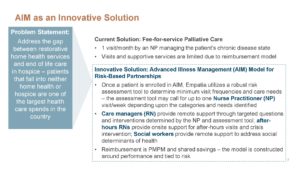
Medicare Advantage organizations and primary physician groups receive a “cost of care” analysis for the duration of the patient care. The organization takes on the risk of that patient costing more than what the MA plan will pay, but can make more money if patient care costs less than anticipated. Palliative care at home costs less. David Causby, President and CEO of Gentiva, a Hospice organization that operates in 35 states across the U.S. and has an average daily census of 26,000, has implemented a plan of care in cooperation with these organizations in what he calls Advanced Illness Management (AIM) Model for Risk-Based Partnerships. Designed for palliative care, Gentiva creates a plan of care that includes visit frequency and care needs and employs nurse practitioners, care managers, after hours RNs and social workers. The hospital pays Gentiva on a PMPM model with shared savings. The hospital still gets paid the full amount from MA but uses fewer resources, has lower costs, and sees reduced rehospitalizations, saving more than what they pay out. According to Gentiva, this partnership “provides value to contracted organizations by decreasing the overall end-of-life spend on this high-risk patient population.”
Supportive Care at Home Innovations
Supportive Care at Home (Private Duty Home Care, Private Pay, Non-medical home care) is not covered by Medicare, Medicare Advantage, or most health insurance plans. Limited Medicaid grants, VA plans, and long-term health insurance pay for some supportive care at home. Without one of these plans, patients and family members pay out-of-pocket for supportive care at home, averaging $22-$27 per hour with a 4-hour minimum. In some states it can cost up to $50 per hour. At $80 per day, that’s around $20,000 per year.
One software company we recently spoke with is upending the home care model with fee-for-service model that charges by the minute, rather than by the hour, making care more affordable for more people. You can see our product review of Caring on Demand here. By reducing the cost for customers and reducing the time for caregivers, agencies can onboard more customers without hiring more caregivers. The system is being used in facilities where these services are not provided, which allows a caregiver to visit several people in one stop. The agency and the caregiver can see the same income in the same time, spread out across multiple private payers.
Combining Innovation for a Win-Win-Win
I heard about Caring on Demand and spoke with its founder in August of 2023. I spoke with one Home Care agency owner who recently started working with Caring on Demand. “Times have changed,” the agency owner said. With fewer caregivers joining the workforce, increased levels of burnout since 2020, and CMS changes that overlook palliative and non-medical care, maybe there’s another way…
- Partnerships with organizations and physician groups that have Medicare, MA, and traditional health insurance patients, non-medical home care agencies, and palliative care providers.
- Localized groups of patients in limited areas like retirement villages, planned communities, neighborhoods, or small towns.
- Cost sharing and care coordination that includes in-home palliative care visits, supportive care, communication with primary care providers and specialists
- Preventative intercessions to avoid unnecessary ER visits and hospitalizations
- Shorter visits per caregiver with multiple visits to a community each day
- Cost sharing among patients splitting a 4-hour minimum visit among 4-8 patients
- Shared savings from reduced hospital stays, shorter durations of hospice care, and nursing visits that are supplemented by supportive care
Gentiva has experienced some success already in using shared savings as a payment model. Can costs be decreased even more by adding supportive home care to this plan? Is there enough shared savings for three payees instead of two? I don’t have the answers to these questions, but I do believe providers of supportive care and palliative care have been in the background, overlooked by CMS and MedPAC for long enough. If they aren’t going to recognize the positive impact and cost savings of home care and palliative care and include them in the reimbursement model, we may have to do it for them.
We’d love to hear your feedback on this and other innovative ways to combat the crisis of paying for care at home.
# # #
Kristin Rowan has been working at Healthcare at Home: The Rowan Report since 2008. She has a master’s degree in business administration and marketing and runs Girard Marketing Group, a multi-faceted boutique marketing firm specializing in event planning, sales, and marketing strategy. She has recently taken on the role of Editor of The Rowan Report and will add her voice to current Home Care topics as well as marketing tips for home care agencies. Connect with Kristin directly kristin@girardmarketinggroup.com or www.girardmarketinggroup.com
©2024 by The Rowan Report, Peoria, AZ. All rights reserved. This article originally appeared in Healthcare at Home: The Rowan Report.homecaretechreport.com One copy may be printed for personal use: further reproduction by permission only. editor@homecaretechreport.com
by Rowan Report | Feb 7, 2024 | Admin, Recruitment & Retention
by Jen Waldron,
Recruiting caregivers for your home care agency franchise can be challenging enough, but it’s even more frustrating when those same caregivers don’t bother to pick up the phone after applying for your jobs. You may have put in a significant amount of time, money, and energy into trying to find qualified caregiver applicants, only to be repeatedly met with radio silence, missed calls, or unanswered texts.
In my mission to help home care agencies recruit more efficiently, I have identified the top five reasons why caregivers do not pick up your calls and what you can do about it.
1. You are not offering competitive pay or benefits
In a comprehensive study Pew Research found that the number one reason people leave their job is, in fact, for more money. But the number two and three reasons are “no advancement opportunities” and “feeling disrespected at work.” If your compensation package — and your career advancement opportunities — are not competitive, caregivers may choose to ignore your calls and continue searching for better opportunities.
2. Your job ad looks like spam; your hiring process does not stand out from the crowd
Candidates do not read your job description, especially if it is wordy. All job posts look like spam to the applicant, they apply to too many jobs, as many as 16 or more at one time!, and, as a result, they never read job descriptions.
This confusion can lead to candidates feeling apprehensive about texts and phone calls from unknown numbers and explain why they often opt not to answer your phone calls. The screen shot below is an example of how caregiver applicants get too many messages about jobs. To stand out from the crowd, an agency HR team must find a different way to communicate with the applicant about the value and challenges of your jobs.
3. You are not demonstrating professionalism in your hiring process
Caregivers are professionals and they expect you to have a professional hiring process. Many agencies use hiring software built for other industries and, as a result, their hiring process is clunky. On many job boards, applicants “1-click” apply with a job seeker profile they may have made several years ago. When they are followed up with through some sort of automated text system (which they think looks spammy – see pic!), they are annoyed that they are being asked to “apply” again.
4. You have poor online reviews or ratings
Today, people trust online reviews and ratings as much as personal recommendations from friends or family. If your agency has too few positive or too many poor online reviews from clients and/or employees, caregivers may not have confidence in you as an employer. Even if the impression they glean from your reviews is inaccurate, they may choose a competitor whose reviews reflect the culture and work ethic more suitable to their own. Therefore, it is imperative that you invite positive feedback from satisfied clients and employees and respond quickly to negative online reviews. This is critically important to attracting caregivers interested in working for you.
5. Your recruitment process takes too long; caregivers are moving on
The data shows that 57% of applicants today expect to hear back about the position they applied for within 1 week. With regard to retention after onboarding, one of the reasons caregivers leave is they are not given enough hours to make full time work. They say they want those hours to be in the right location and compatible with their scheduling needs and experience level.
You do not want to incur the cost of going through the whole interview, orientation, and hiring process if you do not have the right clients to match their needs and preferences at that time. Therefore, it is vital to streamline your recruitment process and to implement fast and efficient process with the best applicants.
In Summary
As a home care agency owner, it is essential to understand why caregivers may not answer your calls, even after applying for your jobs. Based on our five reasons applicants do not pick up your calls after they apply, there are steps you can take to improve your odds of attracting the best applicants:
-
- Evaluate your recruitment process, compensation package, job description, communication methods, and online reputation.
- Ensure you demonstrate professionalism through your interactions, online and during interviews.
- Make your job description and requirements stand out amongst the spammy looking emails and texts out there today.
- Take steps to eliminate bottlenecks in your hiring process.
By doing so, you will attract the best caregivers who will choose to work with you, and your agency can grow and thrive.
# # #
 Jen Waldron is one of the co-founders of Augusta Home Care Recruiting She started working in the senior care industry in 2009 as a professional caregiver in a memory care community. Since then, she has been an executive supporting thousands of home care agencies and other senior care businesses through software solutions. Augusta is an innovative software company designed entirely for home care. The platform gets caregivers to show up to interviews through inspiring confidence in the applicant, speed to hire and identifying top talent.
©2024 by The Rowan Report, Peoria, AZ. All rights reserved. This article originally appeared in Healthcare at Home: The Rowan Report.homecaretechreport.com One copy may be printed for personal use: further reproduction by permission only. editor@homecaretechreport.com
by Kristin Rowan | Feb 7, 2024 | Regulatory
by Kristin Rowan, Editor,
On Wednesday, January 31, Cigna and HCSC signed an agreement to sell all of Cigna’s Medicare business — including traditional Medicare, supplemental benefits, Medicare Part D offerings, and CareAllies, a value-based care management subsidiary. — to HCSC, a Blue Cross / Blue Shield partner with operations in Illinois, Texas, New Mexico, Oklahoma and Montana. The $3.3 billion deal will quadruple the size of HCSC’s Medicare Advantage population, which numbered 217,623 as of this month.
Medicare Advantage had not been a significant business for Cigna. CEO David Cordani explained that it required resources disproportionate to its size in the company. With 19 million insurance customers, Cigna had a little over a half million in its MA business, a little under a half million Medicare supplement members, and 2.5 million in Part D.
It had previously been reported that Cigna believed divesting its Medicare business would make its merger with Humana more acceptable to regulators. The company completed its HCSC deal even though negotiations with Humana had already broken down. Though inked today, the deal is not expected to close until the first quarter of 2025.
# # #
 Kristin Rowan has been working at Healthcare at Home: The Rowan Report since 2008. She has a master’s degree in business administration and marketing and runs Girard Marketing Group, a multi-faceted boutique marketing firm specializing in event planning, sales, and marketing strategy. She has recently taken on the role of Editor of The Rowan Report and will add her voice to current Home Care topics as well as marketing tips for home care agencies. Connect with Kristin directly kristin@girardmarketinggroup.com or www.girardmarketinggroup.com
©2024 by The Rowan Report, Peoria, AZ. All rights reserved. This article originally appeared in Healthcare at Home: The Rowan Report.homecaretechreport.com One copy may be printed for personal use: further reproduction by permission only. editor@homecaretechreport.com
by Tim Rowan | Feb 7, 2024 | Admin, Vendor Watch
by Tim Rowan, Editor Emeritus,
Advertising in The Rowan Report comes with a few perks! Our CEO interview with Tim is one of them. Advertisers with a full-year contract receive one annual CEO interview with Tim. If you’re not an advertiser, CEO interviews can be purchased as well. Highlight the expertise of your leadership with a one-on-one industry overview and company update with Tim, published on The Rowan Report website, social media, and YouTube channel.
Click on these titles to view each episode of our “Meet the CEO” video interview series.
Andre Gomez, Bedrock Healthcare at Home, January 2024
Rich Berner, Complia Health, December, 2022
Emmet O’Gara, Sandata, September, 2022
Roger Shindell, Carosh Compliance Solutions, June, 2022. HIPAA risk assessment workshops
Michael Gelman, CareConnect, May, 2022, Workforce Management
Jim Bland, Seniors Home Services, November, 2021, A menu of products from remote patient monitoring to home modifications, all with revenue sharing for home care partners
Ashley Wharton and Jenna Schwartz, Savii, March, 2021, Private Duty Agency Management Software
Eric Becker, CEO, MiliMatch, on technology to improve recruiting and retention
 Tim Rowan is a 30-year home care technology consultant who co-founded and served as Editor and principal writer of this publication for 25 years. He continues to occasionally contribute news and analysis articles under The Rowan Report’s new ownership. He also continues to work part-time as a Home Care recruiting and retention consultant. More information: RowanResources.com
Tim@RowanResources.com
©2024 by The Rowan Report, Peoria, AZ. All rights reserved. This article originally appeared in Healthcare at Home: The Rowan Report.homecaretechreport.com One copy may be printed for personal use: further reproduction by permission only. editor@homecaretechreport.com
© 2024. All content is produced by The Rowan Report. All rights reserved.
by Kristin Rowan | Jan 31, 2024 | Clinical
By Kristin Rowan, Editor
The National Association for Home Care and Hospice joined other advocacy groups this month on Capitol Hill to fight against the looming pay cuts from CMS. Some members of Congress joined the fight for “common sense policies” to expand access to care in the home for Americans.
Rep. Adrian Smith (R-NE-3), who spoke at the event, decried moves against home health, saying “there are cuts looming that are not based on reality” and “we want to make sure reimbursement policies are reflective of the actual realities.” Smith is also the representative who introduce the “Homecare for Seniors Act,” H.R. 1795, which would allow the use of Health Savings Accounts (HSAs) to be used for home care.
Rep. Terri Sewell (D-AL-7) has a personal connection to home care and spoke about how her mother cared for her father through a series of strokes he suffered. She expressed strong opinions about payment reductions that could see home health lose as much as $20 billion dollars over the next ten years. Sewell called the idea “frightening” and said, “I am a big fan of making sure that my constituents have access to quality, affordable health care.”
The Medicare program has admitted that home health is not just a bringing of great care and not just a more cost effective way to provide care, but is a service that provides dynamic value. Care in the home has decreased overall costs by $3.2 billion dollars just in the small segment of value-based payment model test cases. Patients who receive care in the home are re-admitted to the hospital 37% less frequently than those who do not and are 43% less likely to die than patients who do not receive care at home. Still, CMS is looking at additional pay cuts which bring the total payment reduction down 13.72% since 2019. The costs of everything else have increased in that time. According to the U.S. Bureau of Labor and Statistics, the average cost of living has increased 22% since 2019. NAHC President Bill Dombi said, “Where we’re headed in 2024 is that half of all home health agencies will be operating in the red with the cuts facing them in the Medicare program. It’s not a recipe for continued access to care.”
Dombi, along with many others, is predicting that 50 percent of agencies will be operating in the red after the next round of payment reductions and that without a reversal of these pay cuts we could see the end of care at home altogether with a collapse of the home health payment system.
The advocacy event on Capitol Hill helped raise awareness of the plight of care at home among some policymakers, but more help and advocacy is needed. Please, take a few minutes to click the link below and tell your members of Congress to support the Preserving Access to Home Health Act of 2023.
# # #
Kristin Rowan has been working at Healthcare at Home: The Rowan Report since 2008. She has a master’s degree in business administration and marketing and runs Girard Marketing Group, a multi-faceted boutique marketing firm specializing in event planning, sales, and marketing strategy. She has recently taken on the role of Editor of The Rowan Report and will add her voice to current Home Care topics as well as marketing tips for home care agencies. Connect with Kristin directly kristin@girardmarketinggroup.com or www.girardmarketinggroup.com
©2024 by The Rowan Report, Peoria, AZ. All rights reserved. This article originally appeared in Healthcare at Home: The Rowan Report. One copy may be printed for personal use: further reproduction by permission only. editor@therowanreport.com
- Please GO HERE to tell your members of Congress to support the Preserving Access to Home Health Act of 2023
by Elizabeth E. Hogue, Esq. | Jan 31, 2024 | Admin, Regulatory
by Elizabeth E Hogue, Esq.
Providers may have heard or read about the importance of Fraud and Abuse Compliance Plans in their organizations. Despite the wealth of available information about Compliance Plans, many providers continue to express uncertainty about their value. Here are some of the questions providers commonly ask about Compliance Plans:
Why should we have a Fraud and Abuse Compliance Plan?
First, the Office of Inspector General (OIG) of the U.S. Department of Health and Human Services has clearly stated that, consistent with the Affordable Care Act (ACA) as described below, all providers are now expected to have current Compliance Plans that are fully implemented.
As a practical matter, when providers establish and maintain Compliance Plans, it clearly discourages regulators from pursuing allegations of fraud and abuse violations.
Technically speaking, the Federal Sentencing Guidelines make it clear that establishment and implementation of Compliance Plans is considered to be a mitigating factor. That is, if accusations of criminal conduct are made, the consequences may be substantially less severe because of a properly implemented Compliance Plan.
In addition, providers with Compliance Plans are more likely to avoid fraud and abuse. This is because Plans routinely establish an obligation on the part of every employee to report possible instances of fraud and abuse, and Plans include training for all employees.
Compliance Plans may help to prevent qui tam or so-called “whistleblower” lawsuits by private individuals, rather than by government enforcers, who believe that they have identified instances of fraud and abuse. There are significant incentives to bring these legal actions since whistleblowers receive a share of monies recovered because of their efforts. Some whistleblowers have received millions of dollars. Compliance Plans make it clear that employees have an obligation to bring any potential fraud and abuse issues to the attention of their employers first. Compliance Plans provide a clear path to resolve fraud and abuse issues internally.
In addition, the federal Affordable Care Act (ACA) requires providers to have Compliance Plans. In short, it’s the law!
Finally, the Deficit Reduction Act (DRA) requires providers who receive more than $5 million in monies from state Medicaid Programs per year to implement policies and procedures, provide education to employees, and put information in their employee handbooks about fraud and abuse compliance. These requirements can be met through implementation of Fraud and Abuse Compliance Plans.
We don’t receive reimbursement from the Medicare or Medicaid Programs. Do we still need a Compliance Plan?
Statutes and regulations governing fraud and abuse also apply to providers who receive payments from any federal and state healthcare programs, including Medicaid, Medicaid waiver and other federal and state health care programs, such as TriCare and the VA. Many private insurers have followed the federal government’s lead in terms of fraud and abuse enforcement. Therefore, providers that don’t receive reimbursement from the Medicare Program must have compliance plans, too.
We hear that the OIG of the U.S. Department for Health and Human Services has provided guidance for various segments of the healthcare industry regarding Compliance Plans.
- Specifically, the OIG has already published guidance for clinical laboratories, hospitals, home health agencies, hospices, physicians’ practices, third-party billing companies, and home medical equipment companies. Should we just use the model guidance that is applicable to us?
The answer is, “No!” Guidance from the OIG is not a model Compliance Plan. Guidance from the OIG consists of general guidelines and does not constitute valid Compliance Plans. In addition, the OIG has made it clear that Plans must be customized for each organization.
We have read that, before implementing Compliance Plans, providers must conduct expensive internal audits that can take many months to complete. Is this true?
While beginning the compliance process with an extensive internal audit is certainly one way to proceed, it is not the only viable way to work toward compliance. It is equally valid to begin with Compliance Plans that are customized for the organization and include training for all employees about fraud and abuse, and Compliance Plans. Then all staff members can subsequently participate in internal compliance activities, including audits, with a process in place to handle any issues that arise as a result of the audits.
We have all sorts of policies and procedures in our organization. Why do we need something else called a Compliance Plan?
Compliance Plans are specific types of documents that routinely address fraud and abuse issues that providers do not usually cover in internal policies and procedures. In addition, providers may not gain benefits under the Federal Sentencing Guidelines described in paragraph one (1) above if there is no formal document called a Compliance Plan.
We just spent a lot of money to become accredited or reaccredited. Doesn’t certification mean that we are in compliance?
On the contrary, Compliance Plans appropriately address potential fraud and abuse issues. They also include mechanisms for helping to ensure compliance, such as processes for identification and correction of potential problems that are not addressed during the certification process. In other words, organizations may be accredited, but fail to meet applicable compliance standards for fraud and abuse.
Will the fact that our organization has a Compliance Plan make any difference regarding the outcome of fraud and abuse investigations and the imposition of Corporate Integrity Agreements (CIA’s)?
Yes, it may make a considerable difference, based on statements from the OIG. If providers have Compliance Plans in place during investigations that are current and fully implemented, the OIG may be less aggressive in pursuing potential violations. Enforcers are likely to ask for information about Compliance Plans and related policies and procedures. Enforcers are now also likely to ask providers to show them how much money they have spent on fraud and abuse compliance activities!
When the OIG discovers problems with fraud and abuse in organizations, providers are usually asked to develop and implement a Corporate Integrity Agreement (CIA). The OIG often requires CIA’s to include a process for stringent monitoring by the OIG on a continuous basis. These monitoring activities can be extremely burdensome to providers in terms of both time and money. Providers with valid Compliance Plans may not be asked to develop and implement CIA’s.
Now is the time for all providers to recognize and act upon the need to establish and maintain Compliance Plans. “Working on it” is no longer good enough.
©2024 Elizabeth E. Hogue, Esq. All rights reserved.
No portion of this material may be reproduced in any form without the advance written permission of the author.
by Tim Rowan | Jan 31, 2024 | Clinical, Marketing
by Tim Rowan, Editor Emeritus
Counter-intuitive but true. Over-the-top customer service, intended to delight rather than merely satisfy, creates no more customer loyalty than very good customer service.
Speaking to a crowded room at last week’s Home Care 100, Ian Goddard, of Challenger Performance Optimization, Inc., raised a lot of eyebrows when he presented findings of an extensive research project that surveyed 125,000 customers and 5,000 customer service reps across a range of unrelated industries.
- Lousy customer service discourages return customers.
- Good customer service increases customer loyalty.
- Great service leads to a high level of loyalty, but that is as high as it goes.
Over-the-top, he called it “delight service,” results in the same level of loyalty as great service.
Most people have heard the stories. Anyone who has taken a sales training class know about the Nordstrom’s employee who refunded money to a customer who was dissatisfied with a tire. She had bought the tire at that location when the building housed a tire store, before it was a Nordstrom’s.
Goddard told a similar one about a stuffed giraffe that was left behind at a Ritz-Carlton when the family left for the airport. At bedtime, the giraffe’s poor little owner was distraught. Dad called the hotel and soon began to receive photos of the giraffe “on vacation” but coming home soon. The enthusiastic employee took pictures of the giraffe sunning himself by the pool, having a drink at the cafe, and sleeping in a big comfortable bed. The little guy was at peace and slept well. The father flooded social media, singing the praises of Ritz-Carlton. “I’ll never stay anywhere else,” he proclaimed.
According to the Challenger survey, that enthusiasm does last for a while, but not forever. If that grateful dad’s next vacation is in a city without a Ritz-Carlton, or if there is another upscale hotel with a better price, loyalty takes a back seat. His social media campaign, of course, has a long-lasting ripple effect. Word of mouth today is online, not over the backyard fence.
Effortless Customer Service
The survey discovered that there is, however, one customer service experience that impacts loyalty more than any other, even more than service that delights a customer. “Your customers do not want to talk to you,” Goddard asserted. “The most important experience is the one that requires the least effort on the part of the customer. The customer service rep who acts as your advocate cuts through red tape, solves your problem, and takes steps to avoid you having to call again about the same thing. Advocacy is the characteristic of the rep who creates loyalty. Think of your own customer service experiences. If you have to work, or wait on hold, to get a problem solved or to fix something broken, you come away unhappy, meaning less loyal to the brand, even if your issue is finally resolved.
Out of eight personality types typically found in customer service positions, Goddard said, the “controller” type is the most effective. This is the agent who says, “Hold on, I’m going to take care of this for you,” and then comes back a few minutes later with, “all done, problem solved.”
Avoid the Next Service Issue
Goddard told the story of the customer with a broken vacuum cleaner belt. The service rep recognized the issue and told him, “Your replacement part is already on its way.” When he received two belts instead of one, he called back. She said, “We have learned that some customers have trouble installing the belt and they break it the first time. So, we send two, hoping they will learn what they did the first time and install it correctly with the second part.”
“Thinking forward like this vacuum cleaner company does cost a few extra cents with every replacement, but avoids a far more expensive service rep interaction in the future and cements customer satisfaction,” Goddard explained.
Effortless Service in Home Care
Ryan Iwamoto, owner of 24 Hour Home Care, interpreted this way of thinking about customer loyalty for our industry. Asking, “How do we get effortless experience into our organization?” he partnered with a company called Tethr that listens to and analyzes phone conversations. It then coaches the customer service person on ways to improve effectiveness, think like an advocate, and improve satisfaction. Realizing that his caregivers are much like customers, he uses Tethr for them as well.
From the start of the Tethr implementation to the present, advocacy on all calls increased from 26.3% to 34.1%. Difficult calls decreased from 8.3% to 7.9%. Average call length decreased from 4 minutes, 15 seconds to 3 minutes, 52 seconds. Customer Effortless Score, which was tracked at the company, region, office, and individual level, increased 39 percent. Phone calls tracked came from all customers: clients, caregivers, and referral sources.
 Tim Rowan is a 30-year home care technology consultant who co-founded and served as Editor and principal writer of this publication for 25 years. He continues to occasionally contribute news and analysis articles under The Rowan Report’s new ownership. He also continues to work part-time as a Home Care recruiting and retention consultant. More information: RowanResources.com
Tim@RowanResources.com
©2024 by The Rowan Report, Peoria, AZ. All rights reserved. This article originally appeared in Healthcare at Home: The Rowan Report. One copy may be printed for personal use: further reproduction by permission only. editor@therowanreport.com
by Kristin Rowan | Jan 31, 2024 | Admin, CMS, Regulatory
By Kristin Rowan, Editor
The National Association for Home Care and Hospice joined other advocacy groups this month on Capitol Hill to fight against the looming pay cuts from CMS. Some members of Congress joined the fight for “common sense policies” to expand access to care in the home for Americans.
Rep. Adrian Smith (R-NE-3), who spoke at the event, decried moves against home health, saying “there are cuts looming that are not based on reality” and “we want to make sure reimbursement policies are reflective of the actual realities.” Smith is also the representative who introduce the “Homecare for Seniors Act,” H.R. 1795, which would allow the use of Health Savings Accounts (HSAs) to be used for home care.
Rep. Terri Sewell (D-AL-7) has a personal connection to home care and spoke about how her mother cared for her father through a series of strokes he suffered. She expressed strong opinions about payment reductions that could see home health lose as much as $20 billion dollars over the next ten years. Sewell called the idea “frightening” and said, “I am a big fan of making sure that my constituents have access to quality, affordable health care.”
The Medicare program has admitted that home health is not just a bringing of great care and not just a more cost effective way to provide care, but is a service that provides dynamic value. Care in the home has decreased overall costs by $3.2 billion dollars just in the small segment of value-based payment model test cases. Patients who receive care in the home are re-admitted to the hospital 37% less frequently than those who do not and are 43% less likely to die than patients who do not receive care at home. Still, CMS is looking at additional pay cuts which bring the total payment reduction down 13.72% since 2019. The costs of everything else have increased in that time. According to the U.S. Bureau of Labor and Statistics, the average cost of living has increased 22% since 2019. NAHC President Bill Dombi said, “Where we’re headed in 2024 is that half of all home health agencies will be operating in the red with the cuts facing them in the Medicare program. It’s not a recipe for continued access to care.”
Dombi, along with many others, is predicting that 50 percent of agencies will be operating in the red after the next round of payment reductions and that without a reversal of these pay cuts we could see the end of care at home altogether with a collapse of the home health payment system.
The advocacy event on Capitol Hill helped raise awareness of the plight of care at home among some policymakers, but more help and advocacy is needed. Please, take a few minutes to click the link below and tell your members of Congress to support the Preserving Access to Home Health Act of 2023.
# # #
Kristin Rowan has been working at Healthcare at Home: The Rowan Report since 2008. She has a master’s degree in business administration and marketing and runs Girard Marketing Group, a multi-faceted boutique marketing firm specializing in event planning, sales, and marketing strategy. She has recently taken on the role of Editor of The Rowan Report and will add her voice to current Home Care topics as well as marketing tips for home care agencies. Connect with Kristin directly kristin@girardmarketinggroup.com or www.girardmarketinggroup.com
©2024 by The Rowan Report, Peoria, AZ. All rights reserved. This article originally appeared in Healthcare at Home: The Rowan Report.homecaretechreport.com One copy may be printed for personal use: further reproduction by permission only. editor@homecaretechreport.com
Please GO HERE to tell your members of Congress to support the Preserving Access to Home Health Act of 2023
by Kristin Rowan | Jan 24, 2024 | Clinical, Regulatory, Vendor Watch
The Arizona Healthcare Cost Containment System (AHCCCS American Rescue Plan (ARP) Program has awarded a grant to a collaborative group of care providers, solutions providers, and educators. On January 18th, Arizona home care agency Cypress HomeCare Solutions announced they have been selected at the recipient of this program award along with solutions provider PocketRN and educator Nevvon. As a team, they will implement services that improve client and provider experiences while also creating health system savings.
Last week, we spoke with PocketRN CEO Jenna Morganstern-Gaines. “Nevvon and PocketRN are working with Cypress to implement [the use of] PocketRN by Cypress’s caregivers to study cost of care, experience for clients, families, and the care team, and outcomes,” explained Morganstern-Gaines. She further explained that part of the requirements of the grant is to issue quarterly reports and a final evaluation of the program after one year. They are currently through the first phase of the study, which was to onboard patients, families, and caregivers.
PocketRN is a telehealth platform that engages in “whole person clinical care.” It is a flexible, virtual nursing and clinical service application that wraps clinical care around non-medical care in the home. The use a proactive approach by assigning a virtual nurse to each patient who continues to check in with the patient and the family to provide coaching and assistance and to help coordinate care.
“There’s a real reason we use the phrase ‘nurse you back to health’ and not ‘doctor you back to health’. The person that will help follow through is the nurse and PocketRN provides you a one-to-one relationship with a nurse that will follow through with all of your care providers to ensure that you are ‘nursed’ back to health.”
CEO, PocketRN
We will be following this ongoing study and providing updates from the reports we receive.
Kristin Rowan has been working at The Rowan Report since 2008. She is the owner and Editor-in-chief of The Rowan Report, the industry’s most trusted source for care at home news .She also has a master’s degree in business administration and marketing and runs Girard Marketing Group, a multi-faceted boutique marketing firm specializing in content creation, social media management, and event marketing. Connect with Kristin directly kristin@girardmarketinggroup.com or www.girardmarketinggroup.com
©2025 by The Rowan Report, Peoria, AZ. All rights reserved. This article originally appeared in The Rowan Report. One copy may be printed for personal use: further reproduction by permission only. editor@therowanreport.com